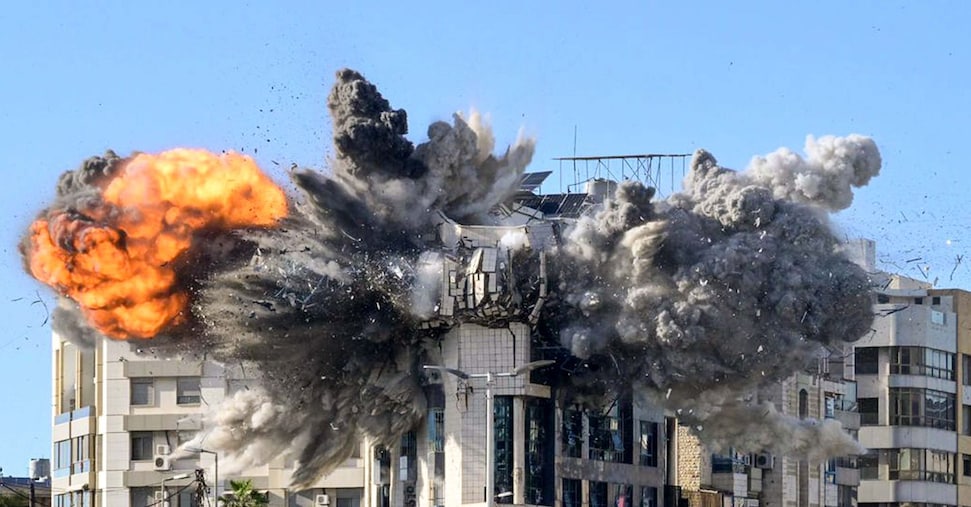
The geopolitical landscape of the Middle East has entered a volatile new phase as reports emerge that U.S. President Donald Trump has urged Israeli Prime Minister Benjamin Netanyahu to reduce military operations in Lebanon. This reported shift in tone comes at a critical juncture, as the international community grapples with the fallout of the broader U.S.-Israeli conflict against Iran and a deepening humanitarian crisis in the Levant.
While the Trump administration has historically provided staunch support for Israel’s security objectives, the current pressure to scale back attacks in Lebanon suggests a strategic pivot. This development coincides with growing friction between Israel and its European partners, with Paris reportedly leading a push to review the existing EU-Israel agreement in response to the escalating regional violence.
For global observers, the tension reflects a complex balancing act. The United States must weigh its commitment to Israel’s deterrence strategies against the risk of a total regional collapse that could disrupt global energy markets and trigger unprecedented migration flows. As the conflict evolves, the focus is shifting from the strategic bombing campaigns of last year to the grueling realities of urban warfare and diplomatic attrition.
The current situation is inextricably linked to the events of 2025, which set the stage for the present crisis. To understand why a request to reduce attacks in Lebanon is significant now, one must look at the trajectory of the U.S.-Israeli alliance over the past year, moving from coordinated aggression to a more cautious, albeit strained, diplomatic approach.
A Delicate Balance: Trump’s Reported Pivot on Lebanon
Recent reports indicate that President Trump has asked Prime Minister Netanyahu to curb the intensity of strikes within Lebanese territory. This request marks a notable departure from the rhetoric seen during the early stages of the current regional escalation. Throughout much of his recent tenure, Trump has positioned himself as a facilitator of Israel’s “maximum pressure” campaigns, often echoing the Israeli leadership’s tactical goals.
The reported request to reduce attacks in Lebanon likely stems from a desire to prevent a full-scale state collapse in Beirut, which would create a power vacuum and further destabilize the eastern Mediterranean. The humanitarian toll in Lebanese cities has become a point of international contention. Reports from Beirut describe a city in turmoil, with civilian infrastructure devastated and a growing sense of desperation among the population.
This diplomatic friction is not isolated to the U.S. In Europe, the reaction has been more severe. French officials have suggested that the European Union may need to revisit the EU-Israel Association Agreement. Such a move would be an extraordinary diplomatic step, potentially impacting trade preferences and political cooperation, signaling that Europe’s patience with the current military strategy in Lebanon and Gaza has reached a breaking point.
The Shadow of the 2025 Iran Conflict
The current instability in Lebanon cannot be viewed in isolation from the direct war between the U.S.-Israeli coalition and Iran. The region was fundamentally altered in June 2025 during a concentrated 12-day conflict. During this period, the United States joined Israel in a series of strikes targeting Tehran’s nuclear facilities, including the Natanz nuclear complex per reports on the June 2025 bombing.
Following those strikes, the relationship between Trump and Netanyahu appeared to be at its zenith. On December 29, 2025, the two leaders met at Mar-a-Lago, where the U.S. President explicitly echoed Netanyahu’s talking points regarding Iranian aggression. During a press conference at the club, Trump stated that if Iran attempted to rebuild its capabilities, the U.S. And Israel would “knock the hell out of them” as documented in the December 2025 meeting. During this visit, Netanyahu further cemented the bond by awarding Trump the Israel Prize, a prestigious honor rarely granted to non-Israelis.
However, the transition from strategic bombing to a sustained “U.S.-Israeli war against Iran” has brought unforeseen complexities as analyzed by the Carnegie Endowment. While the initial strikes were viewed by some as an “easy” war, the subsequent reality has been one of prolonged instability. By March 2026, the cracks in the alliance began to reveal; for instance, on March 25, 2026, President Trump reportedly rebuffed a proposal from Netanyahu to call for a popular uprising within Iran according to Axios.
European Friction and the EU-Israel Agreement
The potential review of the EU-Israel agreement by Paris represents a significant shift in the European Union’s approach to the Middle East. For decades, the agreement has served as a bedrock for economic and political ties. The suggestion that it should be “reviewed” is diplomatic shorthand for the possibility of imposing sanctions or suspending preferential trade status based on human rights concerns and the scale of civilian casualties in Lebanon.
This European pivot is happening as global powers recalibrate their responses to the ongoing conflict. On March 30, 2026, international analysts gathered to discuss how Russia, China, and Europe are relating to the current war with Iran and how the Trump administration is responding to these global shifts per the Carnegie Endowment event. The consensus suggests that while the U.S. Remains the primary military backer of Israel, the political cost of that support is rising globally.
France, in particular, has long viewed itself as a mediator in the Levant. The push to revisit the EU-Israel agreement is likely an attempt to leverage economic pressure to force a ceasefire in Lebanon, fearing that a total collapse of the Lebanese state would lead to a refugee crisis that would inevitably impact European shores.
The Human Cost and Global Ripple Effects
The operational reality on the ground in Lebanon is dire. Reports indicate that Israel has called for the evacuation of South Beirut, a move that typically precedes intensified bombardment. The resulting chaos has left thousands displaced, with families fleeing toward the north and east in a desperate search for safety. In Beirut, the situation is described as catastrophic, with civilian life shattered amid ruins and a complete breakdown of basic services.
Beyond the immediate humanitarian tragedy, the conflict is creating systemic global risks:
- Energy Security: There are unconfirmed reports that the Strait of Hormuz remains closed or heavily restricted, a development that would send shockwaves through global oil prices and threaten the energy security of Asia and Europe.
- Migration Patterns: The instability in Lebanon is reportedly reigniting concerns over the “Balkan route.” As people flee the Levant, migration pressures on Southern Europe and the Balkans are expected to increase, potentially destabilizing political coalitions within the EU.
- Regional Escalation: The intersection of the Lebanon front and the broader war with Iran creates a “multi-front” dilemma for Israel, stretching its military resources and increasing the likelihood of miscalculation.
Key Timeline of the Crisis
| Date | Key Event | Significance |
|---|---|---|
| June 2025 | 12-Day Conflict | U.S. And Israel bomb Iranian nuclear facilities, including Natanz. |
| Dec 29, 2025 | Mar-a-Lago Summit | Trump echoes Netanyahu’s talking points; Trump receives the Israel Prize. |
| Mar 25, 2026 | Uprising Proposal | Trump rejects Netanyahu’s plan to call for an internal Iranian uprising. |
| Mar 30, 2026 | Global Response Forum | Analysis of Russia, China, and Europe’s reaction to the Iran War. |
| April 2026 | Lebanon Pivot | Reports of Trump urging reduced attacks in Lebanon; EU considers agreement review. |
As the conflict continues, the primary question is whether the diplomatic pressure from the U.S. And the EU will be sufficient to alter the Israeli government’s military trajectory. Prime Minister Netanyahu remains focused on the total neutralization of threats from both Hezbollah in Lebanon and the Iranian regime in Tehran, but the strategic cost of this goal is becoming increasingly difficult to sustain.
The next critical checkpoint will be the formal response from the Israeli cabinet to the reported U.S. Requests and any official statement from the European Council regarding the status of the EU-Israel agreement. These developments will determine whether the region moves toward a fragile ceasefire or a deeper, more uncontrollable conflagration.
World Today Journal will continue to monitor these developments as they unfold. We invite our readers to share their perspectives on the evolving crisis in the comments below.