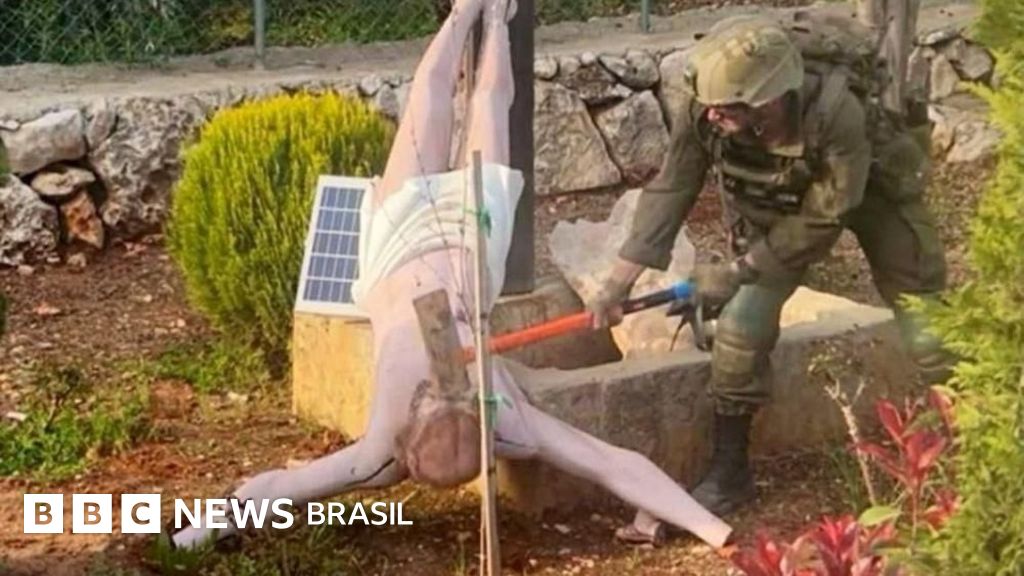
An image of an Israeli soldier appearing to strike a statue of Jesus Christ with a sledgehammer in southern Lebanon has sparked international condemnation and prompted swift reactions from Israeli leaders and the military. The photo, which circulated widely on social media over the weekend of April 18–19, 2026, shows a soldier in uniform swinging what looks like a sledgehammer or axe at the face of a crucifix located outside a family home in the village of Debel, near the Israel-Lebanon border.
The incident occurred during Israel’s continued military presence in southern Lebanon following a U.S.-brokered ceasefire that took effect on Friday, April 18, 2026, ending six weeks of fighting between the Israel Defense Forces (IDF) and Hezbollah. Although the ceasefire has largely held, both sides have reported allegations of violations. The village of Debel is one of the few communities where residents have remained throughout the conflict, and the statue in question stood on a crucifix near a local residence.
Israeli Prime Minister Benjamin Netanyahu responded swiftly, calling the act “stunned and saddened” and condemning it in the strongest terms. In a post on X (formerly Twitter), he stated: “I condemn the act in the strongest terms. We express regret for the incident and for any hurt this has caused to believers in Lebanon and around the world.” Foreign Minister Gideon Saar also issued an apology, saying: “We apologise for this incident and to every Christian whose feelings were hurt.”
The Israeli military confirmed the authenticity of the image and emphasized that the soldier’s actions were inconsistent with its values. In an official statement, the IDF said: “The IDF views the incident with great severity and emphasises that the soldier’s conduct is wholly inconsistent with the values expected of its troops.” The military added that This proves working with the Christian community to restore the statue to its original place and that “appropriate measures” will be taken against those involved.
Father Fadi Flaifel, head of Debel’s congregation, told the BBC that the act was a “desecration of the cross, our sacred symbol, and all religious symbols,” and that it “goes against the declaration of human rights and doesn’t reflect civility.” He noted that similar incidents had reportedly occurred before, though no further details were provided in verified sources.
The incident has drawn attention to the sensitivity of religious symbols in the region, particularly in areas where diverse communities have coexisted despite ongoing tensions. Lebanese officials and international observers have called for accountability and respect for cultural and religious heritage, even amid military operations.
As of Monday, April 20, 2026, the IDF confirmed that an investigation is underway into the soldier’s conduct. No further details about the soldier’s identity, rank, or unit have been released in verified reports. The military reiterated its commitment to distinguishing between militant infrastructure and civilian sites, stating: “The IDF is operating to dismantle the terrorist infrastructure established by Hezbollah in southern Lebanon, and has no intention of harming civilian infrastructure, including religious buildings or religious symbols.”
Local residents in Debel expressed shock and disappointment, with many emphasizing that the village had remained peaceful and that such actions undermined efforts to maintain normalcy during the conflict. Restoration efforts for the statue are expected to begin once the investigation concludes and security conditions allow.
The incident remains under review by Israeli military authorities, with any disciplinary or legal actions to be determined based on the outcome of the investigation. Updates on the case will be issued through official IDF channels.
For ongoing developments, readers are encouraged to follow verified updates from the Israel Defense Forces and international news outlets covering the Israel-Lebanon border situation.
If you have thoughts on this story or related developments, we welcome your comments and encourage you to share this article to help promote informed discussion.
Keep reading
- Swiss Doctors Help Victims After Powerful Earthquake Hits Colombia
- Japan’s H3 Rocket Succeeds While China’s Long March 7A Explodes in Mid-Air
- Netanyahu’s Gaza Deal Rejection: A Risky Political Gamble (archyworldys.com)
- Russia and North Korea Expand Military Alliance Against Ukraine (newsdirectory3.com)