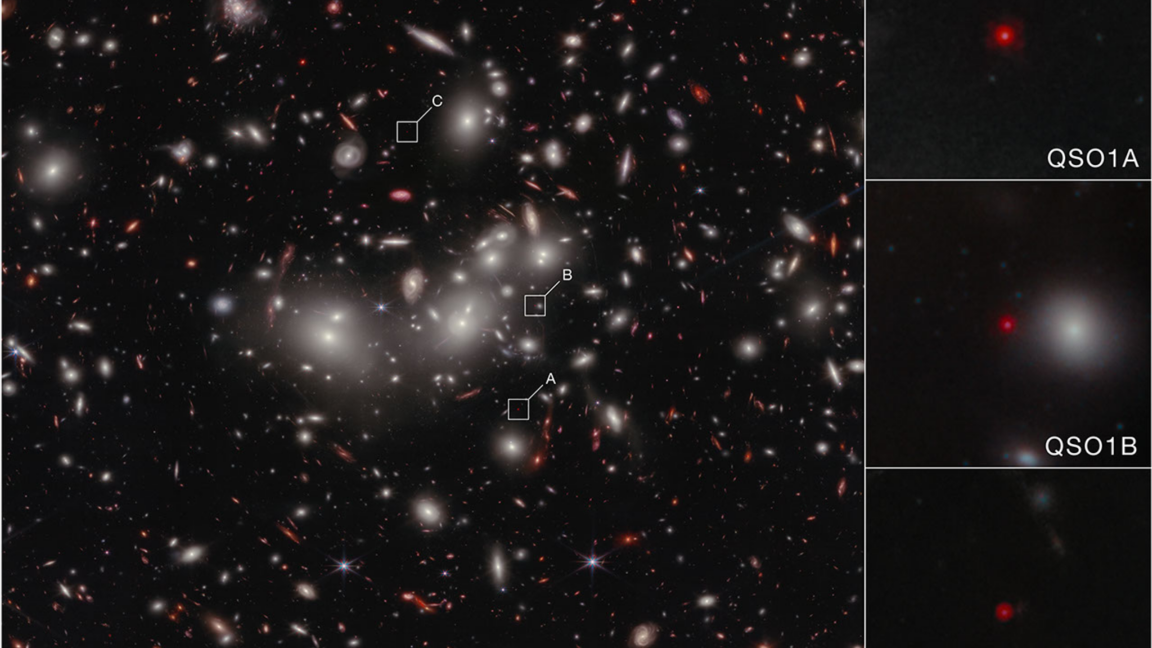
When the James Webb Space Telescope (JWST) began transmitting its first deep-field images, astronomers were braced for the unexpected. Among the most intriguing discoveries were compact, crimson-hued objects that defied easy classification, quickly earning the informal moniker “little red dots.” For months, the scientific community debated whether these points of light represented dense clusters of ancient stars or something far more exotic. New data has now provided a breakthrough, revealing that at least one of these celestial enigmas is, in fact, a naked supermassive black hole existing in the early universe.
Using the power of gravitational lensing, researchers have analyzed the object known as Abell 2744-QSO1. This cosmic phenomenon acts as a natural magnifying glass, bending the light from distant objects and allowing us to see details that would otherwise remain obscured. By studying the light from this specific target, astronomers have confirmed that they are observing the object as it appeared approximately 700 million years after the Big Bang, according to research published in Nature. The findings suggest that these black holes may have begun their growth spurts much earlier—and in a much more isolated fashion—than previously theorized in standard galaxy evolution models.
This discovery challenges our fundamental understanding of how the first structures in the universe formed. Traditionally, astronomers assumed that supermassive black holes grew in tandem with their host galaxies. However, the observation of Abell 2744-QSO1 suggests that some of these massive gravitational anchors may exist with very little surrounding galactic material, essentially acting as “naked” black holes during their early developmental stages.
The Mechanics of Cosmic Magnification
The ability to see Abell 2744-QSO1 with such clarity is a direct result of gravitational lensing, a concept predicted by Albert Einstein’s theory of general relativity. In this instance, a massive galaxy cluster located between Earth and the distant object warped the fabric of space-time, acting as a powerful lens. This magnification not only increased the object’s brightness but also created a rare effect: the same source appears three times in the vicinity of the cluster, as detailed by the NASA James Webb Space Telescope project office.

By analyzing the light spectrum of these three images, scientists could isolate the signature of the black hole from the light of any surrounding stars. The spectral data revealed high-velocity gas and ionizing radiation characteristic of an active galactic nucleus—the energetic heart of a growing black hole. The absence of a massive, mature galaxy surrounding this core is what distinguishes it from the later-stage quasars we typically observe in the more local, modern universe.
Why “Little Red Dots” Matter to Cosmology
The study of these early, compact objects is crucial for solving the “overmassive black hole” problem. Astronomers have been puzzled by the existence of black holes that appear far too large for the age of the universe in which they reside. If these objects began their lives as “little red dots” and grew rapidly in relative isolation, it would provide a viable pathway for them to reach such massive sizes within the first billion years of cosmic time.
This research suggests that we may need to revise our simulations of early star and galaxy formation. If black holes can thrive without a significant host galaxy to feed them, it implies that the accretion of matter—the process by which gravity pulls gas and dust into the black hole—is significantly more efficient than our current models account for. This shift in perspective is prompting astrophysicists to re-examine existing survey data from the JWST to determine how many other “little red dots” might be hiding in plain sight.
Key Takeaways: The Evolution of Early Black Holes
- Discovery Context: The “little red dots” are high-redshift objects identified by the JWST that appear as intense, compact sources of light.
- Confirmation: Gravitational lensing provided the necessary magnification to confirm Abell 2744-QSO1 is a supermassive black hole without a significant host galaxy.
- Cosmic Timeline: These observations allow us to peer back to 700 million years post-Big Bang, a critical window for understanding the “dark ages” of the early universe.
- Scientific Impact: The findings suggest that black hole growth may precede significant galaxy formation, contradicting older “co-evolution” theories.
Looking Ahead: What Happens Next?
The investigation into Abell 2744-QSO1 is far from over. Future observation cycles with the James Webb Space Telescope are already scheduled to target similar “little red dots” across different regions of the sky. Researchers are particularly interested in determining whether these naked black holes are a universal feature of the early universe or if they represent a specific phase of development that only a subset of black holes undergoes.

The next major checkpoint for this research will be the publication of broader surveys using the Near-Infrared Spectrograph (NIRSpec) on the JWST, which will provide more granular data on the chemical composition of the gas surrounding these black holes. These upcoming datasets are expected to be released in late 2024 and throughout 2025 as part of the ongoing General Observer programs. We will continue to track these developments as they reshape our understanding of the cosmos.
What do you think about the mysteries of the early universe? Join the conversation in the comments section below and share this report with your network to keep the discussion going.
Keep reading