Building Blocks of Life Found in distant Galaxy Offer Clues to Universe’s Chemical Origins
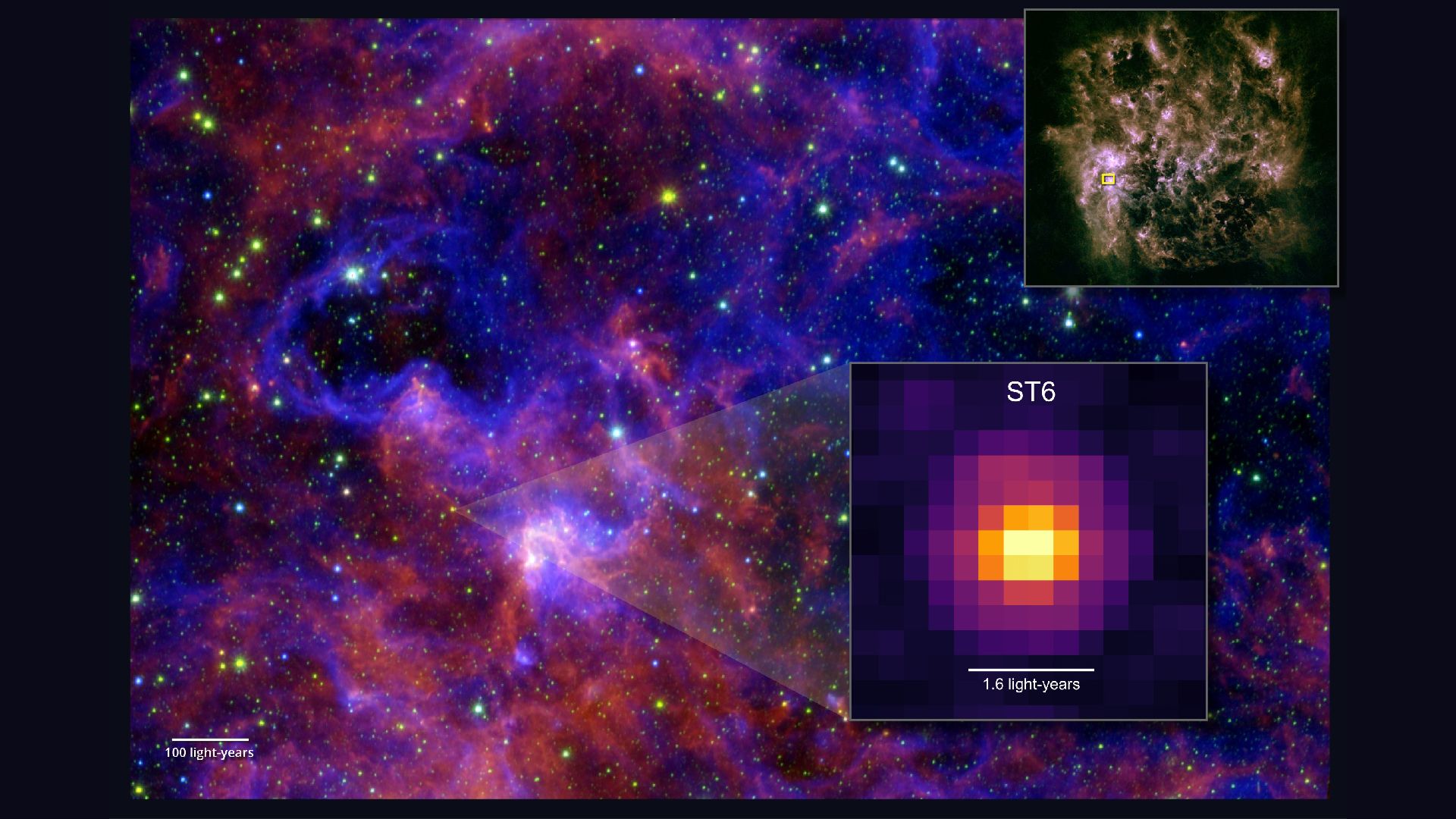
Recent observations from the James Webb Space telescope (JWST) have revealed a surprising wealth of complex organic molecules in a star-forming region of the Large Magellanic Cloud (LMC), a dwarf galaxy orbiting our Milky Way. This groundbreaking discovery offers invaluable insights into the chemical processes that may have paved the way for life in the early universe. As astronomers, we’re incredibly excited about what this means for our understanding of cosmic evolution.
Why This Matters: A Window into the Early Universe
Studying the LMC is like looking back in time.Because it’s less chemically evolved than our own galaxy, the conditions there more closely resemble those of the universe in its infancy. As Marta Sewilo, astronomer at the University of Maryland and NASA’s Goddard Space flight Center, explains, “What we learn in the Large Magellanic Cloud, we can apply to understanding these more distant galaxies from when the universe was much younger.”
essentially, the LMC provides a natural laboratory to investigate how complex chemistry can arise even when the raw ingredients – heavy elements like carbon, nitrogen, and oxygen – are scarce.
Unprecedented Molecular Discoveries
In March 2024, the research team focused JWST’s powerful infrared sensors on ST6, a developing star within the LMC.The results were astounding. They identified five complex carbon-based molecules locked within the ice surrounding the star:
* Methanol: Previously detected in protostars, but this finding expands our understanding of its prevalence.
* Acetaldehyde: A key component in many chemical processes.
* Ethanol: Commonly known as alcohol.
* Methyl Formate: An ester with diverse applications.
* Acetic Acid: The primary component of vinegar – and, remarkably, the first conclusive detection of this molecule in space ice.
Before JWST, methanol was the only complex organic molecule definitively found in ice around protostars, even within our own Milky Way. The sheer amount of data gathered from a single spectrum thanks to webb’s capabilities is unprecedented.
Hints of Prebiotic Chemistry
The team also detected potential signals of glycolaldehyde, a molecule that’s a crucial precursor to ribose. Ribose is a vital component of ribonucleic acid (RNA), which is essential for all known life. While further confirmation is needed, this finding is particularly exciting.
Implications for the Origins of Life
These discoveries demonstrate that complex molecules can form on the surfaces of dust grains, even in harsh, low-element environments. This challenges previous assumptions about the conditions necessary for complex chemistry to emerge.
Here’s what this means for you and your understanding of the universe:
* Robust chemical Pathways: The universe appears to be remarkably efficient at creating the building blocks of life, even in challenging conditions.
* Widespread Potential: If these molecules can form in the LMC, they likely formed throughout the early universe, increasing the potential for life to arise elsewhere.
* Expanding Our search: This research provides a roadmap for future investigations into the origins of life, both within our galaxy and beyond.
What’s Next?
The research team plans to continue this work by searching for these and similar molecules around other protostars. They’ll be looking in both the Milky Way and nearby galaxies, expanding our knowledge of the prevalence of these crucial compounds.
As Sewilo concludes, “With this discovery, we’ve made meaningful advancements in understanding how complex chemistry emerges in the universe and opening new possibilities for research into how life came to be.” This is a truly exciting time for astronomy and the search for life beyond Earth.
Sources:
* NASA Goddard Space Flight Center
Related reading