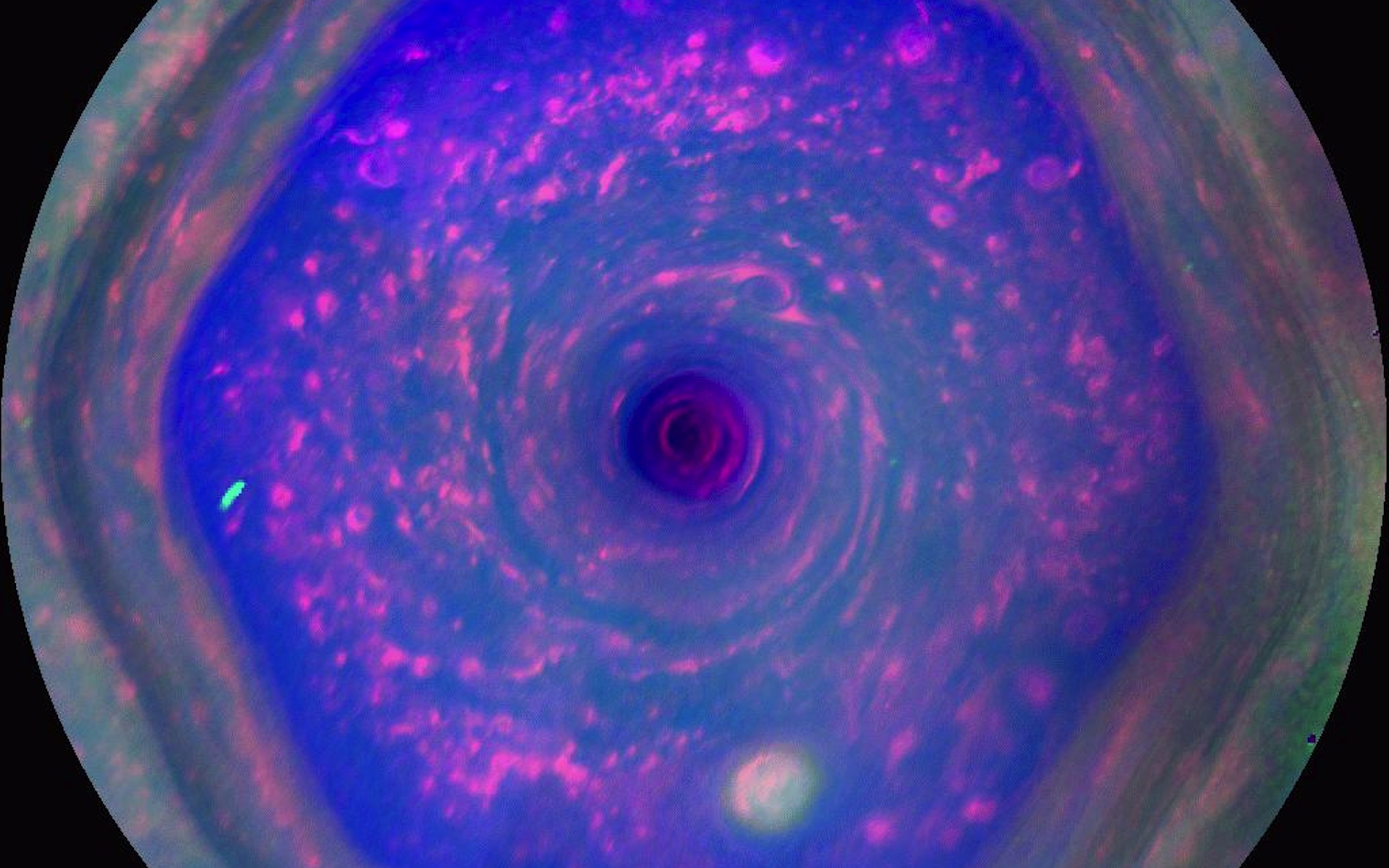
Saturn’s Hexagon and Mysterious Atmospheric Features Revealed by James Webb Telescope
For decades, saturn’s persistent hexagonal jet stream has captivated scientists. This colossal weather pattern, discovered in the 1980s, is a six-sided “tower” of swirling clouds spanning 18,000 miles across the planet’s north pole. It rotates roughly every 10 hours, and its origins have remained largely enigmatic – until now.
Recent observations from the James Webb Space Telescope (JWST) are providing unprecedented insights into this bizarre phenomenon, and revealing even stranger structures in Saturn’s upper atmosphere. These findings promise to unlock key secrets about the gas giant’s dynamics and energy exchange.
A Persistent Mystery: The Hexagon
First spotted during the Voyager missions in 1981, the hexagon continues to fascinate. It’s a stable, geometric shape in a world of swirling chaos.
scientists believe the hexagon is driven by a powerful jet stream, shaped by the unique properties of Saturn’s atmosphere. However, the precise mechanisms behind its formation and stability remain unknown.Furthermore, understanding the behavior of the atmosphere above the hexagon has been challenging due to faint emissions.
JWST Peers into Saturn’s Atmosphere
To address these questions, astronomers turned JWST’s Near-Infrared Spectrograph (NIRSpec) toward Saturn. They focused on the planet’s ionosphere and stratosphere – layers located 373 to 684 miles above the surface.
The telescope tracked:
* Positively-charged hydrogen molecules (H3+): These molecules are crucial to atmospheric chemistry.
* Methane molecules: Present throughout the ionosphere, their distribution reveals atmospheric structures.
The data revealed unexpected features: dark, bead-like structures in the ionosphere and an asymmetric star-shaped pattern in the stratosphere.
What Do These Features Mean?
These newly discovered structures are prompting exciting new theories.
* Dark Beads: Researchers suspect these may result from complex interactions between saturn’s magnetosphere and its rotating atmosphere. This interaction could offer clues to the energy exchange that powers Saturn’s stunning auroras.
* Asymmetric Star Pattern: This pattern may be linked to the hexagonal storm itself, though a direct connection hasn’t been confirmed.
“Tantalisingly, the darkest beads in the ionosphere appear to line up with the strongest star-arm in the stratosphere,” explains Dr. Stallard, a lead researcher on the project. “But it’s not clear at this point whether they are actually linked or whether it’s just a coincidence.”
Why This Matters: Understanding Planetary Dynamics
These observations are more than just a curiosity. They represent a meaningful step toward understanding the basic processes governing gas giant atmospheres.
Understanding these processes can definitely help us:
* Model planetary atmospheres: Improving our ability to predict weather patterns on Saturn and other planets.
* Study energy transfer: Gaining insights into how energy moves within planetary systems.
* Compare planetary systems: Understanding similarities and differences between Saturn and other gas giants, including those orbiting distant stars.
Future Observations and Optimal Viewing Opportunities
The team plans to continue observing Saturn with JWST. The planet is currently near its equinox,meaning the atmospheric patterns are likely to change as the sun’s position shifts.
Furthermore, Saturn will be at its closest approach to Earth on September 21st. This presents an extraordinary possibility for observation, both for professional astronomers and amateur enthusiasts. If you have access to a telescope,this is the perfect time to witness the ringed planet’s beauty and contribute to our understanding of this engaging world.
Resources for Further Exploration:
* Saturn will be at its biggest and brightest on Sept. 21 – here’s how to see it
* Do other planets have auroras?