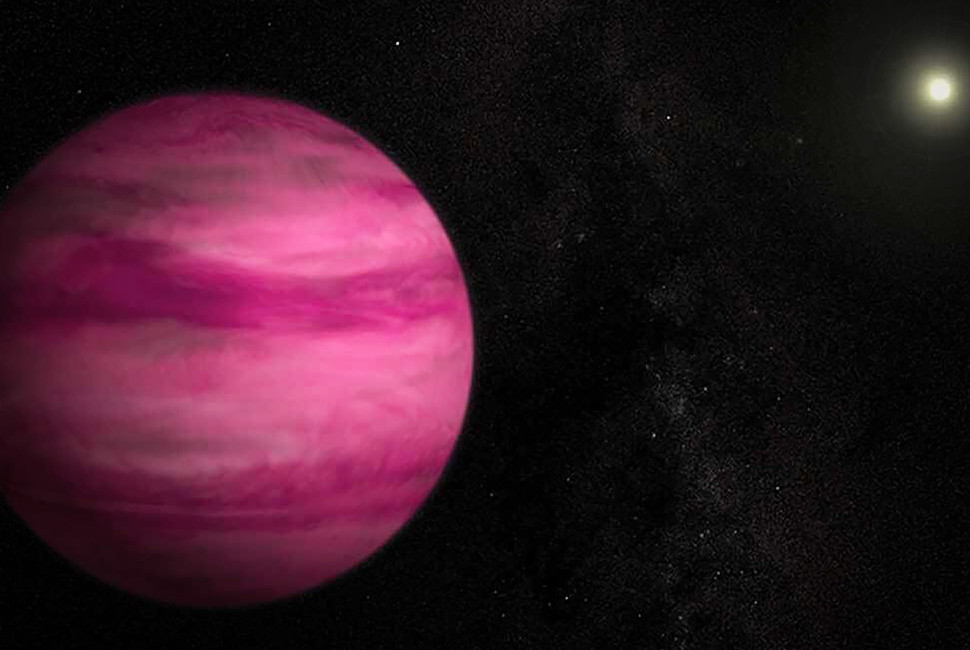
Astronomers using the James Webb Space Telescope (JWST) have identified evidence of salt clouds in the atmosphere of the exoplanet GJ 504 b, a discovery that offers new insights into the chemical composition of giant worlds outside our solar system. The planet, which orbits a star roughly 57 light-years away in the constellation Virgo, appears to possess a complex, layered atmosphere that deviates from simple theoretical models, according to recent data analysis published by researchers studying high-contrast imaging results.
GJ 504 b, often described as a “super-Jupiter,” has long fascinated the scientific community due to its distinct, magenta-hued appearance. While its color initially suggested a relatively clear atmosphere, the latest spectroscopic observations from the James Webb Space Telescope indicate the presence of aerosols or clouds composed of salt particles—specifically sodium chloride—which significantly impact how the planet reflects and absorbs light.
Understanding the Atmosphere of GJ 504 b
The identification of salt clouds on GJ 504 b relies on infrared observations that allow scientists to peer through the outer layers of the planet’s atmosphere. Unlike terrestrial clouds made of water vapor or ice, the clouds on this massive exoplanet are believed to form at much higher temperatures. According to findings presented in studies of exoplanetary atmospheres, the extreme heat of GJ 504 b—estimated to be around 500 degrees Fahrenheit (260 degrees Celsius)—enables salts to vaporize and subsequently condense into reflective clouds in the upper reaches of the atmosphere.

This discovery challenges previous assumptions about the “sweet” or relatively clear appearance of the planet. Researchers noted that the spectral signature observed by the telescope aligns with the predicted behavior of sodium-rich compounds. By analyzing the way the planet emits light across different infrared wavelengths, the team was able to distinguish between simple methane-heavy atmospheres and those containing more exotic chemical constituents like salt-based aerosols.
Why Salt Clouds Matter for Exoplanetary Science
The presence of salt clouds serves as a vital indicator of an exoplanet’s formation history and its internal chemical abundance. When scientists identify specific minerals in the atmosphere of a gas giant, they gain a “chemical fingerprint” that reveals the materials available during the planet’s early development. This data helps researchers determine if the planet formed close to its host star or migrated inward from the colder reaches of its solar system, a process known as planetary migration.
Furthermore, the atmospheric composition of GJ 504 b provides a benchmark for comparing giant planets of different ages. Because GJ 504 b is relatively young—estimated at approximately 160 million years old—it still retains significant heat from its gravitational contraction, making it an ideal candidate for JWST’s high-resolution instruments. The ability to detect these clouds validates the sensitivity of the telescope’s Near-Infrared Spectrograph (NIRSpec) in identifying trace chemicals in environments that were previously considered too distant or too dim to analyze in such detail.
Comparison of Atmospheric Models
To contextualize these findings, it is helpful to look at how GJ 504 b compares to other known giant exoplanets. Early ground-based imaging suggested a fairly uniform atmosphere, but the JWST data introduces a level of complexity that suggests a more turbulent and chemically active environment. The following table summarizes the key characteristics observed:
| Feature | Initial Observations | JWST Observations |
|---|---|---|
| Atmospheric Clarity | Relatively clear | Cloud-covered (salt-rich) |
| Temperature | Estimated 500°F | Consistent with 500°F model |
| Dominant Chemistry | Methane-heavy | Methane with salt aerosols |
Future Research Directions
The study of GJ 504 b is part of an ongoing effort to map the diversity of planetary atmospheres across the galaxy. Astronomers are now looking to refine their models to account for the vertical distribution of these salt clouds. By understanding how these particles move through the atmosphere, scientists hope to learn more about the weather patterns and energy transport mechanisms on worlds that are vastly different from our own.
The next phase of research will likely involve longer-term monitoring of the planet to see if the cloud coverage fluctuates over time. As more data is gathered, the scientific community expects to gain a clearer picture of how common these “salty” atmospheres are among the broader population of gas giants. Updates on these findings will be posted to the NASA official press portal as new peer-reviewed analyses are released. Readers interested in the latest developments in space exploration are encouraged to share this article and follow our ongoing coverage of deep-space discoveries.
Related reading