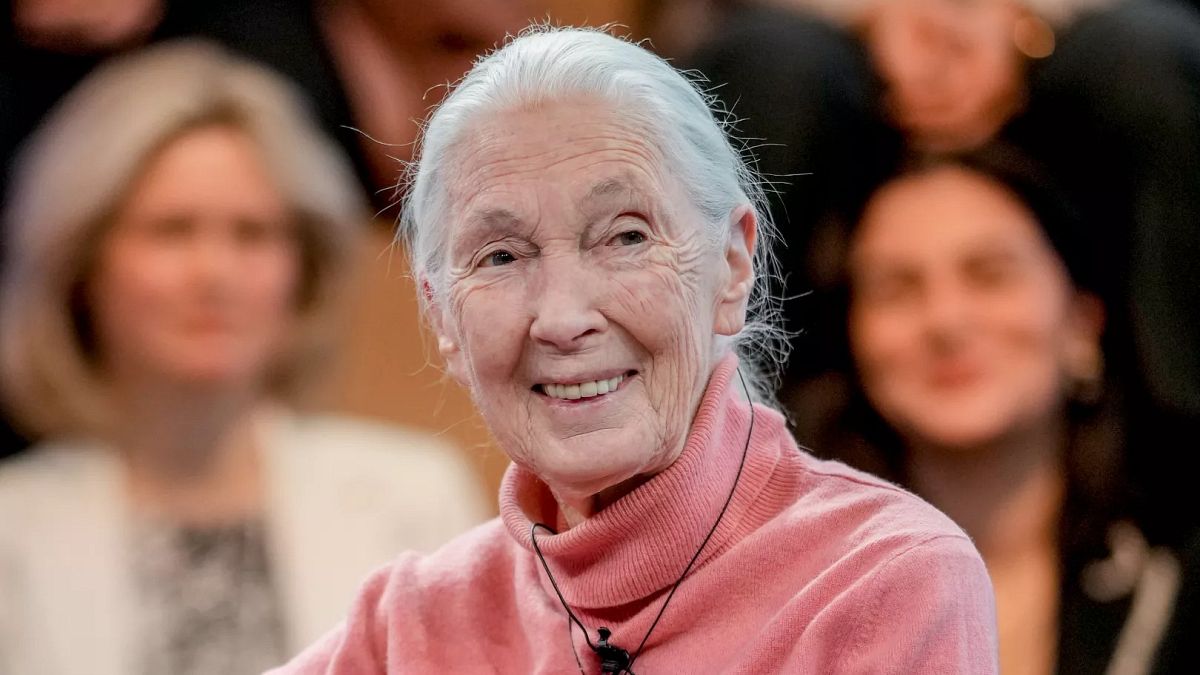
Jane Goodall: A Life Dedicated to Chimpanzees, Conservation, and Hope
For over six decades, dr. Jane Goodall has captivated the world with her groundbreaking research on chimpanzees, her tireless advocacy for conservation, and her unwavering belief in the power of hope. Awarded the prestigious Templeton Prize in 2021 for her fusion of scientific inquiry and spiritual understanding,GoodallS work has fundamentally reshaped our perception of humanity’s place within the natural world. This article delves into the remarkable life and legacy of a woman who dared to challenge conventional wisdom and, in doing so, inspired generations to protect our planet.
From Childhood Fascination to Pioneering Research
Born Valerie Jane Morris-Goodall in London in 1934, her passion for animals ignited at a remarkably young age. Even as a toddler, she displayed an insatiable curiosity, famously disappearing into a henhouse for hours, resolute to witness the miracle of a chicken laying an egg - an incident that briefly prompted a police search! This early fascination was further fueled by her love of literature, especially Edgar Rice Burroughs’ “Tarzan of the Apes,” solidifying her childhood dream of living amongst wild animals in Africa.
Despite societal expectations and a brief foray into secretarial work, Goodall remained steadfast in her ambition. In 1957,an invitation to visit a friend’s family farm in Kenya proved pivotal. It was there she met Dr. Louis Leakey, a renowned anthropologist and paleontologist, who recognized her innate observational skills and offered her a position as his assistant secretary.
Leakey, a visionary in his own right, believed that understanding chimpanzees was key to unlocking the mysteries of human evolution. In 1960, he entrusted Goodall – remarkably, without a college degree – with a groundbreaking task: to study chimpanzees in their natural habitat in what is now Tanzania’s Gombe Stream National park.
Revolutionizing Primatology: challenging Long-Held Beliefs
The initial stages of her research were fraught with challenges.British authorities insisted on a companion, initially her mother, and the chimpanzees themselves were wary, retreating whenever she approached within 450 meters. Goodall persevered, battling illness (likely malaria) and slowly, painstakingly, earning the trust of the Gombe chimps.
her patience and dedication were rewarded with a discovery that shook the scientific community. in the autumn of 1960, she observed David Greybeard, a chimpanzee, meticulously stripping leaves from a twig to create a tool for extracting termites. This observation shattered the prevailing belief that tool-making was exclusively a human trait, forcing a re-evaluation of the boundaries between humans and animals.
But Goodall’s discoveries didn’t stop there. She meticulously documented the complex social lives of chimpanzees,revealing their individual personalities,their capacity for joy,sadness,fear,and their intricate family dynamics. She observed maternal bonds, sibling rivalry, and the establishment of dominance hierarchies - mirroring aspects of human society. Her work demonstrated that the line separating humans from the animal kingdom was far less distinct than previously imagined.
Further research revealed even more complex behaviors, including instances of chimpanzee “warfare” and, in 1987, the remarkable observation of a chimpanzee adopting an orphaned infant unrelated to itself, demonstrating a capacity for compassion and altruism.
From Field Research to Global Advocacy
Goodall’s scientific contributions were recognized with a Ph.D. in ethology from the University of Cambridge in 1966 – a rare achievement for someone without a traditional undergraduate degree. She continued her field research, receiving generous support from the National Geographic Society starting in 1961.
Though, a turning point came in 1986, after witnessing disturbing footage of animal experimentation at a scientific conference. This experience ignited a passion for advocacy, prompting her to dedicate herself to protecting chimpanzees and their habitats. As she famously stated in 1997,”It was payback time.”
She founded the Jane Goodall Institute (JGI) in 1977, which focuses on chimpanzee research, conservation, community-centered conservation in Africa, and environmental education. JGI’s Roots & Shoots program, established in 1991, empowers young people in over 60 countries to create positive change in their communities.
embracing New Platforms for a Timeless Message
Even as she entered her late 80s, Goodall remained a tireless advocate. When the COVID-19 pandemic curtailed her extensive travel schedule in 2020, she seamlessly transitioned
Worth a look