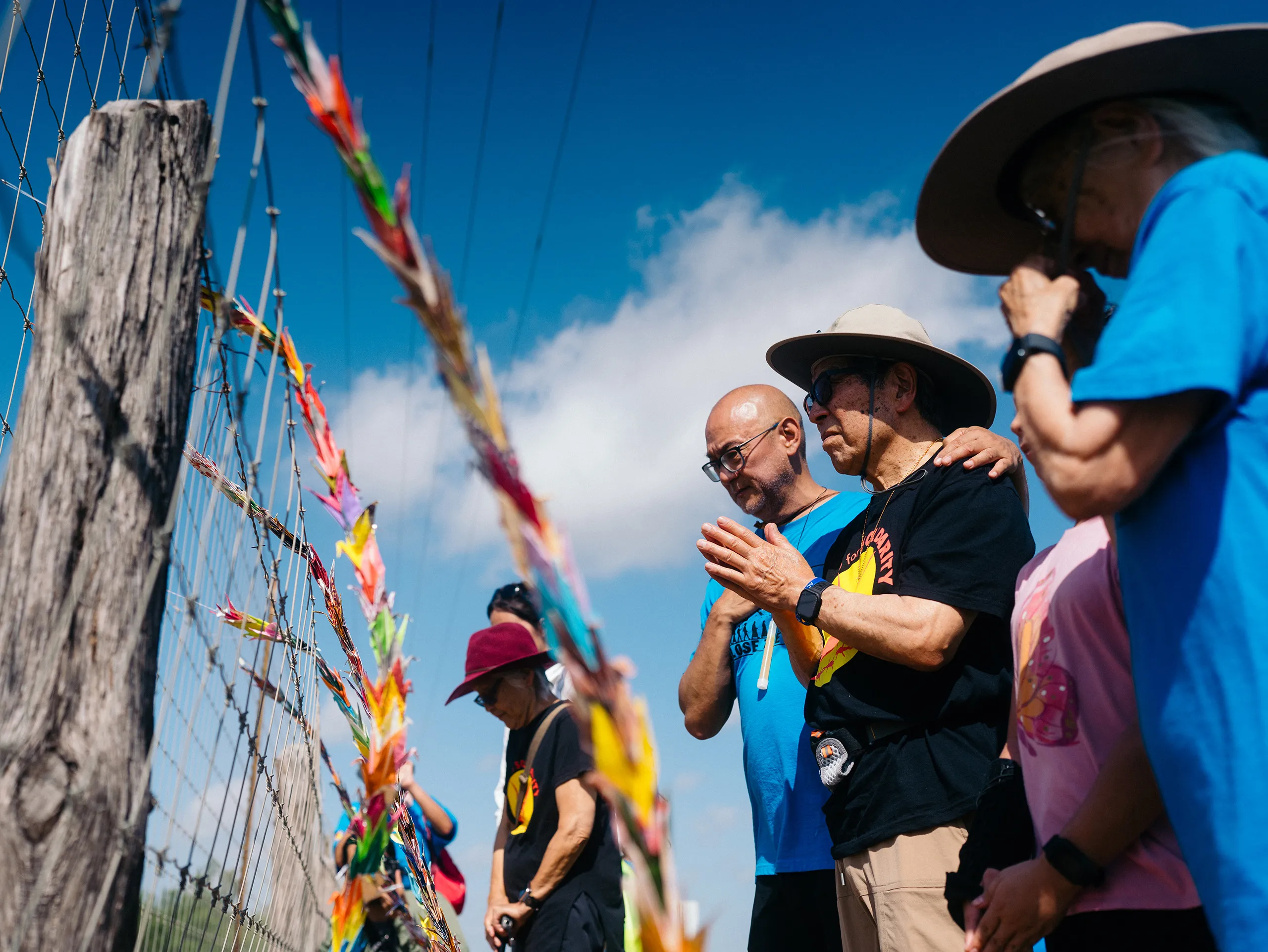
Japanese American internment survivors and immigration advocates concluded a four-day, 45-mile pilgrimage Saturday to the South Texas Family Residential Center in Dilley, Texas, the only remaining federal family detention facility in the U.S., demanding its immediate closure. The activists—including descendants of those incarcerated during World War II—drew parallels between the facility’s conditions and the historical trauma of Japanese American internment, calling the detention center a “repetition of American injustice.”
The protest follows months of legal and public pressure over ICE’s treatment of migrant families, with advocates arguing the facility violates humanitarian standards. The Center for Constitutional Rights and other groups have filed lawsuits challenging the detention policies, while ICE maintains the facility operates within legal and ethical guidelines.
According to the National Public Radio, the pilgrimage was organized by the Denshō Project, a nonprofit documenting Japanese American incarceration, in collaboration with local faith leaders and immigrant rights groups. Participants carried signs comparing the facility’s barbed-wire fencing to the camps of the 1940s and read aloud the names of those who died in detention.
A 2023 report found "serious deficiencies" in medical care, mental health support, and compliance with detention standards, though ICE disputed some findings. The facility currently holds approximately 150 individuals, primarily asylum-seeking families, according to ICE data.
Why This Protest Matters: Historical Parallels and Legal Battles
The protest underscores a growing movement linking modern immigration detention to historical injustices. Japanese American internment survivors, many of whom were children during WWII, have long advocated for reparations and accountability. The comparison to current detention policies is not new: in 2021, a coalition of survivors and advocates filed a formal complaint with the United Nations, arguing that family detention violates international law.
“We survived the camps, but we cannot stand by while another generation suffers the same cruelty,” said a Japanese American internment survivor during a virtual address to the protesters. “This facility is a stain on America’s conscience.”
Legally, the facility’s future hinges on ongoing lawsuits and congressional action. The ACLU and other groups have argued that prolonged family detention is unconstitutional, pointing to psychological harm documented in studies. Meanwhile, ICE has defended the center as a necessary measure for processing asylum claims, though critics note that most detainees are released into the U.S. within weeks.
What Happens Next: Legal and Political Pathways
The protest coincides with heightened scrutiny of ICE detention policies. In February, the Biden administration announced a review of family detention, though no immediate closure was ordered. Advocates are pushing for legislative action, including the Keep Families Together Act, which would end family detention entirely.
Locally, the protest follows a March 15 rally in Dilley organized by the RAICES legal aid group, which serves detained migrants. RAICES has documented cases of children separated from parents due to detention policies, a practice banned under a 2018 court order that was later partially overturned.
ICE has not commented on the pilgrimage but reiterated its stance that detention is used as a “last resort” for families who pose a flight risk. The agency pointed to a 2023 report showing that 85% of families detained in fiscal year 2023 were released within 30 days, often while their asylum cases were pending.
Who Is Affected and How: The Human Cost of Detention
The South Texas Family Residential Center is one of two remaining ICE family detention facilities in the U.S., alongside the Karnes County Residential Center in Texas. Unlike adult detention centers, these facilities hold children alongside their parents, raising unique ethical and legal concerns.
Studies from the American Psychological Association and Children’s Rights have linked prolonged detention to trauma, developmental delays, and long-term mental health issues in children. A 2022 report by the Physicians for Human Rights found that detained children exhibited symptoms of post-traumatic stress disorder at rates comparable to those seen in refugee populations.
For Japanese American survivors, the emotional weight of the protest is compounded by personal history. Many, like Fred Korematsu, whose legal challenge to internment led to the landmark Korematsu v. United States case, have spent decades advocating for civil liberties. Their involvement in this protest reflects a generational commitment to preventing state-sanctioned cruelty.
Where to Find Updates: Official Resources and Advocacy
Readers seeking further information can consult the following verified sources:

- U.S. Immigration and Customs Enforcement (ICE) – Official statements and detention policies.
- ACLU Immigration Project – Legal challenges and advocacy updates.
- Denshō Project – Historical context on Japanese American internment.
- RAICES – Legal aid and detention monitoring for Texas families.
- DHS Office of Inspector General – Audit reports on detention facilities.
The next key checkpoint for the detention center's future is a March 31 hearing before the U.S. Advocates expect the hearing to focus on medical neglect and lack of due process for detainees.
If you found this report valuable, we encourage you to share it with others or leave a comment below. For direct action, consider supporting organizations like RAICES or ACLU, which provide legal aid to detained families.
Related reading
- Nigel Farage and Donald Trump: The Populist Playbook and Political Scandals
- Medical Examiner Identifies Victims and Suspect in Minnesota Daycare Murder-Suicide
- Sam Short Swims Fastest 400m Freestyle in US History, Narrowly Misses World Record (world-today-news.com)
- Kumar Rocker and Texas Rangers Face Athletics in West Sacramento (news-usa.today)