
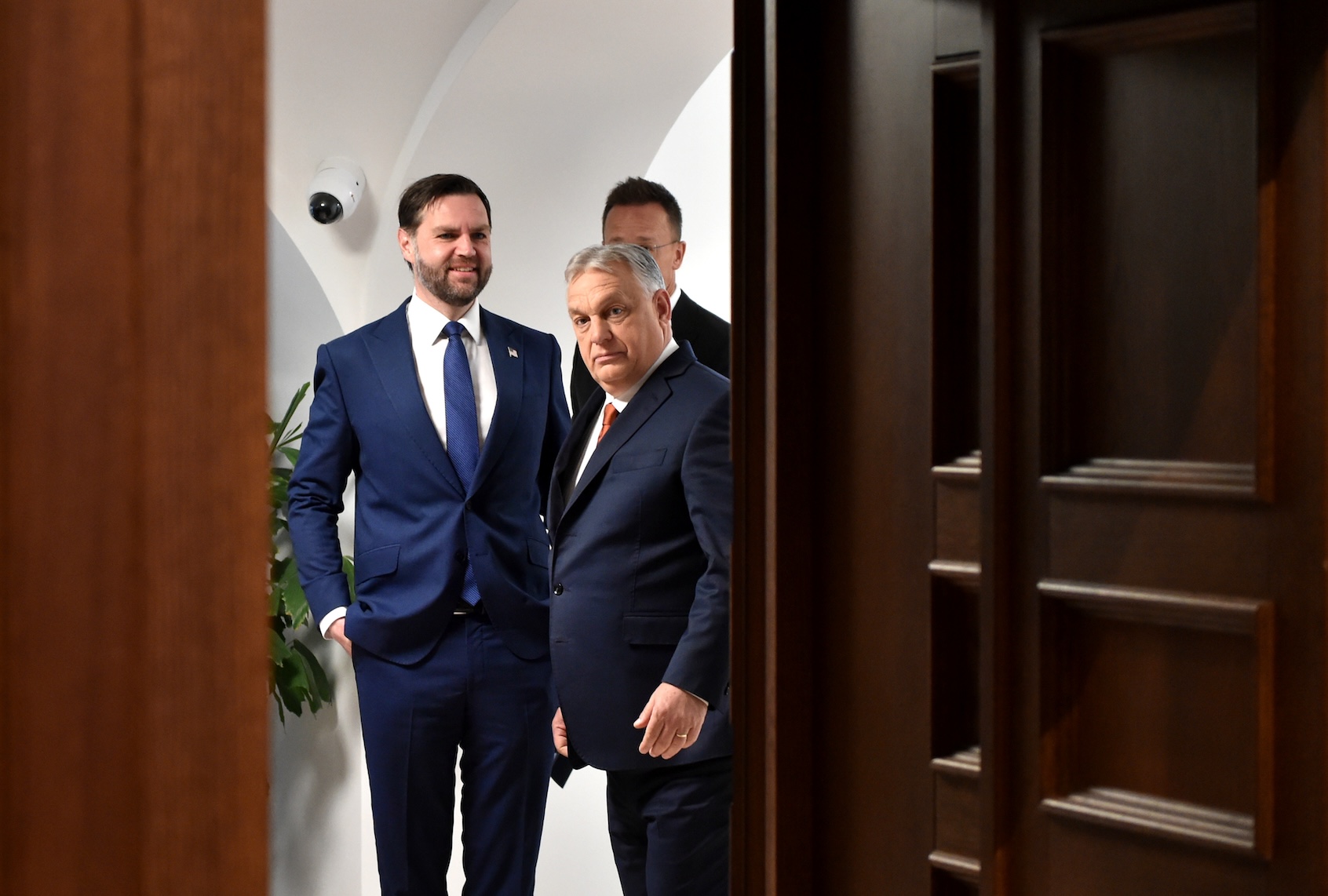
U.S. Vice President JD Vance arrived in Budapest on Tuesday, April 7, 2026, to deliver a high-profile endorsement of Prime Minister Viktor Orbán just days before Hungary’s general election. In a series of public appearances and a stadium rally, Vance urged Hungarian voters to reelect the populist leader, framing the vote as a pivotal moment for the preservation of “Western civilization.”
The visit comes at a critical juncture for Orbán, who has ruled Hungary for 16 years. Current polling indicates that Orbán and his nationalist Fidesz party are trailing behind the pro-European opposition Tisza party, led by Péter Magyar ([1]). The Trump administration’s decision to deploy Vance—following a February visit by Secretary of State Marco Rubio—signals a “go all-in” strategy to ensure Orbán remains in power ([3]).
Vance’s rhetoric during the trip focused heavily on a shared ideological struggle against “bureaucrats in Brussels,” whom he accused of attempting to destroy the Hungarian economy. By linking Orbán’s leadership to the defense of Christian values and national sovereignty, Vance aimed to project international support for a leader who has frequently clashed with the European Union over the rule of law and democratic standards.
“A Defense of Western Civilization”: Vance’s Campaign Strategy
During a “Day of Friendship” press conference and a subsequent rally at a soccer stadium in Budapest, Vice President Vance explicitly campaigned for Orbán’s return to office. Speaking before a crowd of over 1,000 supporters, Vance asked the audience, “We have got to get Viktor Orbán reelected as prime minister of Hungary, don’t we?” ([3]).
Vance framed the election not merely as a national political contest, but as a moral imperative. He stated that the United States and Hungary provide a “defense of Western civilization,” which he noted is founded on “Christian civilization and Christian values.” He further challenged the crowd, asking, “Will you stand for freedom, truth, and the God of our fathers? Then, my friends, go to the polls and stand for Viktor Orbán.”
The Vice President also used his platform to attack the European Union, describing the EU’s actions toward Hungary as “one of the worst examples of foreign election interference.” This was a reference to Hungary’s 2022 downgrade from a full democracy to an “elective autocracy.” Vance argued that the leadership of Orbán could serve as a “model to the continent,” suggesting that other European nations should follow his policy approach.
Opposition Backlash and the “Trump Boomerang Effect”
The intervention by the U.S. Vice President drew immediate and sharp criticism from the Hungarian opposition. Péter Magyar, the leader of the Tisza party, accused the United States of meddling in the country’s internal democratic process. Magyar asserted that “no foreign country may interfere in Hungarian elections,” adding that Hungarian history is “not written in Washington, Moscow, or Brussels — it is written in Hungary’s streets and squares.”
Statement on the occasion of the visit of the U.S. Vice President to Budapest:
No foreign country may interfere in Hungarian elections. Here’s our country. Hungarian history is not written in Washington, Moscow, or Brussels – it is written in Hungary’s streets and squares.— Magyar Péter (Ne féljetek) (@magyarpeterMP) April 7, 2026
Political analysts have suggested that such overt foreign endorsements may actually prove counterproductive for Orbán. Alberto Alemanno, a professor of European Union Law at HEC Paris, referred to this as the “Trump Boomerang Effect,” suggesting that endorsements from Washington provide “ammunition for the opposition.” According to Alemanno, the high-profile nature of the Trump administration’s support allows candidates like Magyar to frame the election as a choice between national sovereignty and foreign influence.
Geopolitical Stakes: Russia, the EU, and the Rule of Law
The tension surrounding the election is amplified by Orbán’s unique position between the West and Russia. Even as most European leaders have aligned with Ukraine against the Russian invasion, Orbán has maintained close ties with Vladimir Putin. He has gone as far as stating on the campaign trail that the European Union represents a greater threat to Hungary than Russia ([2]).

This alignment has led to severe friction with the European Commission. Due to breaches of the rule of law, the EU has frozen approximately 17 billion euros in funds intended for Hungary ([2]). The government has also faced allegations of widespread vote-buying and pressure on rural voters, as detailed in the documentary *The Price of a Vote*, though the administration has dismissed these claims as politically motivated ([1]).
For the Trump administration, an Orbán victory is seen as a validation of shared right-wing policies, including hardline immigration stances and a skeptical approach to multilateral institutions. Conversely, a loss for Fidesz after 16 years would mark a significant shift in the European political landscape and a potential blow to the “illiberal democracy” model Orbán has championed.
Key Election Dynamics at a Glance
| Feature | Viktor Orbán (Fidesz) | Péter Magyar (Tisza) |
|---|---|---|
| Political Alignment | Nationalist-Populist / “Illiberal Democracy” | Center-Right / Pro-European |
| Primary Support | U.S. Trump Administration | European Union / Pro-EU Voters |
| Stance on EU | High Distrust / Confrontational | Aligned with EU Standards |
| Poll Status | Trailing | Leading |
The final outcome will be decided this coming Sunday, as Hungarians head to the polls in what is being described as one of the most contentious elections in Europe this year. The world awaits to see if the “Trump Boomerang Effect” or the appeal of “Western civilization” rhetoric will determine the future of the Hungarian premiership.
Next Checkpoint: Official election results are expected following the close of polls this Sunday.
Join the conversation: Does foreign endorsement help or hinder candidates in democratic elections? Share your thoughts in the comments below.