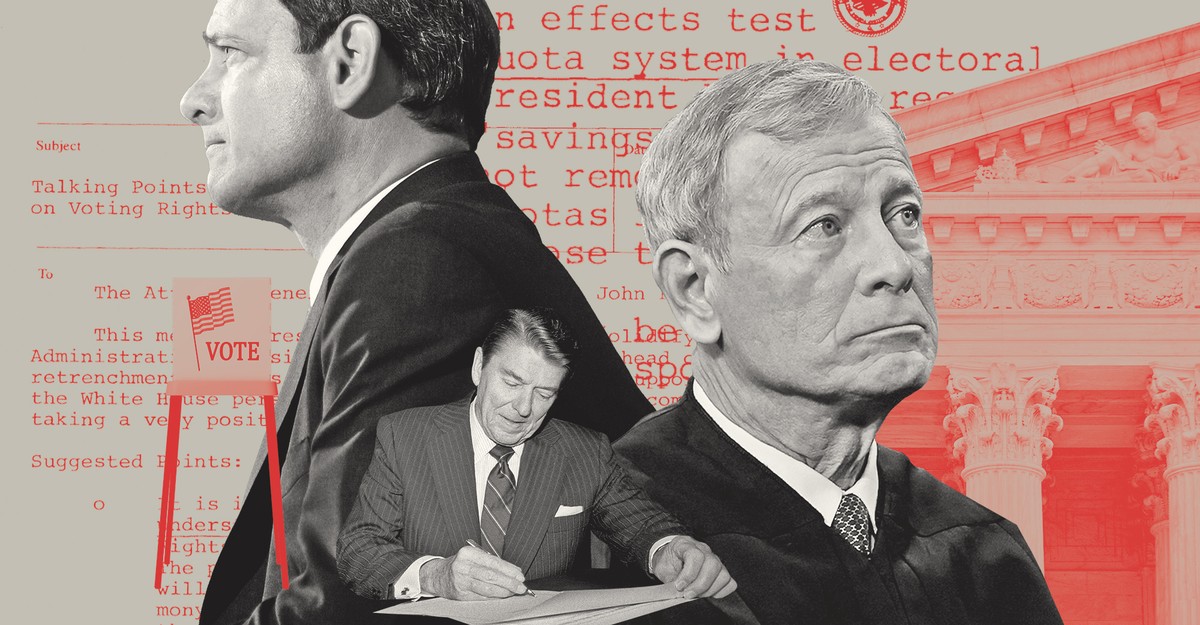
Teh Long Game: How John Roberts & a Conservative Legal Strategy Undermined Voting Rights
For decades, the fight over voting rights in America has been waged not just in Congress, but increasingly, within the halls of the Supreme Court. Recent decisions haven’t emerged from a vacuum. They are the culmination of a purposeful, decades-long strategy, and a key figure at the center of it is indeed Chief Justice John Roberts.
This isn’t about a sudden shift in legal interpretation. It’s about a carefully constructed plan, originating in the Reagan administration, that has fundamentally reshaped the landscape of american democracy. And understanding its origins is crucial to understanding where we are today.
The Origins of a Strategy: Roberts’ Early Role
The narrative ofen presented is one of Roberts as a pragmatic legal mind,simply applying the law as he sees it. However, evidence suggests a more proactive role, one that began during his time in the Justice Department under Attorney General William French Smith in the early 1980s.
Roberts has publicly described his work during this period as supporting the Reagan administration’s policy of extending the Voting Rights Act without changes. he framed it as promoting the views of the attorney General and the President. But this account is, at best, incomplete.
The crucial ”effects standard” – a key element in evaluating voting discrimination – didn’t originate with the Reagan administration. It was developed within the Department of Justice itself. This means Roberts wasn’t simply executing existing policy; he was actively shaping the legal arguments surrounding a critical piece of civil rights legislation.
This is significant as, at the time, these arguments were failing to gain traction in congress. The arena simply wasn’t receptive. But the arrival of roberts and fellow young conservative Samuel Alito at the Supreme Court changed everything.
From Losing Arguments to Landmark Rulings
What was once debated and rejected in the legislative branch found a new home – and a more favorable audience – in the judiciary. The Supreme Court became the vehicle for enacting a vision that couldn’t succeed through conventional political means.
Consider this: John Roberts no longer needs the support of the President, 60 Senators, or 218 Representatives to enact his vision. A solid bloc of four like-minded conservative justices is enough. Currently, that number appears to be five, including Roberts himself.
This shift in power represents a profound change in the balance of our democracy. It’s a move away from broad political consensus and towards judicial decree.
What Does This Mean for You?
The implications are far-reaching. Here’s what you need to understand:
* Gerrymandering: The Court’s rulings have significantly weakened federal oversight of gerrymandering, allowing for the drawing of electoral districts that disproportionately favor one party.
* Voting Restrictions: The dismantling of key provisions of the Voting Rights Act has opened the door to a wave of restrictive voting laws, particularly in states with a history of discrimination.
* Erosion of Voter Access: These changes collectively make it harder for many Americans – particularly voters of color – to exercise their fundamental right to vote.
This isn’t a matter of simply disagreeing with legal interpretations. It’s about recognizing a long-term strategy to reshape American elections, one that has been remarkably prosperous.
Further Reading
Want to delve deeper into this story? David Daley’s book, Antidemocratic: Inside the Far Right’s Fifty-Year Plot to Control american Elections, provides a thorough and disturbing account of this decades-long effort.
Antidemocratic: Inside The Far Right’s Fifty-Year Plot To Control American Elections by David Daley.
Disclosure: When you purchase a book through links on this page, we may earn a commission. Thank you for supporting The Atlantic.
This isn’t just a ancient analysis. It’s
Related reading