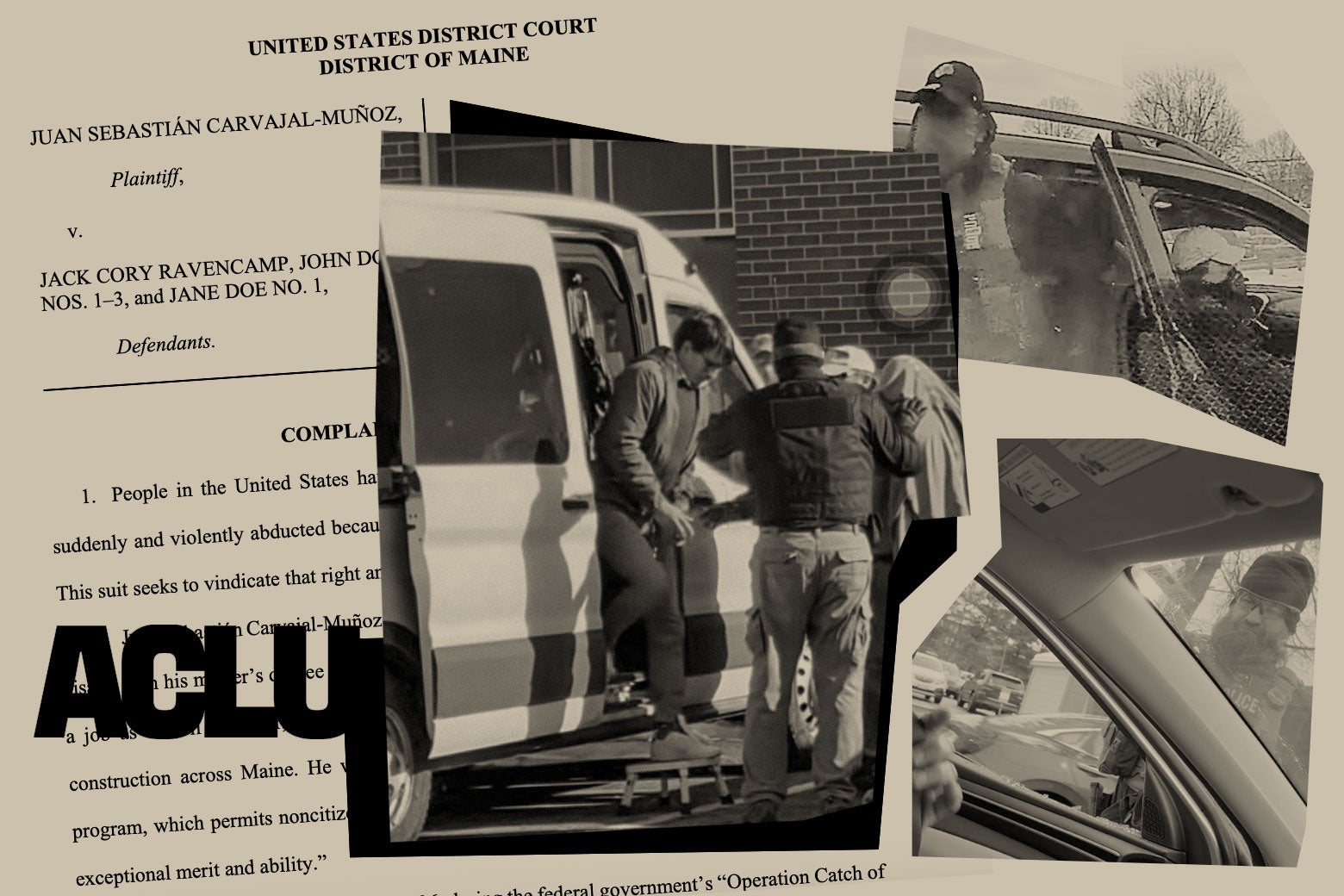
A legal battle unfolding in Maine may soon set a significant precedent for how federal officers are held accountable for alleged civil rights violations. At the center of the case is Juan Sebastián Carvajal-Muñoz, a Portland-based civil engineer originally from Colombia, who has filed a lawsuit against ICE agents following a violent encounter in January.
The complaint, filed in the federal courthouse in Portland on Tuesday, April 14, 2026, alleges that agents from Immigration and Customs Enforcement (ICE) violated Carvajal-Muñoz’s constitutional rights through racial profiling and excessive force. According to the legal team representing the plaintiff, the case is not merely about a single arrest, but is a strategic effort to utilize state law to challenge the perceived immunity of federal agents.
Carvajal-Muñoz is in the United States on a visa for specialized workers and has no criminal record. Despite his lawful status, he describes being targeted based on his race and ethnicity during a morning commute that escalated into a forceful seizure. His legal representatives, including Carol Garvan of the ACLU of Maine, are seeking compensatory and punitive damages for the psychological, physical, and economic harm resulting from the incident.
A Violent Encounter in Downtown Portland
The events leading to the lawsuit occurred on the morning of January 22. Between 8:45 a.m. And 10:00 a.m., Carvajal-Muñoz was driving toward his place of work on Pearl Street in downtown Portland. According to a detailed timeline provided by the ACLU, he was stopped when federal agents in an unmarked SUV with Minnesota plates cut in front of his vehicle.
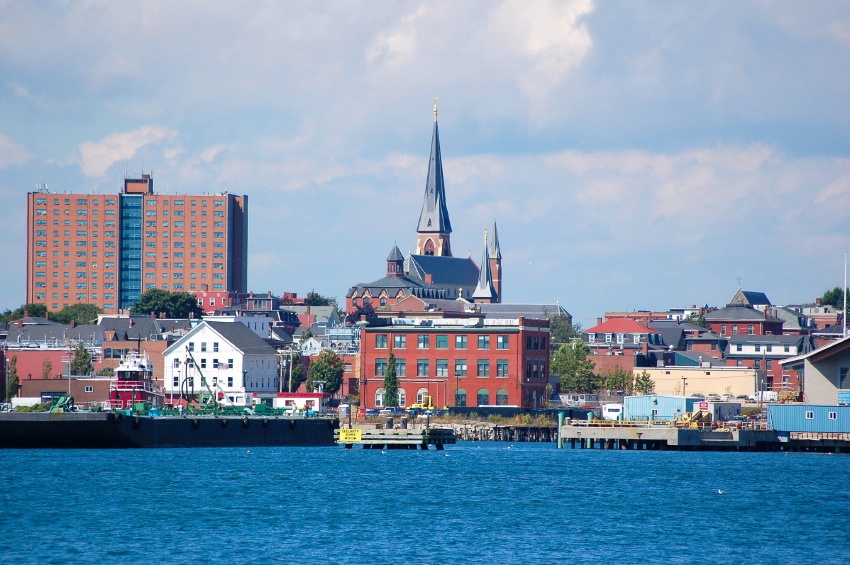
The encounter quickly turned volatile. While some agents were reportedly wearing masks, they surrounded the vehicle and demanded that Carvajal-Muñoz produce immigration documentation. The plaintiff complied by showing his REAL ID through the window—a document that, according to the ACLU of Maine, is only issued to non-citizens who possess documented lawful status.
Despite the presentation of valid identification, agents ordered Carvajal-Muñoz to exit the vehicle. When he reached for his phone to record the incident and call for help, an agent allegedly smashed his car window with a crowbar. A second masked agent then forced the door open and dragged him from the car while another agent pointed a taser at him. He was subsequently handcuffed and transported in the unmarked SUV.
The aftermath of the arrest left Carvajal-Muñoz’s vehicle running in the middle of the street with the driver’s side door open. His phone was left lying in the street, and his keys and bag remained on the passenger seat. He was transferred to Massachusetts and released later that same night.
Leveraging the Maine Civil Rights Act
The legal strategy employed in Carvajal-Muñoz v. Ravencamp is designed to bypass the traditional hurdles associated with suing federal employees. While federal agents often benefit from broad protections, the plaintiff’s legal team is seeking damages under the Maine Civil Rights Act.
Carol Garvan, one of the attorneys on the case, stated that this approach is an attempt to “reestablish this long tradition of being able to use state law as another alternative way to hold federal officers accountable.” By framing the violation within state law, the lawsuit seeks to create a stronger precedent for accountability when federal agents are alleged to have violated the Fourth and Fifth Amendment rights of individuals.
The Fourth Amendment protects citizens and lawful residents from unreasonable searches and seizures, while the Fifth Amendment ensures due process. The complaint argues that the agents had no legal basis for the stop and arrest, asserting that the action was motivated by racial profiling rather than legitimate law enforcement necessity.
The Human and Economic Cost of Profiling
For Carvajal-Muñoz, the incident was more than a legal technicality. it was a traumatic event that left him fearing for his life. In a press release issued on April 14, he stated, “Even though I followed all the rules, federal agents targeted me based on my race.”

The pursuit of compensatory and punitive damages reflects the multi-faceted impact of the arrest. Beyond the immediate physical danger and the destruction of his property, the lawsuit cites psychological distress and economic harm. As a specialized professional working as a civil engineer, the disruption and trauma of such an arrest can have lasting implications on professional standing and mental well-being.
The case also highlights a growing tension in “blue states” where local laws and civil rights protections often clash with federal immigration enforcement tactics. By challenging the conduct of agents who operated in an unmarked vehicle with out-of-state plates, the lawsuit brings attention to the methods used by federal agencies in local communities.
Case Summary: Carvajal-Muñoz v. Ravencamp
| Detail | Information |
|---|---|
| Plaintiff | Juan Sebastián Carvajal-Muñoz |
| Defendant | ICE Agents (Ravencamp et al.) |
| Filing Date | April 14, 2026 |
| Primary Legal Basis | Maine Civil Rights Act; 4th & 5th Amendments |
| Legal Representation | ACLU of Maine |
| Status | Ongoing |
As the proceedings continue in the federal courthouse in Portland, the outcome of this case could signal a shift in how state laws are used to check federal power. If successful, it may provide a blueprint for other individuals in similar jurisdictions to seek redress for alleged misconduct by federal agents.
The case is currently listed as ongoing by the ACLU. Further updates will depend on subsequent court filings and scheduled hearings.
We invite our readers to share their thoughts on the intersection of state and federal law in the comments section below.
Related reading