
A rare celestial alignment of Jupiter, Venus, and Mars will create a striking visual spectacle in the night sky on June 16–17, 2026, with the three planets appearing unusually close together—an event astronomers describe as a “great conjunction” of the brightest planets in our solar system. According to NASA’s planetary ephemeris data and confirmed by astronomical forecasts from the International Astronomical Union (IAU), this alignment will be visible to the naked eye from most locations on Earth, weather permitting, and will mark one of the most accessible planetary gatherings in years.
The alignment occurs as Jupiter and Venus—already in close proximity—will be joined by Mars, creating a triangular formation low in the western sky after sunset. “This is a rare opportunity to observe three of the brightest planets in our solar system clustered together,” said Dr. Emily Levesque, an astronomer at the University of Washington and member of the IAU’s Public Outreach Committee. “Such alignments happen every few years, but the proximity of these three planets this time will make it particularly striking.”
For skywatchers, the event presents a chance to witness planetary motion firsthand. Jupiter, the largest planet in our solar system, will appear as a bright, golden point of light, while Venus—currently the brightest natural object in the night sky after the Moon—will shine with a silvery hue. Mars, though dimmer, will add a reddish tint to the trio. The alignment will be most visible during twilight, with the planets setting shortly after darkness falls.
Why This Alignment Is Unusual—and When to See It
Planetary alignments occur when multiple planets appear close together in the sky from Earth’s perspective, though they are not physically aligned in space. The upcoming event is notable because Jupiter and Venus will be in conjunction—meaning they will share nearly the same celestial longitude—while Mars drifts into close proximity, creating a visually compelling grouping.

According to NASA’s Jet Propulsion Laboratory (JPL), Jupiter and Venus will reach their closest approach on June 16, 2026, with an angular separation of approximately 0.5 degrees—a distance so small that both planets could theoretically fit within the field of view of a typical telescope eyepiece. Mars will join the formation the following evening, adding a third bright point to the scene. “This is a great time for amateur astronomers to practice observing planetary motion and understanding orbital mechanics,” said Dr. Levesque.
The alignment will be visible globally, though optimal viewing conditions vary by region. Observers in the Northern Hemisphere will see the planets low in the western sky shortly after sunset, while those in the Southern Hemisphere may catch a glimpse slightly later in the evening. Cloud cover or light pollution could obscure the view, so clear skies and dark locations away from city lights are ideal.
How to Observe the Alignment Safely
Unlike solar eclipses, which require special protective gear, this planetary alignment can be observed safely with the naked eye. However, binoculars or a small telescope will enhance the view, allowing observers to distinguish the planets’ disks and even spot Jupiter’s moons. NASA recommends using astronomy apps like Stellarium or SkySafari to locate the planets accurately.
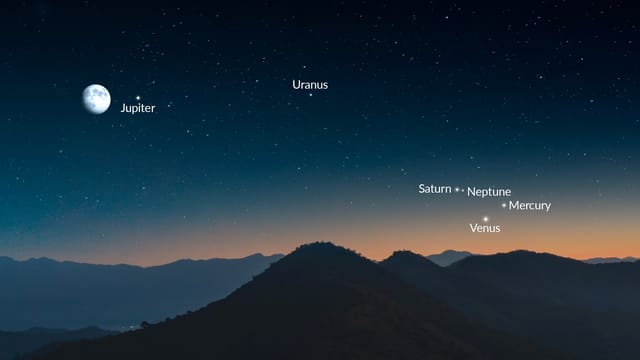
“This event is a fantastic opportunity for public engagement in astronomy,” said Dr. Levesque. “It’s a reminder of how dynamic our solar system is and how accessible space science can be.” For those unable to observe the alignment in person, livestreams from telescopes such as those hosted by the Virtual Telescope Project will provide real-time views.
What This Means for Astronomy and Future Observations
The June 2026 alignment is part of a series of planetary conjunctions that will continue into 2027, culminating in a rare five-planet alignment in early 2028. Astronomers use such events to study planetary orbits, refine ephemeris data, and engage the public in citizen science initiatives. The IAU has noted that alignments like this one help validate models of planetary motion and improve predictions for future celestial events.
Historically, planetary conjunctions have held cultural and scientific significance. For example, the conjunction of Jupiter and Saturn in 7 BC is often cited as the “Star of Bethlehem” in Christian tradition, though astronomers debate its exact nature. Modern alignments, while lacking such mythological weight, still captivate observers worldwide. “Events like this remind us of our place in the cosmos,” said Dr. Levesque. “They’re a chance to step outside, look up, and connect with something much larger than ourselves.”
Key Takeaways for Stargazers
- When: June 16–17, 2026, shortly after sunset.
- Where: Visible globally, best viewed from dark-sky locations.
- What to expect: Jupiter (golden), Venus (silvery), and Mars (reddish) appearing close together in the western sky.
- Tools: Naked eye, binoculars, or a small telescope for enhanced detail.
- Next major event: A five-planet alignment in early 2028, including Mercury and Saturn.
Looking Ahead: What’s Next for Planetary Alignments?
While the June 2026 alignment is a highlight, astronomers are already tracking future celestial events. The next notable conjunction will occur in December 2027, when Venus and Saturn align, followed by the five-planet alignment in January 2028. NASA’s planetary science division will provide updates on these events, including opportunities for public observation and educational programs.
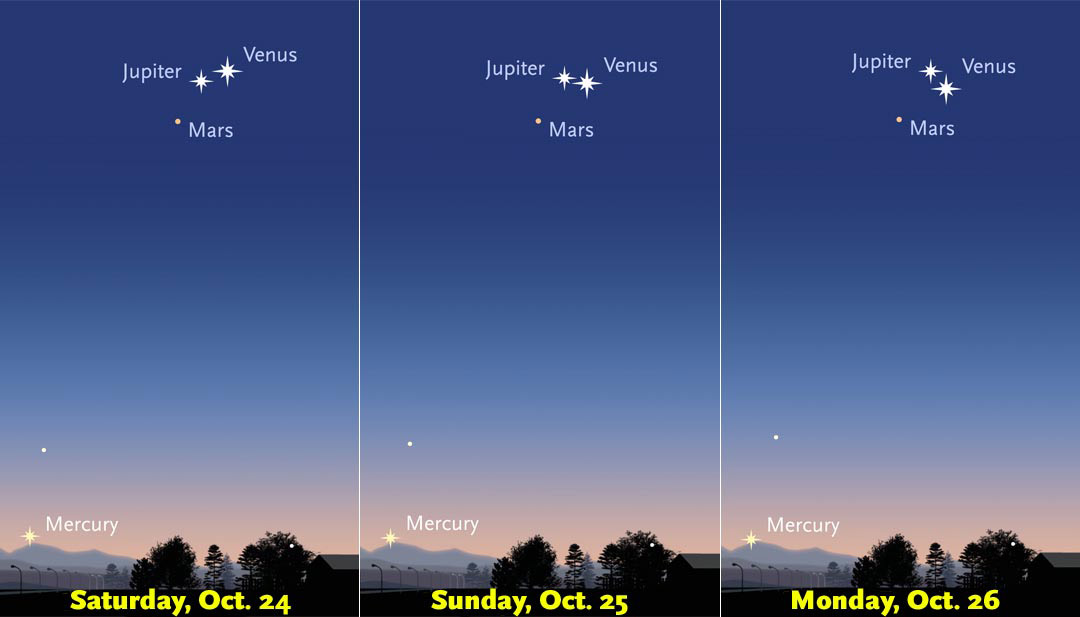
For now, skywatchers are encouraged to mark their calendars for June 16–17, 2026, and prepare for a rare celestial show. Whether you’re a seasoned astronomer or a casual observer, this alignment offers a chance to witness the beauty of our solar system firsthand.
Have you observed planetary alignments before? Share your experiences or questions in the comments below—or tag @WorldTodayJ to join the conversation.
Note: Visualizations of planetary alignments are typically generated using NASA’s Eyes on the Solar System or similar tools. For accurate simulations, visit NASA’s Eyes or use astronomy apps like Stellarium.
Worth a look