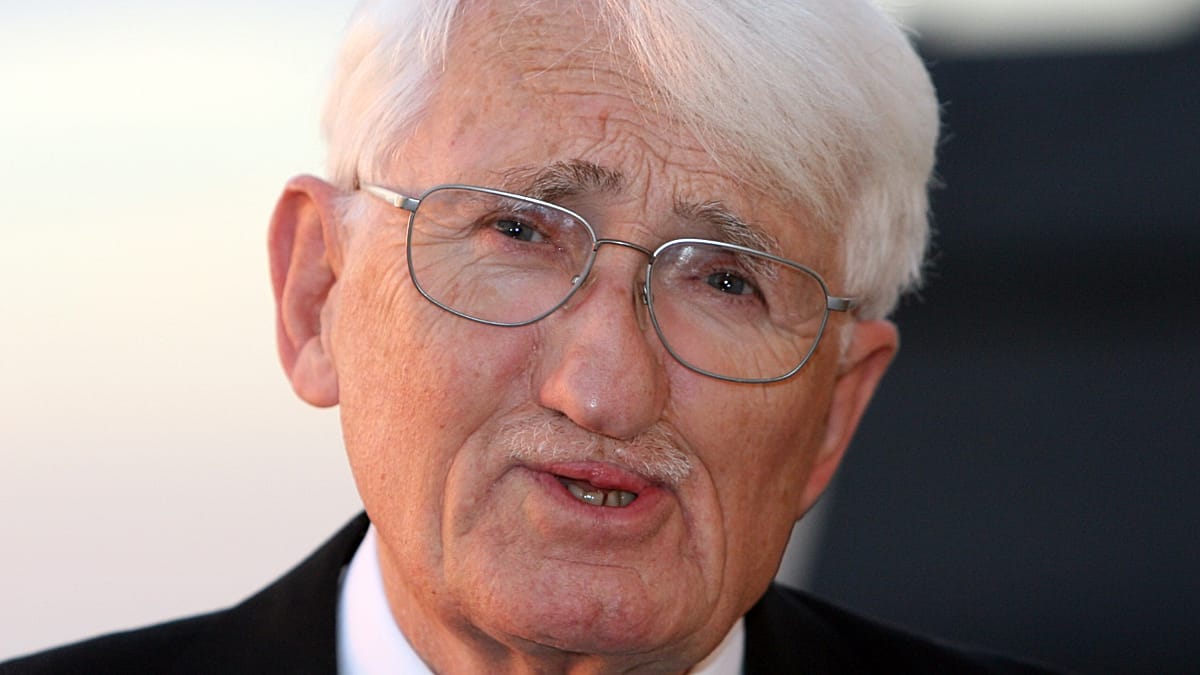
Jürgen Habermas, one of Germany’s most influential philosophers and a towering figure of the postwar intellectual landscape, has died at the age of 96. His publishing house, Suhrkamp, announced his death on Saturday, March 14, 2026, in Starnberg, Bavaria. Habermas’s work profoundly shaped fields ranging from sociology and political science to law and communication studies, leaving an indelible mark on contemporary thought and public discourse.
Habermas was best known for his development of the theory of communicative action, a complex framework exploring the conditions for rational discourse and consensus-building in society. His scholarship consistently grappled with the challenges of modernity, the erosion of traditional authority, and the potential for achieving a more just and democratic public sphere. Throughout his long and distinguished career, he remained a committed advocate for reason, dialogue, and the principles of a constitutional democracy. He was a leading figure of the Frankfurt School, carrying forward the tradition of critical theory alongside thinkers like Theodor Adorno and Max Horkheimer.
Born in Düsseldorf, Germany, on June 18, 1929, Habermas’s early life was deeply affected by the rise and fall of Nazism. As a young boy, he was enrolled in the Hitler Youth, a common experience for German children during that period. However, the collapse of the Nazi regime at the end of World War II proved to be a formative experience, leading him to question the foundations of political power and the dangers of unchecked ideology. He later reflected on the experience, describing the realization that he had lived within a “politically criminal system.” This early exposure to the horrors of totalitarianism profoundly influenced his lifelong commitment to critical analysis and the pursuit of a more rational and ethical social order.
The Legacy of Critical Theory and Communicative Action
Habermas’s intellectual project built upon the foundations of the Frankfurt School’s “Critical Theory,” which sought to analyze society, politics, and culture by questioning existing power structures and dominant ideologies. He reworked and expanded upon this framework, shifting the focus from a primarily pessimistic critique of domination to a more constructive exploration of the potential for rational communication and social progress. His magnum opus, The Theory of Communicative Action, published in 1981, laid out his central argument: that rational consensus can be achieved through open and uncoerced dialogue, guided by the “unforced force of the better argument.”
Central to Habermas’s theory is the concept of the “ideal speech situation,” a hypothetical scenario in which all participants have equal opportunities to express their views, challenge assumptions, and reach a mutual understanding. While acknowledging that such a situation is rarely, if ever, fully realized in practice, Habermas argued that it serves as a normative ideal for evaluating the quality of public discourse and identifying the obstacles to rational communication. His work also introduced the concept of “communicative rationality,” emphasizing the importance of reason and argumentation in achieving social coordination and resolving conflicts.
Beyond his theoretical contributions, Habermas was a prominent public intellectual who actively engaged with contemporary political issues. He consistently defended the principles of liberal democracy, the rule of law, and the importance of a vibrant civil society. He was a strong advocate for European integration and a vocal critic of nationalism and populism. He also engaged with debates surrounding bioethics, genetic engineering, and the future of public broadcasting.
Academic Career and Recognition
Habermas held professorships at several prestigious universities, including the University of Marburg, the University of Heidelberg, and the University of Frankfurt. He also spent time as a visiting scholar at the University of California, Berkeley. His teaching and scholarship inspired generations of students and researchers across a wide range of disciplines. According to his Wikipedia entry, he was a doctoral advisor to Hans-Hermann Hoppe, though their intellectual paths later diverged.
Throughout his career, Habermas received numerous accolades and honors, recognizing his profound contributions to philosophy and social thought. He was awarded the Peace Prize of the German Book Trade in 2001, a prestigious award recognizing individuals who have made outstanding contributions to the promotion of peace and understanding. Suhrkamp’s author page for Habermas lists a comprehensive array of awards, including the Order Pour le Mérite (2022), the Erasmus Prize (2013), and the Holberg Prize (2005). These awards reflect the international recognition of his intellectual achievements and his commitment to public engagement.
Navigating the Student Movement and Personal Life
During the 1960s, Habermas found himself in a complex relationship with the German student movement. While he sympathized with some of the movement’s critiques of traditional authority and social injustice, he also cautioned against radicalization and the apply of violence. He warned against the dangers of what he termed “left-wing fascism,” arguing that the pursuit of revolutionary goals could easily lead to new forms of oppression. Later in life, however, he acknowledged that the student movement had contributed to a “fundamental liberalization” of German society, challenging established norms and opening up space for greater social and political participation.
Habermas’s personal life was also marked by challenges. He was born with a cleft palate and underwent multiple surgeries as a child. He later reflected on how this experience shaped his thinking about language and communication, fostering a sensitivity to the importance of clarity, precision, and mutual understanding. He was married to Ute Wesselhöft from 1955 until her death in 2025. Together, they had three children: Tilmann, Rebekka (who predeceased her mother and father in 2023), and Judith.
A Lasting Impact on Political and Social Thought
Jürgen Habermas’s death marks the end of an era in German and international philosophy. As the last surviving member of the first generation of the Frankfurt School, he represented a crucial link to a tradition of critical thought that has profoundly shaped our understanding of modernity and its discontents. His work continues to be widely studied and debated, inspiring scholars and activists to grapple with the challenges of building a more just, rational, and democratic world. His emphasis on the importance of communicative action and the pursuit of rational consensus remains particularly relevant in an age of polarization, misinformation, and declining trust in public institutions.
Habermas’s influence extends beyond academic circles, informing debates about public policy, media regulation, and the future of democracy. His concept of “constitutional patriotism” – the idea that citizens can develop a sense of shared identity and loyalty based on adherence to constitutional principles rather than ethnic or cultural ties – has been particularly influential in discussions about immigration and multiculturalism. His work continues to provide a powerful framework for analyzing the challenges facing contemporary societies and for envisioning a more inclusive and equitable future.
Key Takeaways
- Jürgen Habermas, a leading German philosopher, died on March 14, 2026, at the age of 96.
- He was a central figure in the Frankfurt School and developed the influential theory of communicative action.
- Habermas’s work emphasized the importance of rational discourse, consensus-building, and the principles of a constitutional democracy.
- He received numerous awards and honors throughout his career, recognizing his profound contributions to philosophy and social thought.
- His legacy continues to inspire scholars and activists working to address the challenges of modernity and build a more just and equitable world.
As of today, March 14, 2026, Suhrkamp, Habermas’s publisher, is expected to release a more detailed statement regarding memorial arrangements in the coming days. Further information will be available on their website. The intellectual community and the public at large mourn the loss of a truly remarkable thinker whose ideas will continue to resonate for generations to come. We invite readers to share their reflections on Habermas’s life and work in the comments below.
Keep reading