
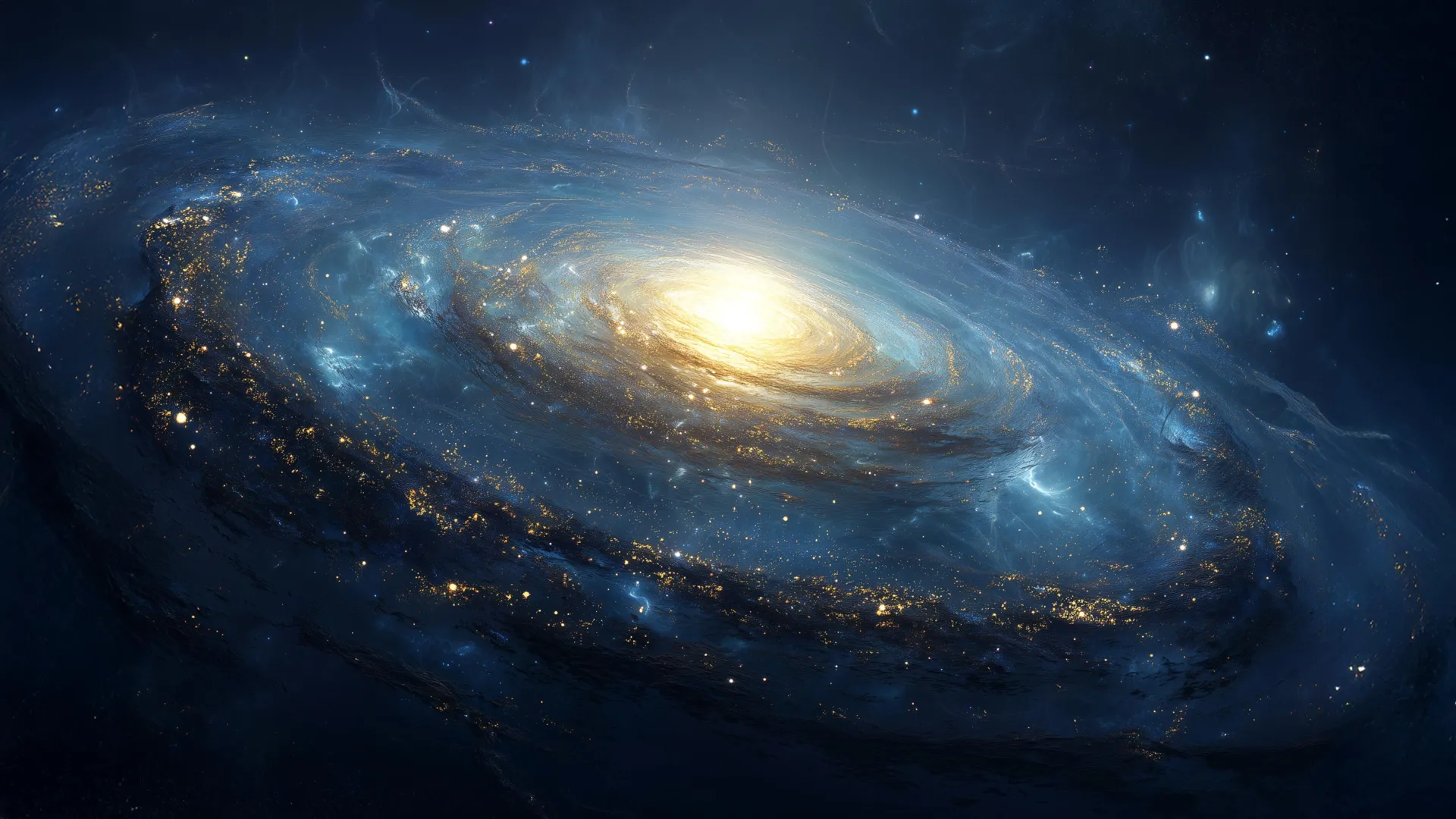
Astronomers have encountered a cosmic anomaly that defies the established laws of galactic evolution. Using the James Webb Space Telescope (JWST), a research team has identified a giant galaxy that doesn’t spin, appearing in a region of the universe where such a characteristic should be physically impossible according to current models.
The discovery, centered on a massive system formed less than 2 billion years after the Big Bang, challenges the fundamental understanding of how the first structures in our universe coalesced. In the standard model of cosmology, young galaxies are expected to possess significant rotation, a byproduct of the angular momentum generated as gas clouds collapse under gravity to form stars and galactic cores.
This finding suggests that our timeline for galactic maturation may be fundamentally flawed, or that the mechanisms driving early galaxy formation are far more complex than previously theorized. The lack of rotation is a trait typically reserved for “evolved” or “dead” galaxies—massive elliptical systems seen in the local universe that have spent billions of years colliding and merging, effectively cancelling out their original spin.
The study, published on May 4 in Nature Astronomy, provides a rare glimpse into a transitional phase of the universe that was previously invisible to human technology. By peering through the dust and gas of the early cosmos, the JWST has revealed a structure that possesses the mass of a mature galaxy but the rotational profile of an ancient one, all while existing in the universe’s infancy.
A Cosmic Anomaly in the Early Universe
The lead author of the study, Ben Forrest, a research scientist in the Department of Physics and Astronomy at the University of California, Davis, described the discovery as surprising and highly significant. According to the research, the galaxy in question shows no detectable evidence of rotation, meaning its stars and gas are not orbiting a central point in a coherent disk, but are instead moving in more random, disordered directions.
For astronomers, Here’s a contradiction in terms. During the first few billion years of the universe, the prevailing theory is that galaxies grew via the steady accretion of gas. As this gas fell inward, any slight initial rotation would be amplified—much like a figure skater spinning faster as they pull their arms in—creating the iconic spiral shapes we see in galaxies like the Milky Way. A massive galaxy without this spin, formed so early in cosmic history, suggests that the “skater” never started spinning in the first place, or something intervened to stop it almost immediately.
The scale of the galaxy further complicates the mystery. The system is not a small, primitive clump of stars, but a “giant” galaxy. The presence of such a massive, non-rotating structure so soon after the Big Bang implies that the processes of galaxy assembly happened much faster and more violently than current simulations can account for.
The Physics of the Spin: Why Angular Momentum Matters
To understand why a non-spinning galaxy is so disruptive to astronomical theory, one must look at the concept of angular momentum. In the early universe, matter was not perfectly distributed; it existed in a web of dark matter and gas. As gravity pulled this matter together to form galaxies, the inherent “swirl” of the surrounding environment gave these systems their rotation.
Rotation is more than just an aesthetic feature; it is a stabilizing force. The centrifugal force created by a galaxy’s spin prevents it from collapsing entirely into its own center, allowing for the creation of stable disks where stars can form over billions of years. When a galaxy lacks this rotation, it typically indicates one of two things: either it is a particularly small, irregular system, or it is a massive elliptical galaxy that has undergone multiple “major mergers.”

In a major merger, two large galaxies collide. Their respective rotations can clash and cancel each other out, leaving behind a bloated, swarm-like collection of stars moving in random orbits. However, these mergers take billions of years to occur across a population of galaxies. Finding this state in a galaxy that existed less than 2 billion years after the Big Bang is like finding a fully grown adult in a nursery of toddlers; the timing simply does not align with the known biological—or in this case, cosmological—clock.
Challenging the Standard Model of Galaxy Formation
The existence of this non-spinning giant forces astrophysicists to reconsider the “Standard Model” of how the universe evolved. If galaxies can reach massive sizes and lose their rotation within the first 2 billion years, it suggests that the early universe was a far more chaotic environment than previously imagined. It may be that the density of the early universe triggered mergers at a rate far higher than what is observed today.

Another possibility is that some galaxies form through a process called “monolithic collapse,” where a massive cloud of gas collapses directly into a galaxy without the gradual accretion of smaller pieces. While this theory has existed for decades, it has largely been superseded by the hierarchical model (small things merging to make big things). This discovery may breathe new life into the idea that some giants were born “big and still” rather than “small and spinning.”
This discovery also raises questions about the role of dark matter. Since dark matter provides the gravitational scaffolding for galaxies, any anomaly in the visible matter’s rotation likely reflects an anomaly in the underlying dark matter halo. If the dark matter distribution in the early universe was more turbulent or structured differently, it could explain why some early galaxies failed to develop a coherent spin.
The Technological Edge: How JWST Made This Possible
This discovery would have been impossible with previous instruments. The James Webb Space Telescope is specifically designed to detect infrared light, which is crucial for this type of research. Because the universe is expanding, light from the earliest galaxies is “redshifted,” stretching from visible light into the infrared spectrum by the time it reaches Earth.
The JWST’s unprecedented sensitivity allows it to perform spectroscopy on these distant objects. By analyzing the light from the galaxy, astronomers can measure the Doppler shift of the gas and stars. If one side of the galaxy is moving toward us (blueshifted) and the other is moving away (redshifted), the galaxy is spinning. In the case of this giant galaxy, the data showed no such pattern, confirming the lack of overall rotation.
The telescope’s position at the second Lagrange point (L2), 1.5 million kilometers from Earth, ensures it remains cold and stable, allowing its mirrors to capture the faint heat signatures of galaxies that formed when the universe was only a fraction of its current age. This capability is transforming the “Dark Ages” of the early universe into a visible map of cosmic evolution.
What Happens Next in the Search for Cosmic Origins
The discovery of this non-spinning giant is likely not an isolated incident but the first of many anomalies that the JWST will uncover. The research team is now looking to determine if this galaxy is a “lone wolf” or if there is a larger population of non-rotating early galaxies that have simply remained hidden until now.

Further observations will focus on the chemical composition of the galaxy to see if its stars are older or younger than the galaxy’s overall age. This will help determine if the galaxy formed rapidly in a single burst of star formation or if it is the result of a series of incredibly fast, early mergers. Astronomers will seek to find similar galaxies in different environments to see if the lack of rotation is tied to the density of the surrounding cosmic web.
As the JWST continues its mission, each new “impossible” galaxy provides a data point that helps refine our understanding of the Big Bang’s aftermath. The goal is no longer just to find the first galaxies, but to understand why they behaved the way they did—and why some decided to break the rules of physics as we know them.
The astronomical community awaits further data releases from the JWST’s ongoing surveys of the deep field, which are expected to provide more context on the distribution of angular momentum in the early universe. Updates on these findings are typically published through official NASA and ESA mission portals as peer-reviewed studies are completed.
Do you think our current models of the universe are due for a complete rewrite? Share your thoughts in the comments below or share this article with your fellow space enthusiasts.