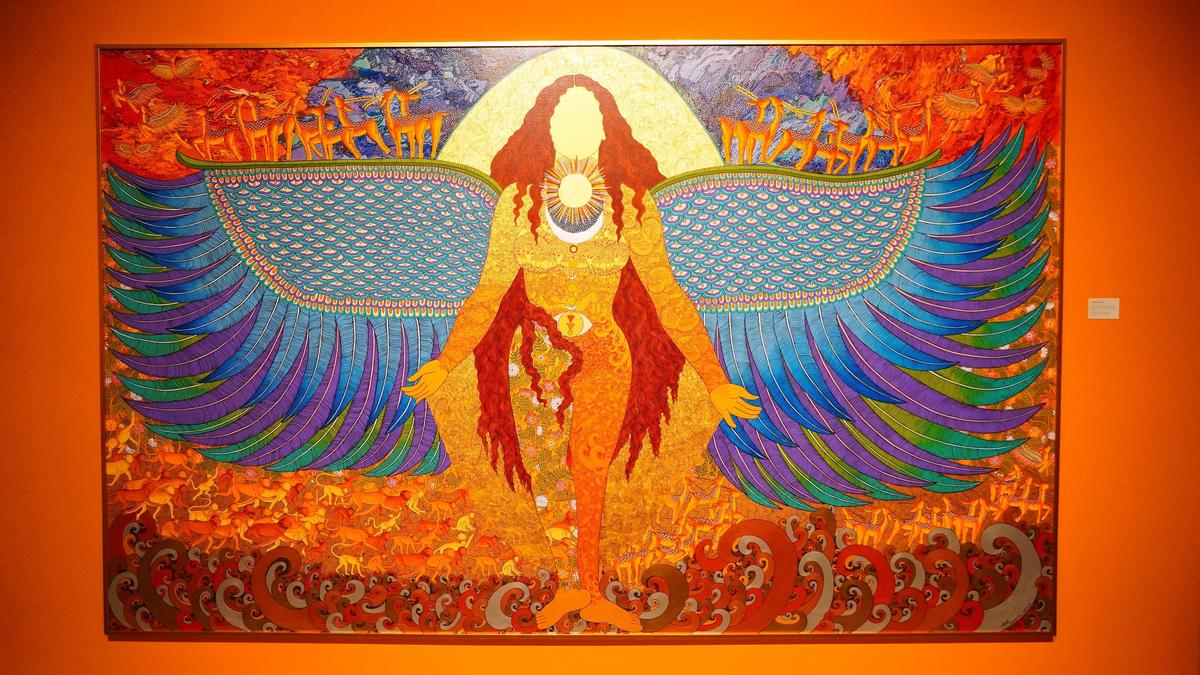
The Enduring Symbolism of Trees and Desire: Exploring Seema Kohli’s “Kaal Netra”
For many artists, inspiration stems from a deeply personal connection to the world around them. This is certainly true for artist Seema Kohli, whose current exhibition, “Kaal Netra,” at the National Gallery of Modern Art, beautifully illustrates a lifelong captivation with nature and the complexities of human desire.
kohli’s work isn’t simply about trees; it’s infused with thier spirit. She recalls a childhood spent as a “tree hugger,” fostering an innate empathy that continues to shape her artistic vision. This early connection blossomed into a profound understanding of trees as powerful symbols, resonating across cultures and spiritual traditions.
Trees: Universal Symbols of Life and Spirituality
consider the rich symbolism found within various belief systems. The Bhagavad Gita references trees as integral to the natural order. Buddha attained enlightenment beneath the pipal tree, a pivotal moment in spiritual history. Similarly, trees hold significance in Sufism and Christianity, representing growth, connection, and the divine.
“In most of my work, trees have an critically important role to play,” Kohli explains, “and I’m driven by the idea of trees growing on their own, wild and free.” This desire to depict untamed growth speaks to a deeper yearning for authenticity and liberation.
A Provocative Exploration of Desire: The Tongue Installation
Beyond the evocative depictions of trees, the exhibition features a striking installation of multi-colored tongues. It’s a piece designed to capture your attention and provoke thought.
this isn’t a literal exploration of taste, but rather a meditation on the broader concept of rasa - the aesthetic experience of flavor, extending beyond the palate. Think about the sensation when listening to beautiful music or beholding a stunning flower. That feeling, that resonance, is what Kohli aims to capture.
* The tongue is the most sensitive part of the body, crucial for experiencing the world through our five senses.
* It’s the instrument of both articulation and temptation.
* Every desire, from the simplest craving to the loftiest ambition, originates within this space.
The Dual Nature of temptation
Kohli elaborates on the symbolism, explaining that all temptations stem from the tongue. We use it to speak, to praise, to incite, and to express our deepest imaginations. Ultimately, she views desire as the very engine of life.
“Provided that there is temptation or a desire to live, one will live,” she states. This isn’t necessarily about material possessions or fleeting pleasures. Ambition, the yearning for growth, even the desire for peace - all are forms of temptation.
Consider this: even the wish to renounce everything is a desire. Kohli’s work suggests that these inherent tensions are not something to be avoided, but rather embraced as basic to the human experience. There will always be something to ignite your passion, to keep you engaged with the world.
“Kaal Netra” isn’t just an art exhibition; it’s an invitation to contemplate the forces that drive us, the symbols that shape our understanding, and the enduring power of nature to inspire and provoke. It’s a journey into the heart of what it means to be alive, and a testament to the artist’s profound connection to the world around her.