
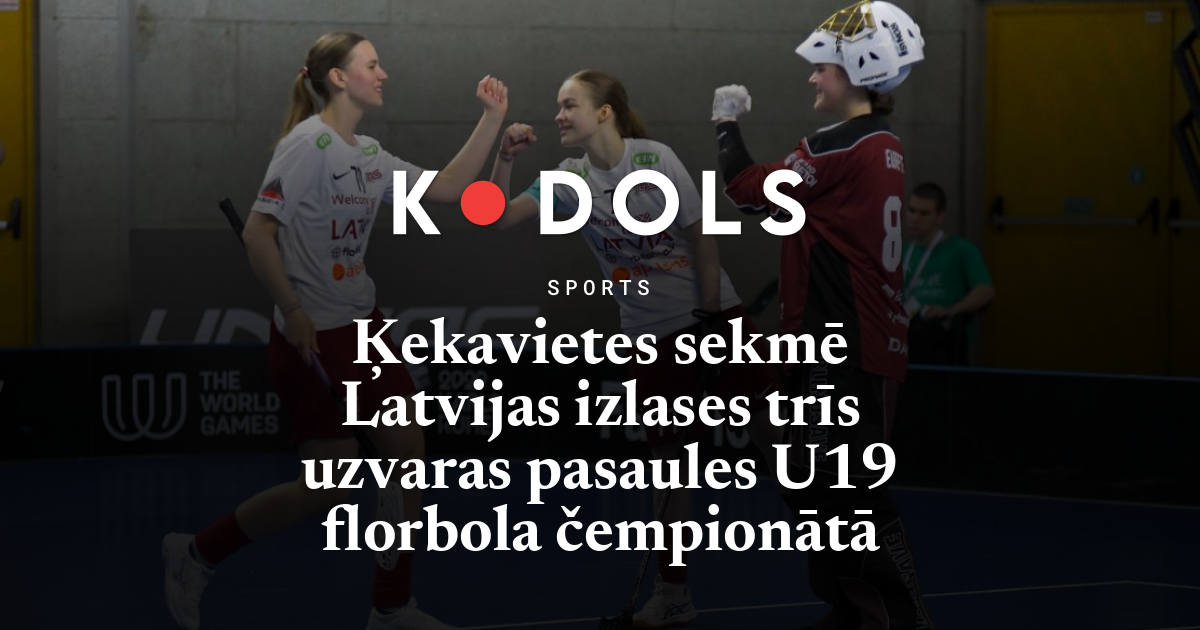
The Latvian U19 women’s floorball team has launched a commanding campaign at the World U19 Floorball Championships in Italy, securing three consecutive victories to signal their intent on the international stage. For a squad determined to reclaim its status among the global elite, the opening phase of the tournament has been less of a contest and more of a statement of dominance.
Coming off a challenging previous championship where they finished in ninth place, the Latvian side entered this competition with a clear objective: restoration. Because of their prior ranking, the team began their journey in the second-tier tournament, a structure that limits their maximum possible final standing to seventh place. However, the clinical nature of their early performances suggests a team that has outgrown its current bracket.
The momentum is not merely a result of collective effort but is being driven by a core of talented players from the “FK Ķekava”/”Latvijas mediji” club. Their synergy has translated into a high-scoring offense and a disciplined defense that has left opponents struggling to find any rhythm in the opening matches of the event.
A Masterclass in Efficiency: Three Games, Three Wins
Latvia’s opening match against Australia served as an immediate warning to the rest of the field. The team established control early, carving out a staggering 9-0 lead by the middle of the second period. The match concluded in a 17-3 rout, showcasing a level of offensive fluidity that set the tone for the rest of the group stage.
The second encounter against Singapore followed a similar trajectory. Latvia mirrored their previous aggression, sprinting to an 8-0 lead early in the game. While Singapore managed to find the net once, the final score of 11-1 reflected a mismatch in both tactical execution and physical conditioning.
The third match, faced against a more resilient Hungarian side, provided a slightly different challenge. The game progressed at a more measured pace, with Latvia holding a 5-0 lead after two periods. Despite the tighter contest, the Latvian defense remained impenetrable, securing a 9-0 shutout to complete their perfect start to the tournament.
The Ķekava Connection and Individual Brilliance
Much of the team’s current success can be attributed to the influence of the “FK Ķekava”/”Latvijas mediji” contingent. Four players from the club are integral to the national squad, providing the leadership and technical skill necessary to navigate the pressures of a world championship.
At the center of this effort is Annija Dārta Dankfelde, the captain of the U19 national team. Dankfelde’s impact was most evident in the opening victory over Australia, where she was named the best player of the match after recording three goals and four assists. Over the first three games, the captain has accumulated nine points, consisting of three goals and six assists, acting as the primary engine for the Latvian attack.
Supporting Dankfelde is a disciplined group of teammates from the same club who have contributed steadily to the scoreboard. Patrīcija Kubuliņa has proven clinical in front of the goal, netting three goals (3+0), while Elīza Eikena has contributed two points (1+1). Enija Kalniņa also added to the tally with one assist (0+1), illustrating a balanced distribution of play among the Ķekava representatives.
While the Ķekava core provides the stability, Elīna Dīce from the championship-winning “NND/RJTC” team has emerged as the most lethal offensive threat. Following the group stage, Dīce leads the scoring charts with 13 points, comprising seven goals and six assists, making her the most productive player in the Latvian lineup thus far.
The Strategic Climb: Navigating the Second Tier
For the casual observer, the scorelines might suggest a team destined for the podium, but the tournament’s regulatory structure adds a layer of complexity to Latvia’s ambitions. Due to their ninth-place finish in the previous world junior championship, the team was placed in the second-tier tournament for this event.
This placement creates a “glass ceiling” for the current competition; regardless of their performance in the remaining rounds, the highest rank the Latvian women can achieve in the final overall standings is seventh place. This creates a unique psychological dynamic for the players—they are playing not just for a trophy, but to prove they belong back in the top eight of the global rankings.
The pursuit of a top-seven finish is more than a statistical goal; This proves a strategic necessity for the long-term growth of floorball in Latvia. Securing a higher seed ensures better matchups and more favorable conditions in future championships, allowing the next generation of athletes to compete against the world’s best from the outset rather than fighting their way up through the second tier.
The dominance displayed in Italy—specifically the ability to maintain clean sheets and high-scoring margins—indicates that the gap between Latvia and the second-tier competition has widened significantly. The focus now shifts from merely winning games to refining their play for the higher-intensity matches that characterize the top eight of the world rankings.
Key Performance Metrics
The following breakdown highlights the offensive output of the key contributors during the opening phase of the tournament:
| Player | Club | Goals | Assists | Total Points |
|---|---|---|---|---|
| Elīna Dīce | NND/RJTC | 7 | 6 | 13 |
| Annija Dārta Dankfelde | FK Ķekava | 3 | 6 | 9 |
| Patrīcija Kubuliņa | FK Ķekava | 3 | 0 | 3 |
| Elīza Eikena | FK Ķekava | 1 | 1 | 2 |
| Enija Kalniņa | FK Ķekava | 0 | 1 | 1 |
The statistical dominance is further emphasized by the goal differential across the first three matches. With a combined score of 37 goals scored and only 4 conceded, Latvia is averaging over 12 goals per game while maintaining a defensive rigidity that has kept them in total control of every contest.
As the tournament progresses into the weekend, the Latvian national team continues its fight to secure the highest possible position. Their ability to sustain this level of intensity will be critical as they look to finalize their standing and solidify their return to the upper echelon of international floorball.
The next phase of the competition will determine if Latvia can translate this early momentum into a seventh-place finish, marking a successful recovery from their previous ninth-place standing. We will continue to monitor the results as the tournament reaches its conclusion in Italy.
Do you think the current tournament structure unfairly limits teams that have improved rapidly between championships? Share your thoughts in the comments below or share this story with fellow sports enthusiasts.