
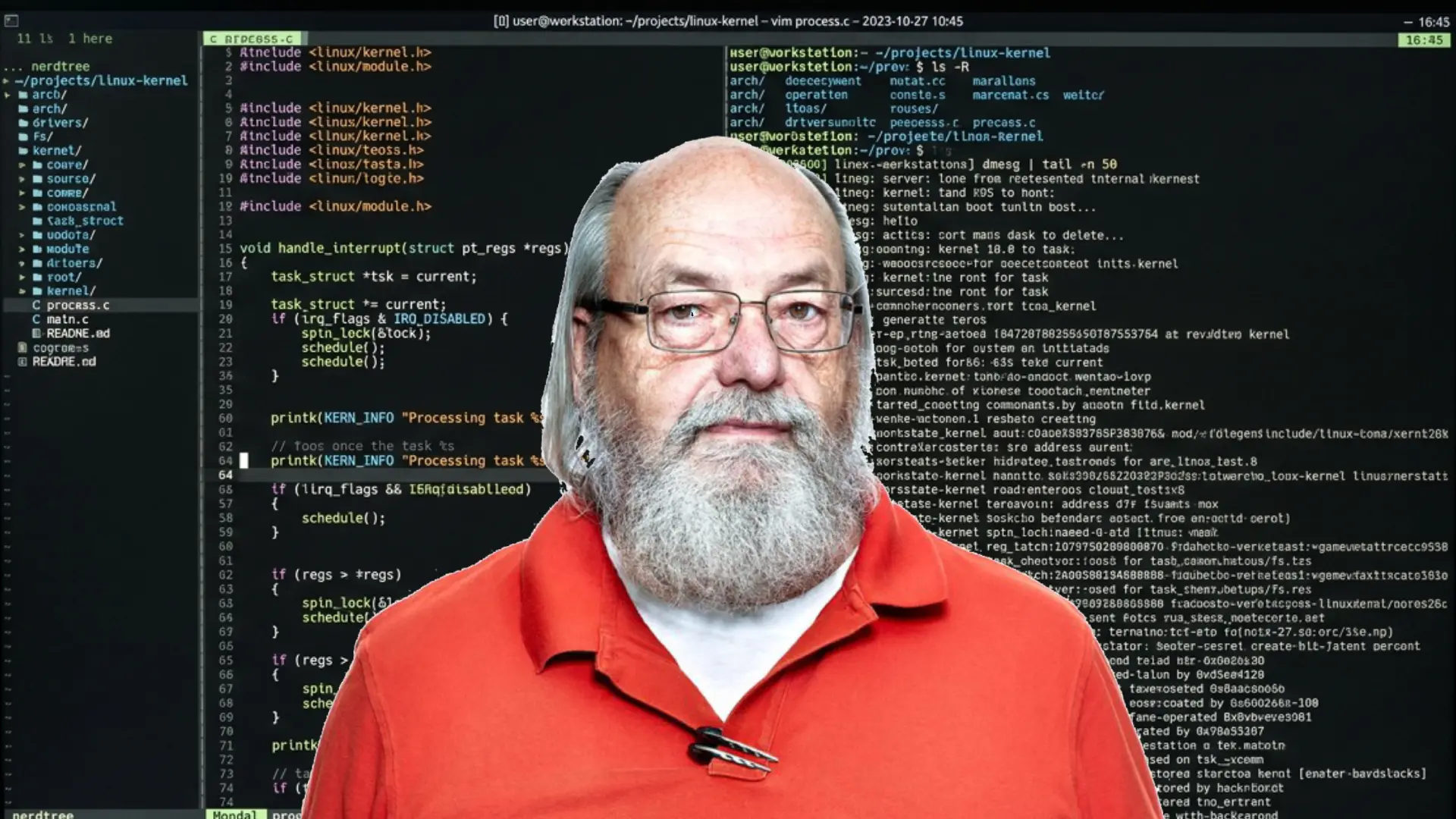
Ken Thompson’s name is inseparable from the origins of Unix, the operating system that quietly shaped the digital world we inhabit today. As a pioneering computer scientist at Bell Labs in the late 1960s, Thompson co-created Unix alongside Dennis Ritchie, laying the groundwork for everything from modern Linux distributions to macOS and the server infrastructure powering the internet. His contributions extend beyond code — he helped define a philosophy of simplicity, modularity, and elegance in software design that continues to influence developers decades later.
One of the most frequently cited anecdotes about Thompson comes from a reflective moment in his career: he once described one of his most productive days as the day he deleted 1,000 lines of code. This seemingly counterintuitive statement captures a deeper truth about software development — that progress isn’t always measured in additions, but sometimes in what we choose to remove. The quote, often shared in tech circles, speaks to the value of minimalism and the courage to refactor or simplify complex systems.
To understand the context behind this remark, it’s essential to look at Thompson’s actual contributions during Unix’s formative years. In 1969, even as working on the PDP-7 minicomputer at Bell Labs, Thompson began developing what would become Unix as a personal project to create a more usable environment for running games. He wrote the initial version in assembly language, later rewriting it in C — a language he co-developed with Ritchie — which made Unix portable across different hardware platforms.
The idea that removing code could be productive aligns with core Unix principles. Thompson and Ritchie believed that a good system should do one thing well, and that complexity should be avoided unless absolutely necessary. This mindset led to the creation of small, focused utilities that could be combined in powerful ways — a concept now known as the Unix philosophy. Deleting unnecessary or redundant code wasn’t just about cleanliness; it was about improving reliability, maintainability, and performance.
Verified historical accounts confirm that Thompson was deeply involved in refining Unix’s early codebase. According to the Bell Labs Technical Journal and interviews archived by the Computer History Museum, Thompson frequently revisited and streamlined components of the system during its first few years. One well-documented example is his work on the file system and input/output routines, where he simplified mechanisms to reduce overhead and improve clarity.
The quote about deleting 1,000 lines of code has appeared in various interviews and talks over the years, including a 1982 lecture at the University of California, Berkeley, where Thompson discussed the evolution of Unix and the importance of keeping systems lean. While the exact phrasing may vary slightly across sources, the sentiment remains consistent: true progress in software often involves knowing what to leave out.
This perspective remains highly relevant in today’s era of bloated software applications and over-engineered systems. Modern developers frequently grapple with technical debt, feature creep, and the pressure to constantly add functionality. Thompson’s reminder that deletion can be an act of creation serves as a timely counterbalance — suggesting that sophistication doesn’t require complexity, and that the best systems are often those that have been carefully pruned.
Thompson’s influence extends far beyond Unix. He later co-created the Belle chess machine, which won multiple computer chess championships, and contributed to the development of UTF-8, the dominant encoding standard for Unicode text on the web. In recognition of his lifelong contributions to computing, he received the Turing Award in 1983 alongside Dennis Ritchie, often described as the “Nobel Prize of computing.”
Despite his monumental impact, Thompson has consistently emphasized collaboration and humility in interviews. He has noted that Unix was not the work of any single individual, but the result of a collective effort among talented researchers at Bell Labs who shared a vision for a better way to build systems. This ethos of open exchange and iterative improvement helped Unix spread beyond Bell Labs, eventually influencing the development of BSD, Linux, and countless other operating systems.
Today, as cloud computing, containerization, and microservices architectures dominate infrastructure design, the Unix philosophy — championed by Thompson — finds renewed relevance. Tools like Docker, Kubernetes, and various command-line utilities echo the same principles of modularity, simplicity, and composability that Thompson helped establish over fifty years ago.
For readers interested in exploring Thompson’s legacy further, the Computer History Museum offers oral histories and archived lectures where he reflects on Unix’s origins and the lessons learned from early software development. The Bell Labs Technical Journal archives provide primary source material detailing the technical evolution of Unix during its formative years.
As technology continues to evolve at a rapid pace, the wisdom embedded in Thompson’s approach — that less can be more, and that clarity emerges through refinement — remains a guiding light for engineers and designers striving to build systems that are not only powerful, but similarly enduring.
What does Ken Thompson’s idea of productivity through deletion imply for modern software teams grappling with complexity? Share your thoughts in the comments below, and consider sharing this article with colleagues who appreciate the deeper principles behind great code.