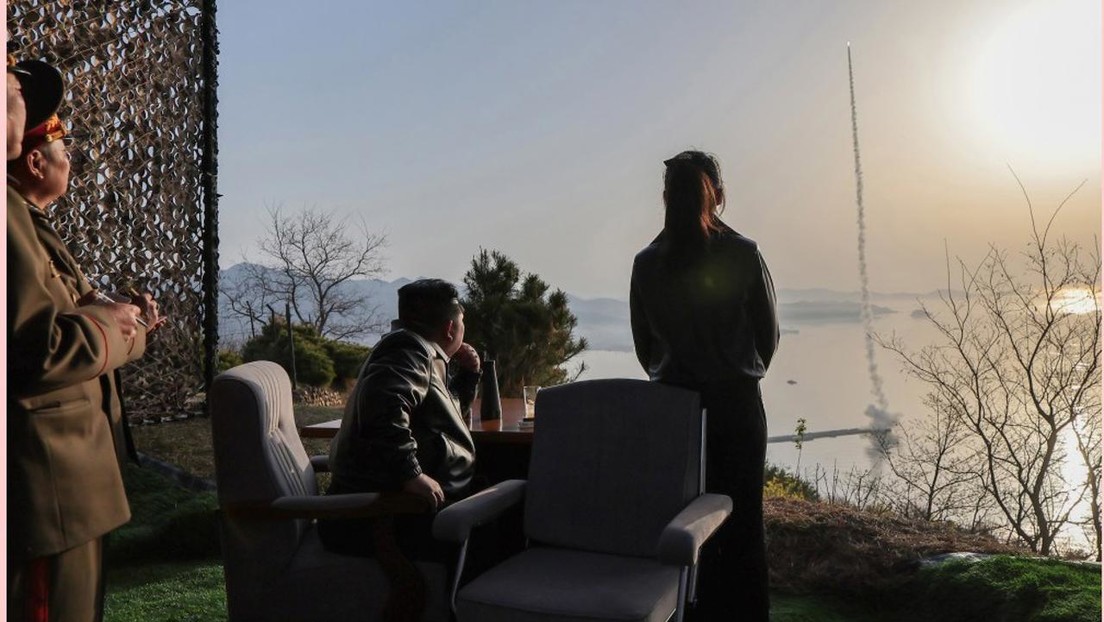
North Korean leader Kim Jong-un was recently photographed inspecting a ballistic missile launch alongside his young daughter, Kim Ju-ae, according to state media reports. The images, released by the Korean Central News Agency (KCNA), show the pair observing the test-firing of what analysts believe to be short-range ballistic missiles from a mobile launcher. The event underscores Kim’s continued emphasis on military modernization and the symbolic role his daughter plays in public appearances tied to the regime’s defense capabilities.
The photographs depict Kim Jong-un and Kim Ju-ae standing near a launch site, with the leader pointing toward the horizon as missiles ascend into the sky. State media described the launch as a successful demonstration of tactical nuclear capabilities, though independent verification of the missile types and ranges remains limited due to restricted access to North Korean military facilities. Such public engagements involving Kim Ju-ae have become increasingly frequent since her first confirmed appearance in late 2022, signaling a potential effort to normalize her presence in succession-related narratives.
According to KCNA, Kim expressed satisfaction with the results of the tests, stating that the missiles demonstrated “accurate and reliable” performance under simulated combat conditions. The agency reported that five projectiles were launched during the exercise, identified as Hwasongpho-11 Ra systems—a designation associated with North Korea’s solid-fuel, short-range ballistic missile arsenal. These missiles are designed for rapid deployment and are capable of carrying nuclear warheads, posing a direct threat to regional stability in Northeast Asia.
Independent analysts from the James Martin Center for Nonproliferation Studies (CNS) have noted that the Hwasongpho-11 Ra, also known by its foreign designation KN-23, shares technological similarities with Russia’s Iskander-M missile system. CNS research indicates that the KN-23 employs maneuverable re-entry vehicles to evade missile defense systems, increasing its effectiveness against potential targets in South Korea and Japan. The system’s solid-fuel propulsion allows for quicker launch preparation compared to liquid-fuel alternatives, reducing warning times for adversaries.
The launch comes amid heightened tensions on the Korean Peninsula, following a series of joint military exercises between the United States and South Korea that North Korea has repeatedly denounced as provocative. In response, Pyongyang has accelerated its weapons testing cadence, conducting over 90 missile launches in 2022 and 2023 combined—the highest annual total in its history. These actions have prompted condemnation from the United Nations Security Council, though enforcement of sanctions remains inconsistent due to geopolitical divisions among member states.
Kim Ju-ae, believed to be around 10 or 11 years old, has appeared alongside her father at multiple high-profile military events since late 2022, including inspections of missile units, submarine-launched ballistic missile (SLBM) tests, and nuclear facility visits. Her recurring presence has led international observers to speculate about her potential role in a future leadership succession, although North Korea has not officially designated her as an heir apparent. The regime maintains strict control over information regarding the Kim family’s internal dynamics, making definitive assessments difficult.
South Korea’s Joint Chiefs of Staff confirmed detecting the missile launches through its surveillance networks, stating that the projectiles traveled approximately 300 to 350 kilometers before landing in the waters off the country’s east coast. Official statements from the JCS emphasized that the launches violated multiple UN Security Council resolutions prohibiting North Korea from developing ballistic missile technology. Japan’s Ministry of Defense similarly reported tracking the missiles, noting their trajectory posed no immediate threat to Japanese territory but reaffirmed Tokyo’s commitment to strengthening its missile defense posture.
The timing of the launch coincides with ongoing diplomatic stalemates between North Korea and the United States over denuclearization talks, which have remained stalled since the collapse of the 2019 Hanoi summit between Kim Jong-un and former U.S. President Donald Trump. Despite intermittent outreach attempts, including letters exchanged between leaders, substantive negotiations have not resumed. Pyongyang continues to insist that its nuclear arsenal is non-negotiable, framing it as a deterrent against perceived hostility from Washington and its allies.
Human rights organizations have raised concerns about the implications of involving minors in military spectacles, arguing that such exposure may constitute psychological harm or indoctrination. Human Rights Watch has documented the pervasive militarization of North Korean society, where children are routinely exposed to propaganda glorifying the state’s armed forces and leadership. Even as no direct evidence suggests Kim Ju-ae is being groomed for a formal military role, her visibility in these contexts contributes to the cult of personality surrounding the Kim dynasty.
Experts at the Stimson Center have warned that normalizing children’s participation in military events could desensitize future generations to the realities of conflict and reinforce authoritarian narratives. Their analysis suggests that the regime may be using Kim Ju-ae’s presence to signal continuity and stability to both domestic and international audiences, particularly amid concerns over Kim Jong-un’s health and the lack of a clear succession plan.
As of now, You’ll see no publicly scheduled missile tests or military parades announced by North Korean state media. Yet, historical patterns indicate that Pyongyang often times major weapons demonstrations around significant political anniversaries, such as the founding of the Korean People’s Army (April 25) or the birthdays of past leaders (February 16 for Kim Jong-il, April 15 for Kim Il-sung). Observers recommend monitoring KCNA releases and satellite imagery from commercial providers like Planet Labs or Maxar Technologies for signs of increased activity at known missile facilities.
For readers seeking authoritative updates on developments related to North Korea’s missile program, official sources include the United Nations Panel of Experts reports on sanctions enforcement, periodic briefings from the U.S. Indo-Pacific Command, and analyses from the International Atomic Energy Agency (IAEA) regarding dual-use technologies. While direct access to North Korean military data remains impossible, open-source intelligence (OSINT) platforms such as 38 North and the Nuclear Threat Initiative (NTI) continue to provide valuable insights through remote sensing and defectors’ testimonies.
The intersection of family imagery and military prowess in North Korean state media serves as a deliberate narrative tool—one that blends dynastic legitimacy with technological ambition. As Kim Jong-un continues to prioritize military advancement amid economic hardship and international isolation, the public role of his daughter may evolve beyond symbolism into a more consequential position within the regime’s long-term survival strategy. Whether this trajectory leads to formal institutionalization remains uncertain, but each appearance reinforces the message that the Kim lineage intends to endure.
What do you suppose about the growing visibility of Kim Ju-ae in North Korea’s military displays? Share your perspective in the comments below, and help spread awareness by sharing this article with others interested in global security and leadership dynamics.
Related reading