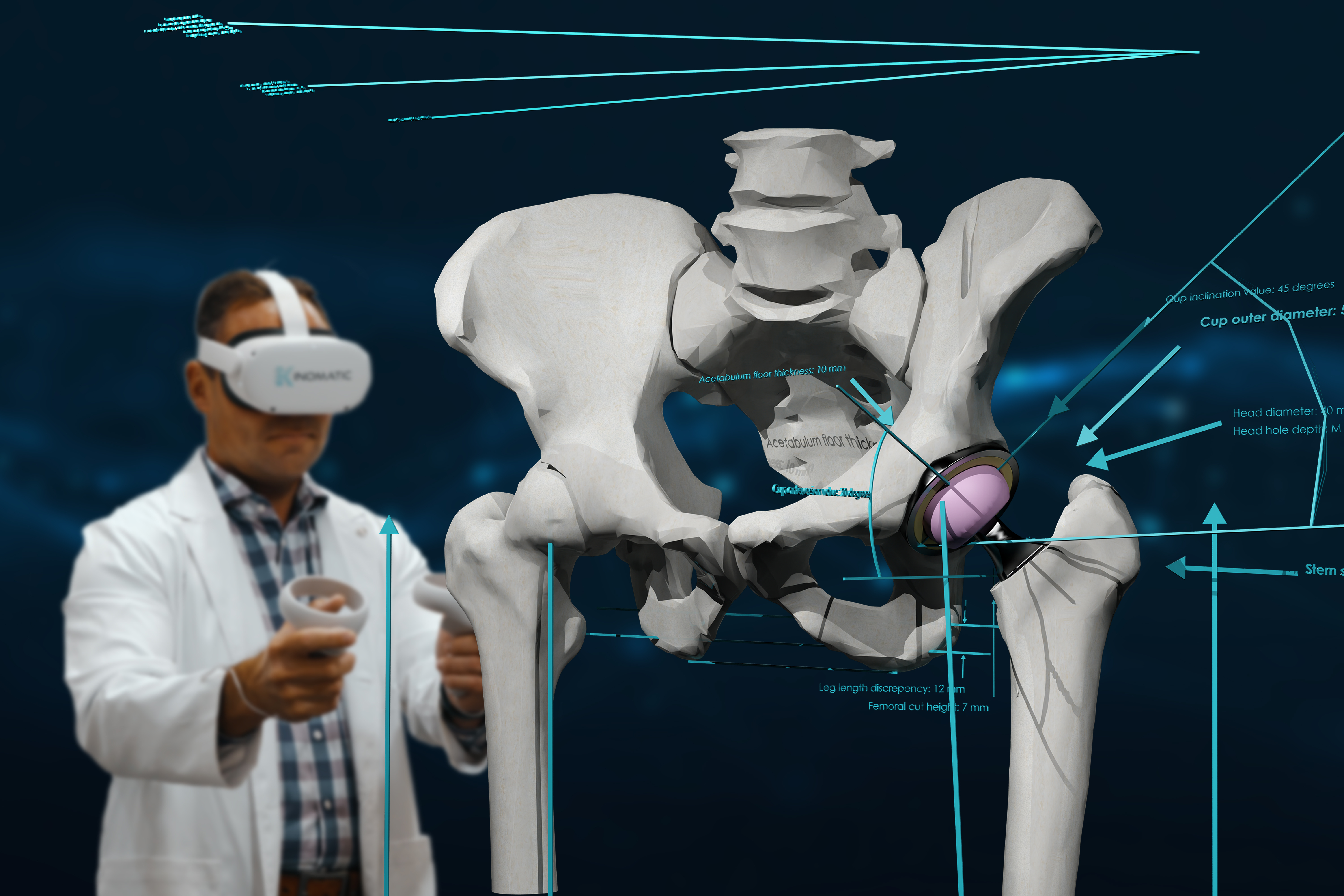
Kinomatic, an orthopedic technology firm based in Arroyo Grande, California, has secured $4 million in seed funding to scale its AI-enabled surgical planning and virtual reality (VR) simulation platform. The financing round was led by Waterline Ventures, a healthcare-focused venture capital firm, and will support the company’s expansion of its engineering team and the establishment of a new centralized headquarters, according to recent corporate announcements.
The company, which specializes in personalized orthopedic surgery, intends to use the capital to accelerate the development of its cloud-native software. The platform is designed to replace traditional, two-dimensional surgical planning with three-dimensional, data-driven modeling. By leveraging high-resolution CT scan data, the system aims to reduce the reliance on generic, one-size-fits-all implant configurations that have long characterized joint replacement procedures.
Addressing the Clinical Paradox in Joint Replacement
Despite significant advancements in surgical robotics and the durability of implant materials, the fundamental approach to mapping orthopedic procedures has remained largely analog for decades. Surgeons have traditionally relied on standard, population-wide alignment parameters, a practice that can fail to account for the unique biomechanical requirements of individual patients. This gap between advanced hardware and static planning often leads to suboptimal outcomes, including prolonged recovery times and potential implant wear.
Kinomatic’s platform seeks to bridge this divide by processing over two million data points and more than 1,000 unique anatomical measurements per patient. By comparing this data against a digital inventory of over 30,000 possible implant configurations, the software identifies the precise size and placement angle required to mirror a patient’s natural joint mechanics. This level of precision is intended to minimize micro-motion and structural wear, which are critical factors in the 20- to 30-year lifecycle of a hip or knee replacement.
Integration of VR for Surgical Rehearsal
A central component of the Kinomatic workflow is its virtual reality simulation workspace, which allows surgical teams to conduct a pre-operative rehearsal. By virtually entering a 3D model of a patient’s skeletal structure, surgeons can practice specific bone cuts and evaluate implant balancing before the patient enters the operating room. This simulation-based approach is intended to increase the velocity and accuracy of procedures, effectively reducing the time a patient spends under anesthesia.

The addition of Dr. Andrew B. Wickline, a well-known orthopedic specialist and advocate for opioid-reduction in surgical recovery, as Chief Medical Officer, marks a significant shift in the company’s leadership. Dr. Wickline’s clinical focus on optimizing patient outcomes aligns with the company’s goal of reducing the need for post-operative narcotics by improving the mechanical success of the initial procedure.
Commercial Growth and Future Outlook
Kinomatic has reported significant commercial momentum, documenting a seven-fold increase in revenue over the past four years and a five-fold expansion in its regional provider networks. The company also maintains a Net Promoter Score (NPS) of 85, a metric used to gauge patient and provider satisfaction, according to company-provided data. This growth reflects a broader industry trend where healthcare systems are increasingly seeking data-driven, integrated platforms to manage care from the pre-operative phase through to long-term recovery.

As the company prepares to scale its operations, the focus remains on integrating these digital workflows into the standard orthopedic practice. The next phase of the company’s development will involve scaling its engineering infrastructure to support the increased demand for its AI-native platform. Further updates on the company’s operational expansion and the deployment of its VR suite in additional clinical settings are expected as the firm utilizes its new funding to grow its footprint in the orthopedic market.
Readers interested in the evolution of orthopedic surgical technology and the integration of AI in clinical settings are encouraged to follow official company announcements for updates on future product releases and clinical research findings.
Worth a look
- How Obesity May Lead to Alzheimer’s: New Study Reveals the Fatal Link Between Fat Molecules and Brain Decay
- The Distinguished Academic Legacy of a Global Scholar: Honors and Awards
- Gravity g0.0 PDRN Hair Recovery Shampoo: KAIST-Developed Anti-Hair Loss & Volume Solution (archynewsy.com)
- Birkenstock Raises Annual Sales Forecast Following Strong Quarterly Revenue (newsdirectory3.com)