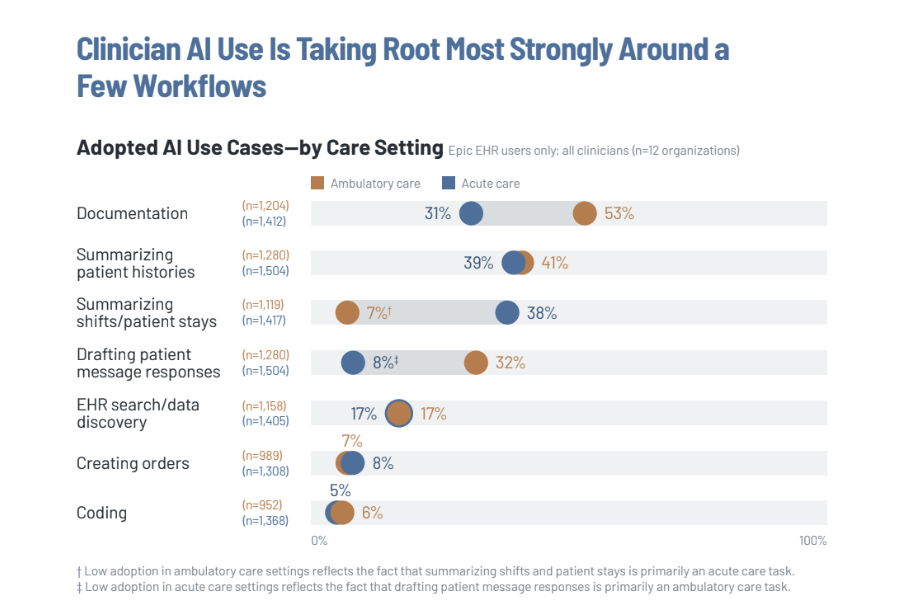
Clinicians who integrate artificial intelligence into their electronic health record (EHR) workflows report a Net EHR Experience Score (NEES) of 72.2, significantly outperforming the 64.9 score of their non-using peers, according to the KLAS Arch Collaborative 2026 report. While AI adoption correlates with higher operational efficiency, data from 12 Epic-backed organizations suggests that the benefits of automation peak when clinicians use four or fewer tools; exceeding this threshold introduces digital noise that diminishes overall productivity. The findings highlight a critical need for role-specific training, as less than 25% of clinicians currently feel adequately prepared to manage AI-generated content within their daily clinical responsibilities.
Health systems, grappling with unprecedented burnout and staffing shortages, have prioritized AI as a primary capital investment. However, the data indicates that simply deploying these tools is insufficient. We are currently at an operational crossroads where the focus must shift from broad technological availability to the strategic, role-specific enablement of our workforce.
The Four-Tool Saturation Limit and the Training Deficit
The Arch Collaborative dataset reveals a counterintuitive ceiling for digital transformation. Clinicians who adopt up to four individual AI applications see a reliable increase in their satisfaction and efficiency scores. Beyond this point, however, the return on investment plateaus. The small cohort of users attempting to juggle five or more automated tools reports no incremental improvement in their EHR experience, suggesting that “stacking” applications can lead to cognitive overload rather than streamlined care.
This saturation is exacerbated by a pronounced training deficit across the industry. Although hospital leadership remains optimistic about the potential of automated workflows, the frontline workforce frequently lacks the necessary guidance to integrate these tools safely. With adequate EHR training historically linked to a 20-point improvement in system satisfaction, the fact that fewer than 25% of clinicians feel properly trained to validate AI outputs represents a significant barrier to long-term digital adoption.
Role-Specific Workflow Optimization
A “one-size-fits-all” approach to automation is likely to fail, as different clinical roles face distinct administrative hurdles. The KLAS report underscores that effective AI deployment requires targeting the specific pain points of different healthcare professionals. Physicians and advanced practice providers (APPs), for example, prioritize tools that alleviate the burden of documentation, with 71% of physicians and 61% of APPs utilizing ambient visit-note drafting to manage clerical tasks.
In contrast, nursing staff utilize AI primarily for shift and patient-stay summaries, a priority for 30% of nurses who must maintain accurate records during high-volume handoffs. Meanwhile, allied health professionals increasingly rely on automated tools for semantic data discovery, with nearly half of these users leveraging AI to generate patient-history summaries. By aligning automation with these unique workflow requirements, health systems can move beyond generic tool implementation to achieve measurable efficiency gains.
Measuring Efficiency Gains
The most substantial improvements in perceived EHR efficiency are not necessarily found in general documentation tools, but in specific, high-frequency operational tasks. According to the report, clinicians who utilize automation for order creation report a 9% improvement in efficiency, while those using AI for patient-stay summaries and EHR data discovery report gains of 6% and 5%, respectively. These metrics demonstrate that the most effective AI strategies are those that “weaponize” automation against the most repetitive, time-consuming administrative tasks.
For health systems, the path forward requires a more rigorous feedback loop. Informatics leaders are encouraged to monitor how specific tools impact the day-to-day work of clinicians, ensuring that new software serves as a bridge to better patient care rather than an additional layer of digital clutter. As organizations evaluate their 2026 digital health roadmaps, the focus must remain on sustainability—ensuring that the workforce is not just equipped with new technology, but empowered by it through structured education and intentional workflow design.
For ongoing updates on healthcare technology performance and clinical experience benchmarks, health systems and practitioners can monitor future releases from the Arch Collaborative. I invite readers to share their own experiences with AI implementation in their clinical settings in the comments below.
Keep reading