The field of pathology is undergoing a quiet revolution, driven by the increasing adoption of digital technologies. For decades, pathologists have relied on microscopes and glass slides to diagnose disease. Now, a growing number of US hospitals are investing in digital pathology systems – a shift fueled by recent regulatory approvals, evolving reimbursement models, and a desire for improved efficiency and diagnostic accuracy. However, the transition isn’t without its challenges, as hospitals navigate a complex landscape of vendors and technologies, with satisfaction levels varying significantly.
Digital pathology involves scanning glass slides into high-resolution digital images that can be viewed, analyzed, and shared remotely. This technology offers numerous potential benefits, including faster turnaround times, improved collaboration among pathologists, and the ability to leverage artificial intelligence (AI) for more precise diagnoses. While the concept has been around for some time, widespread adoption has been hampered by factors such as the high cost of equipment, the need for robust IT infrastructure, and concerns about image quality and regulatory approval. The current surge in interest, however, suggests that these hurdles are beginning to be overcome. The US digital pathology market is rapidly growing, but remains in its early stages, with fewer than 15% of US healthcare organizations having selected a digital pathology vendor, according to a recent report by KLAS Research.
The move towards digitization is also being driven by the increasing demand for subspecialty expertise. Digital slides can be easily shared with specialists located anywhere in the world, enabling faster and more accurate diagnoses, particularly in complex cases. What we have is especially vital in rural areas where access to specialized pathology services may be limited. Digital pathology facilitates the integration of AI-powered tools, which can assist pathologists in identifying subtle patterns and anomalies that might be missed by the human eye. This integration is becoming a key requirement for hospitals evaluating digital pathology solutions.
The Image Management System Landscape: Specialists vs. Generalists
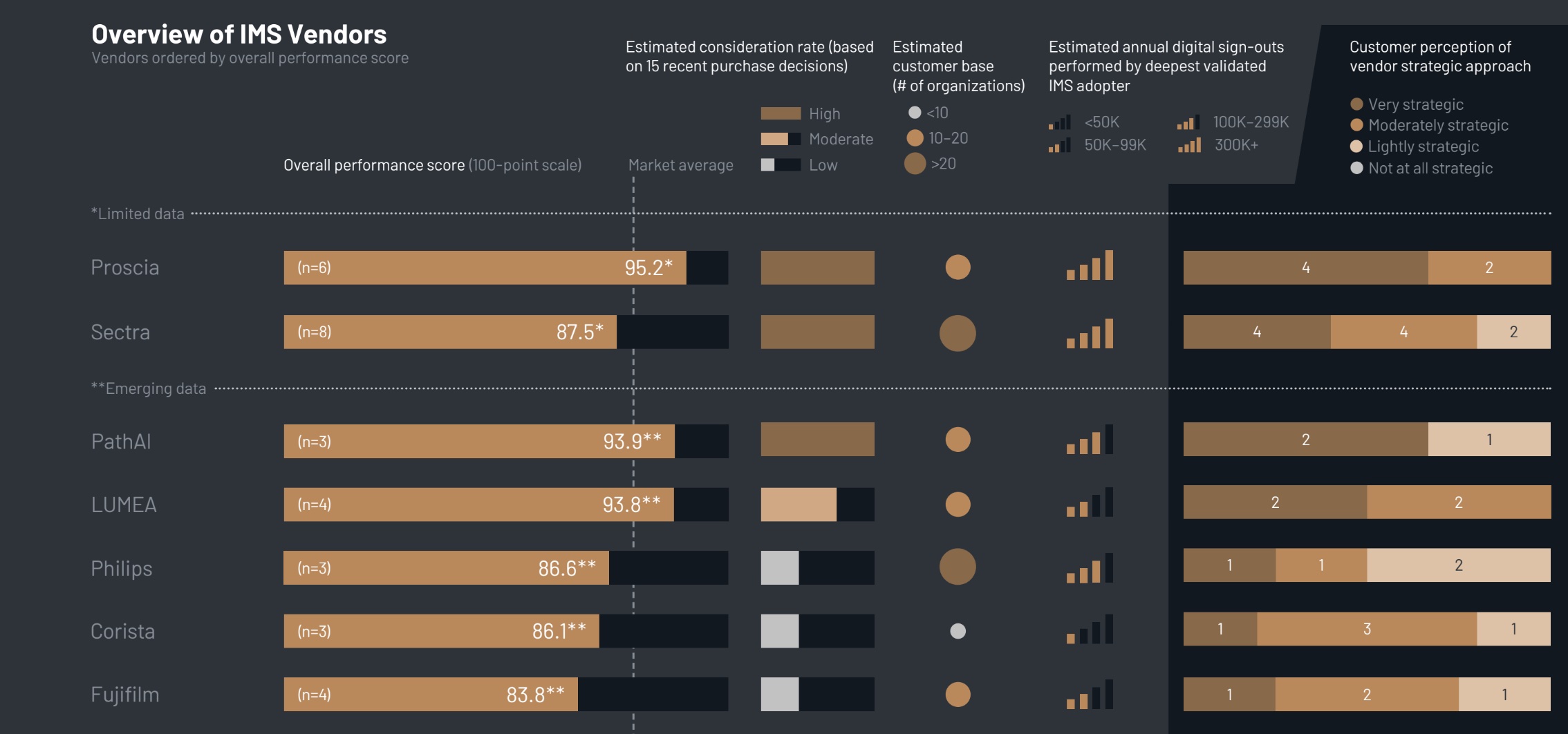
At the heart of any digital pathology system lies the Image Management System (IMS), the software responsible for storing, managing, and displaying digital slides. The IMS market is currently characterized by a divide between vendors with roots in traditional radiology and those built specifically for pathology. According to KLAS Research, pathology-specific vendors are currently leading in customer satisfaction. These specialized companies, such as Proscia, PathAI, and LUMEA, are praised for their purpose-built platforms and strategic guidance, offering a more tailored approach to the unique needs of pathologists.
Proscia consistently ranks as a top contender, with customers highlighting their collaborative and education-focused approach. PathAI is gaining traction with its proactive communication, hands-on integration efforts, and visible executive engagement. LUMEA receives positive feedback for its user-friendly interface and strategic support in adapting workflows to individual customer needs. While established imaging vendors like Sectra, Philips, and Fujifilm continue to grow, some customers report limited post-go-live engagement, particularly regarding AI interoperability. As organizations mature in their digital pathology journey, they are increasingly demanding proactive guidance and seamless integration with AI tools.
Scanning at Scale: Leica Biosystems Leads the Hardware Market
High-quality scanning is crucial for successful digital pathology implementation. In the scanner hardware market, Leica Biosystems currently dominates, with its Aperio GT 450 DX scanner being the most widely adopted for clinical use in the US. Customers consistently praise the scanner’s high-quality images, efficient slide loading, strong throughput, and day-to-day reliability, citing these features as significant productivity drivers. Leica Biosystems was also among the first to receive FDA clearance for a digital pathology slide scanner for primary diagnostic use in 2017, solidifying its position as a pioneer in the field. Philips has also established itself as a key player, having helped over 300 customers transition to fully digital workflows.
However, not all vendors are experiencing the same level of success. Customers of Roche scanners have reported significant challenges with reliability and throughput, disrupting high-volume workflows. These issues echo concerns raised in global research, highlighting the importance of selecting a scanner that can consistently deliver high-quality images and handle the demands of a busy pathology lab.
The Rise of AI in Digital Pathology: Seamless Integration is Key
The true potential of digital pathology lies in its ability to unlock the power of artificial intelligence. Hospitals are increasingly evaluating AI algorithms for clinical use, with a particular focus on breast and prostate cancer applications. These algorithms can assist pathologists in tasks such as identifying cancerous cells, quantifying biomarkers, and predicting treatment response. For example, there is growing interest in breast cancer applications that support biomarker assessment, including Ki-67, HER2, estrogen receptor (ER), and progesterone receptor (PR).
Leading AI developers currently being considered include Ibex, Visiopharm, Paige.ai, and PathAI. However, a critical requirement for these AI tools is seamless integration into the existing IMS workflow. Hospitals are seeking solutions that function as a natural extension of their current processes, rather than requiring pathologists to log into separate, disconnected systems. This emphasis on integration reflects a growing understanding that AI is most effective when We see embedded within the clinical workflow, providing real-time insights and support to pathologists.
Key Takeaways
- Digital pathology adoption in the US is growing, but remains in the early stages, with less than 15% of organizations having selected a vendor.
- Pathology-specific IMS vendors (Proscia, PathAI, LUMEA) are currently outperforming traditional radiology vendors in customer satisfaction.
- Leica Biosystems is the dominant player in the scanner hardware market, known for its reliability and image quality.
- Seamless integration of AI into the IMS workflow is a critical requirement for hospitals evaluating digital pathology solutions.
As digital pathology continues to evolve, we can expect to see further innovation in both hardware and software. The development of more sophisticated AI algorithms, coupled with improved scanning technologies and more user-friendly IMS platforms, will undoubtedly drive wider adoption and unlock the full potential of this transformative technology. The KLAS Research report will be updated again in 2024, providing further insights into the evolving digital pathology landscape. For healthcare professionals interested in learning more about digital pathology, resources are available through the Johns Hopkins Department of Pathology.
What are your thoughts on the future of digital pathology? Share your comments below, and let’s continue the conversation.
Related reading