
The CN Tower, an enduring icon of the Toronto skyline, officially marks its 50th anniversary this year, celebrating five decades as a marvel of Canadian engineering and a centerpiece of global tourism. Originally constructed by Canadian National Railway, the tower held the title of the world’s tallest free-standing structure for 32 years, from its completion in 1976 until the Burj Khalifa surpassed it in 2008, according to official records from the CN Tower management.
Standing at a height of 553.33 meters, the structure serves as a primary telecommunications hub and a major cultural landmark. Since opening to the public on June 26, 1976, the tower has welcomed millions of visitors to its observation decks, maintaining its status as one of Canada’s most recognizable architectural achievements. The anniversary serves as a retrospective of the tower’s evolution from a functional radio relay necessity to a high-tech entertainment destination.
Engineering a Landmark: The Origins of the CN Tower
The decision to build the CN Tower was driven by a practical need for reliable telecommunications in a rapidly growing Toronto. In the 1960s, the city’s skyline was expanding, and traditional low-rise radio antennas were increasingly obstructed by new high-rise developments. Canadian National Railway proposed a massive tower that would solve signal interference issues while demonstrating Canadian engineering prowess, as noted by the Canadian Encyclopedia.
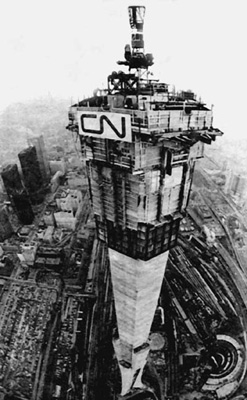
Construction began in February 1973. The project required a workforce of 1,537 people working 24 hours a day, five days a week, for 40 months. The concrete shaft was poured using a self-climbing slipform system, a state-of-the-art technique at the time that allowed the structure to rise continuously. When it was topped off in 1975, it secured its place in history as the tallest structure in the world, a record it held until the completion of Dubai’s Burj Khalifa in 2008, as verified by Guinness World Records.
Technological Evolution and Modernization
While the tower remains a feat of concrete and steel, its internal technology has undergone significant upgrades to keep pace with the digital age. Beyond its role as a broadcast transmitter for television and radio signals, the tower has integrated advanced LED lighting systems that allow for dynamic, programmable light shows visible across the city. These systems have transformed the tower into a canvas for public art and commemorative displays during major national events.

The visitor experience has also been modernized with high-speed glass-fronted elevators and the integration of interactive exhibits. The EdgeWalk, introduced in 2011, allows visitors to walk hands-free on a 1.5-meter-wide ledge encircling the top of the tower’s main pod, 356 meters above the ground. This addition shifted the tower’s utility from a passive observation point to an active, high-adrenaline adventure site, managed under strict safety protocols supervised by provincial regulators.
The CN Tower in the Global Landscape
The CN Tower continues to function as a vital component of Toronto’s infrastructure. It supports the transmission needs of numerous broadcasters and emergency services, ensuring that the city’s communications remain robust. According to data provided by the City of Toronto, the tower remains a primary engine for regional tourism, contributing significantly to the local economy by drawing international visitors who seek to experience one of the world’s great urban vistas.
As the tower enters its next half-century, its focus has shifted toward sustainability and accessibility. Recent renovations have focused on improving energy efficiency, particularly in the lighting and climate control systems of the observation pods. The tower remains under the ownership of Canada Lands Company, a federal crown corporation, which oversees the ongoing maintenance and public programming for the site.
Key Milestones in the Tower’s History
- 1973: Construction officially commences in February to address urban telecommunications challenges.
- 1976: The tower opens to the public on June 26, claiming the title of the world’s tallest free-standing structure.
- 1995: The American Society of Civil Engineers names the CN Tower one of the Seven Wonders of the Modern World.
- 2008: The Burj Khalifa surpasses the CN Tower in height, ending its 32-year reign as the world’s tallest structure.
- 2011: The EdgeWalk attraction opens, providing a new way for visitors to interact with the structure at extreme heights.
Looking ahead, the next scheduled milestone for the site involves continued infrastructure assessments to ensure the longevity of the concrete shaft, which is inspected annually by independent structural engineers to meet building code standards. Readers interested in visiting or learning more about the ongoing 50th-anniversary exhibitions can find official updates and ticket information on the official CN Tower portal. We invite you to share your memories of visiting the tower in the comments section below.
Keep reading