Los Angeles police Officer Daniel Flores faces 16 felony counts following a court arraignment where he pleaded not guilty to charges tied to secretly recording colleagues making derogatory comments, according to reporting from ArcaMax.
The criminal charges stem from secret audio recordings captured by Flores, which reportedly feature officers in an internal unit making racist, homophobic, and misogynistic remarks. While Los Angeles County District Attorney Nathan Hochman asserted that recording colleagues violated the law regardless of intent, legal experts warn that prosecuting a whistleblower so harshly sends a message across the department regarding the blue wall of silence.
According to ArcaMax coverage, Flores was arraigned on felony charges that could lock him up in state prison for 13 years. Prior to the court appearance, District Attorney Nathan Hochman filed a summary of the case that critics argue attempted to characterize Flores as a money-grubber with a plan to sue taxpayers into a retirement rather than intending to expose misconduct. At the same time, the filing drew scrutiny for offering what observers described as a defense of the ugly commentary of the recorded officers.
The recorded conversations reportedly include severe slurs and degrading language directed at Black individuals, women, Asian people, Hispanic people, and individuals with disabilities. Despite agreement between prosecutors and critics that the underlying commentary is deplorable and unacceptable, legal experts diverge on how the district attorney chose to exercise prosecutorial discretion.
“The message to everyone in the police department is keep your mouth shut,” said David A. Harris, a law professor at the University of Pittsburgh and an expert on police misconduct, as reported by ArcaMax. Harris noted that officers attempting to stand up for principle or department policy now face risks to their careers, well-being, and freedom.
Legal Scholars Weigh In on Prosecutorial Discretion and Whistleblower Rights
The decision to pursue felony charges against a police whistleblower has drawn commentary from legal figures. Critics argue that prosecutors should weigh the benefit of exposing misconduct against violations of the law, utilizing discretion to address the underlying behavior rather than penalizing the source.
Erwin Chemerinsky, dean of UC Berkeley’s law school and an investigator of LAPD culture following the Rampart scandal in 2000, addressed the balance of the case in statements reported by ArcaMax. “On one hand, being a whistleblower doesn’t give a person the right to violate the law,” Chemerinsky said.
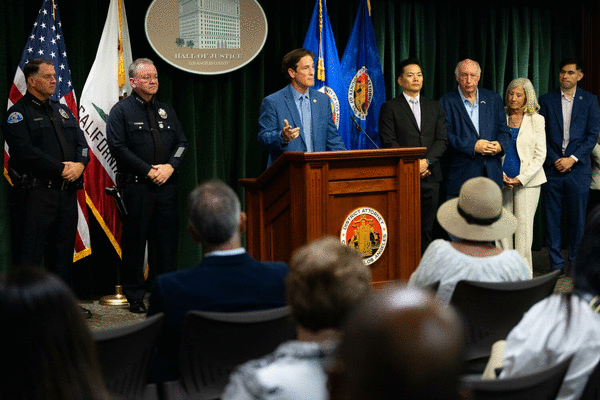
District Attorney Nathan Hochman defended the prosecution in an interview reported by ArcaMax, emphasizing that law enforcement officers are not above the law. Hochman reiterated that the deplorable nature of the comments made by the recorded officers warrants punishment, even as his office proceeds with the criminal case against Flores.
Implications for LAPD Recruitment and Department Culture
The controversy centers on the specific unit involved in the recordings, which is charged with recruiting the officers of the future. Analysts point out that if personnel charged with recruiting new officers casually engage in hateful comments, trust in their judgment on hiring is undermined.
By focusing criminal penalties on the officer who brought the internal culture to light, the prosecution risks reinforcing institutional secrecy. Observers warn that officers witnessing unprofessionalism or bigotry will now hesitate to report violations, fearing risks to their careers and freedom.
As the legal proceedings continue following Flores’ not-guilty plea, the case is being monitored for its impact on internal reporting of police misconduct within Los Angeles law enforcement.