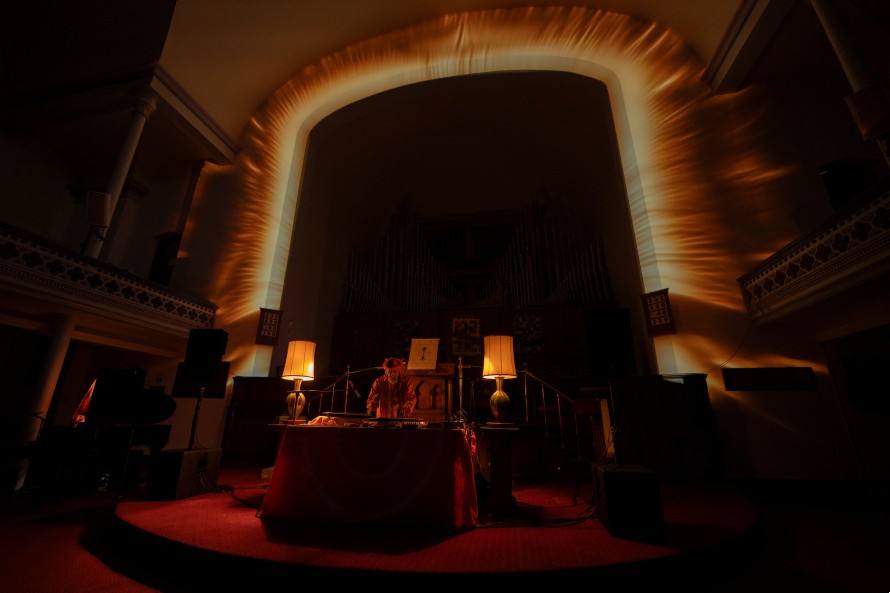
In the hallowed, echoing expanse of a 120-year-old Gothic cathedral, a unique intersection of spirituality and sound unfolded as the Brooklyn-based collective Ambient Church made its Canadian debut. The event, which served as a cornerstone of a trio of concerts across Ontario and Quebec, brought the visionary Philadelphia new-age minimalist Laraaji to Ottawa for a performance that transcended traditional concert boundaries. On the evening of April 11, 2026, the atmosphere at Centretown United Church was one of expectant stillness, as a diverse cross-section of the city’s most open-minded communities gathered to experience a master of ambient experimentalism at Centretown United Church.
The evening was not merely a musical recital but a curated spiritual experience. Before the first note was struck, Ambient Church founder Brian Sweeney welcomed the audience, sharing his affection for Canada and grounding the room through a series of guided breathing exercises. This preparation set the stage for a 90-minute journey that sought to awaken the “consciously unconscious,” blending the sacred architecture of the church with the boundary-pushing sounds of a musician who has spent decades exploring the limits of sound and silence.
Laraaji, born Edward Larry Gordon in Philadelphia in 1943, has long been a central figure in the ambient and spiritual music scenes as a visionary musician and spiritual guide. His presence in Ottawa was a testament to the enduring appeal of devotional music in sacred spaces, a mission that Ambient Church has championed for a decade. By pairing Laraaji’s ethereal compositions with the cavernous acoustics of the cathedral, the event transformed a religious site into a sanctuary of sonic meditation.
A Multisensory Approach to Devotional Music
Dressed in flowing red robes and a matching beret, the 82-year-old musician began the performance with a ritualistic opening, gently tolling Tingsha cymbals to christen the space. This transition into the musical set was seamless, as Laraaji turned to his iconic modified autoharp and zither. To create a layered, organic atmosphere, he utilized a pulsating backdrop recording of amphibians and insects, allowing the natural sounds of the wild to reverberate through the cathedral’s stone walls. The result was a meditative wash of sound that left the audience divided between those who closed their eyes in deep absorption and those who remained transfixed by his physical movements.
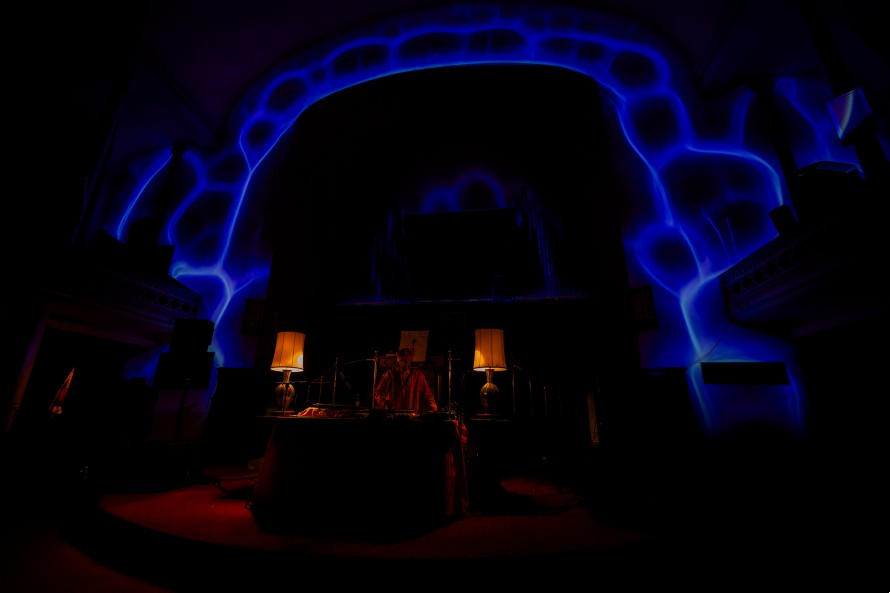
The visual elements of the performance were as carefully considered as the audio. Fire-flickering projections sparked across the pulpit’s chancel, adding a primal, flickering energy to the serene music. This juxtaposition of the ancient and the electronic defined much of the evening. Laraaji explored the full range of his string-and-electronics setup, employing a hand pedal to bend notes and strategically dropping the volume to highlight the tactile, intimate pluck of the autoharp.
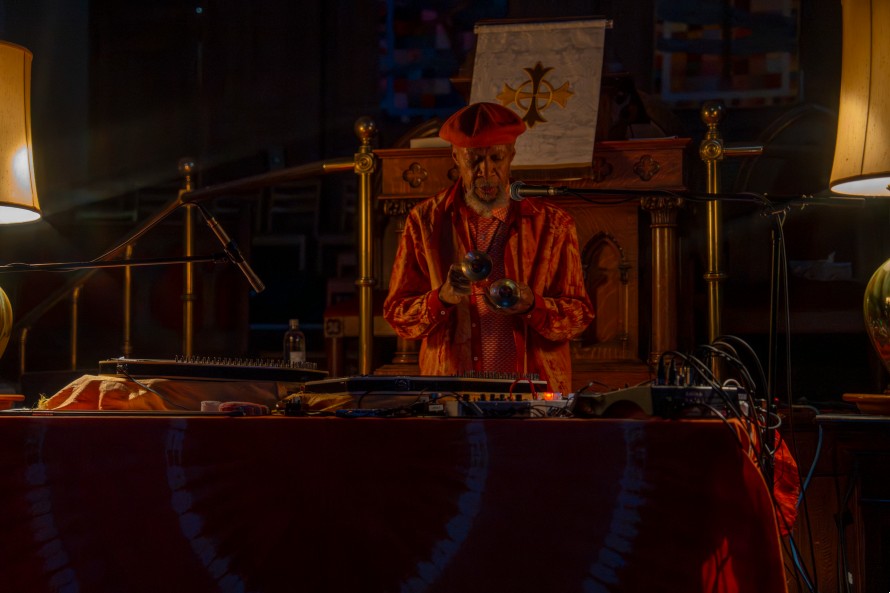
Further expanding the sonic palette, Laraaji draped a kerchief over his zither to produce soft, muted rhythms using metal brushes. He then layered in bright, music-box tones by looping a pair of kalimbas, creating a complex tapestry of sound that felt both ancient and futuristic. This approach to experimentalism is a hallmark of his work, earning him early accolades from pioneers like Brian Eno as a collaborator of Brian Eno.
Bridging the Gap Between Experimentalism and Intimacy
As the performance progressed, Laraaji steered the energy toward a fervent rhythmic breakdown, a sequence so intense it seemed to physically awaken the attendees. He then guided the room toward a gradual denouement, utilizing an EBow and a traditional bow across his electrified zither and autoharp to create sustained, ethereal drones that filled every corner of the Gothic space.
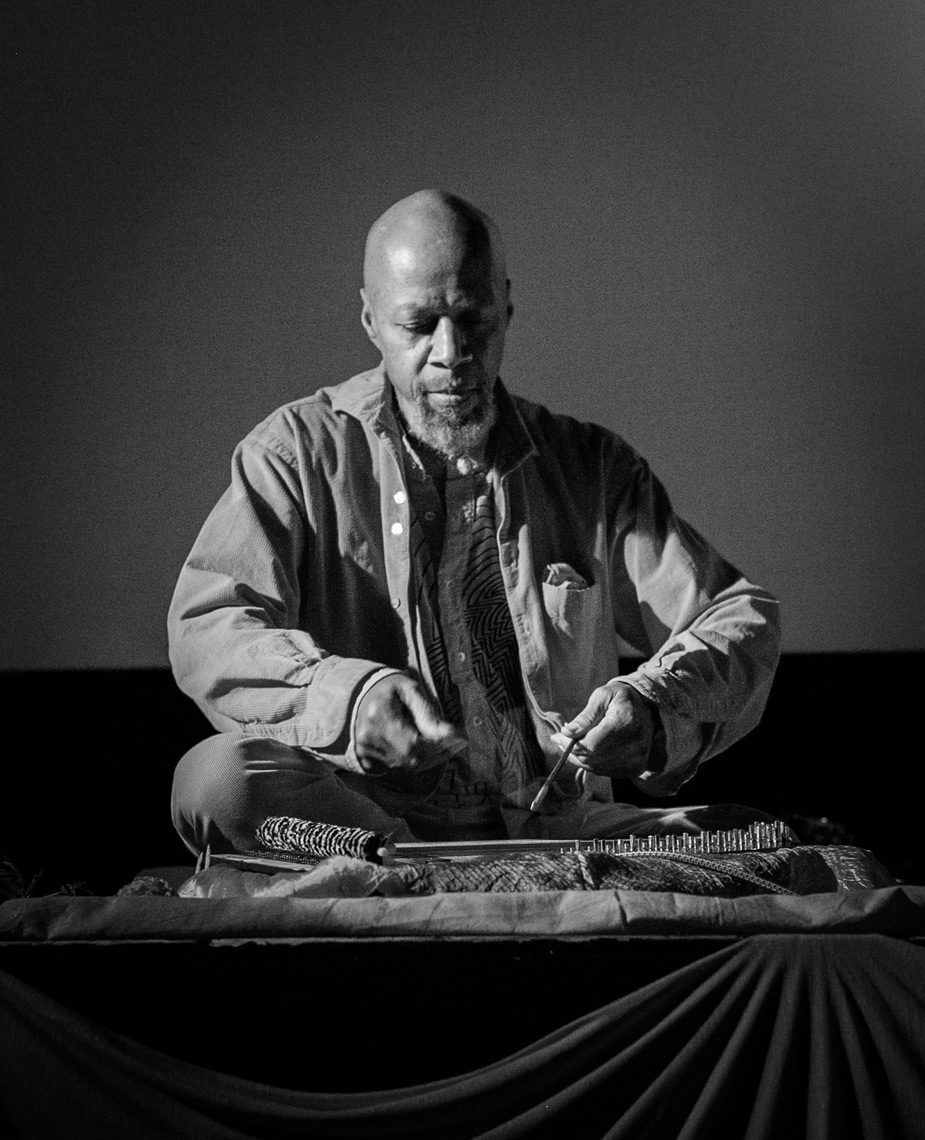
Despite the high level of technicality and the meditative tone, the evening was punctuated by moments of genuine human connection. Laraaji incorporated vocalizations that spanned a wide emotional spectrum, from deep tranquility to spontaneous laughter. In a moment that broke the “fourth wall” of the performance, a patch cord produced a loud, unintended thunking noise. Rather than allowing the moment to disrupt the flow, Laraaji playfully addressed the crowd, saying, “You didn’t hear that,” evoking a shared sense of intimacy and warmth among the audience.
The performance then shifted in scale as Laraaji moved to a baby grand piano. For 20 minutes, he delivered a set characterized by sweeping glissandos and expressive vocalizations, demonstrating his versatility as a musician and his ability to command different sonic environments within a single show.
The Spiritual Resonance of the Peace Garden
The culmination of the evening saw Laraaji return to his primary setup for a poignant closing. He performed a spoken word piece, reciting the lines, “I walked in the peace garden / The light was everywhere…” against an electronic-tinged backdrop. This final movement tied together the themes of nature, light, and inner peace that had permeated the entire concert.
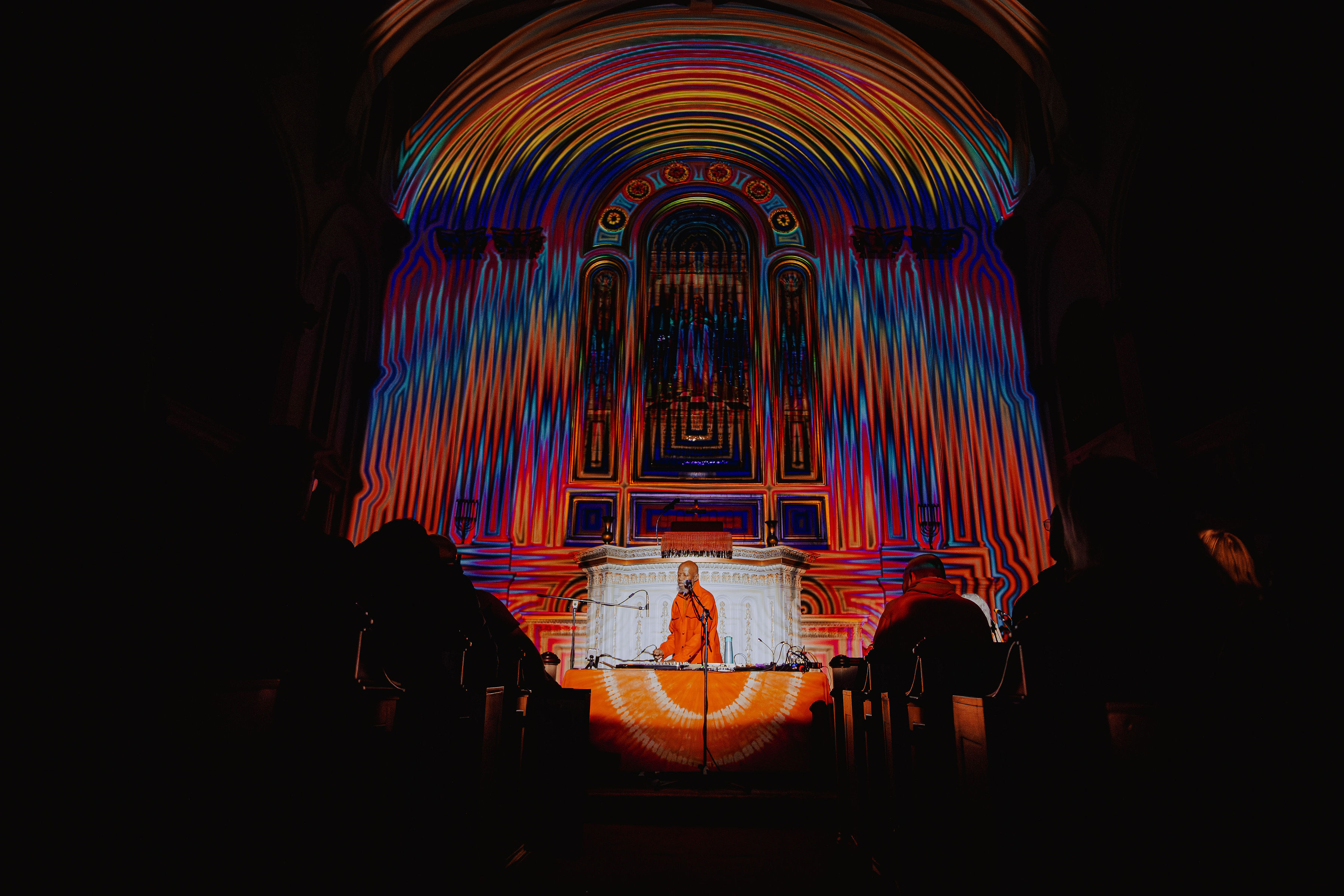
As the 90-minute performance reached its conclusion, the room erupted in a standing ovation. Laraaji absorbed the adoration with his arms outstretched, his body quaking with an animated energy that belied his age. The event succeeded in transforming a boundary-pushing, experimental performance into something that felt, for many in attendance, truly divine.
Key Elements of the Laraaji Ottawa Performance
| Element | Detail |
|---|---|
| Date | April 11, 2026 |
| Venue | Centretown United Church, Ottawa |
| Primary Instruments | Modified autoharp, zither, baby grand piano, kalimbas |
| Duration | 90 minutes |
| Organizer | Ambient Church (Brooklyn-based collective) |
The success of this Canadian debut underscores the growing appetite for music that functions as a meditative practice. By utilizing sacred spaces and ancient instruments modified for the modern era, Ambient Church and Laraaji have created a blueprint for how contemporary art can engage with spirituality and mindfulness in a public setting.
For those following the work of Ambient Church, this series of concerts marks a significant expansion of their reach beyond New York. The collective continues to present devotional music in sacred spaces, building on a legacy that includes past performances by artists such as Suzanne Ciani, William Basinski, and Weyes Blood.
As the tour continues through Ontario and Quebec, the echoes of the “peace garden” remain a poignant reminder of the power of ambient music to create a shared space of tranquility in an often chaotic world. Further updates on Ambient Church’s upcoming sacred space presentations are typically shared through their official collective channels.
Do you believe sacred spaces enhance the experience of experimental music? Share your thoughts in the comments below or share this article with fellow music enthusiasts.