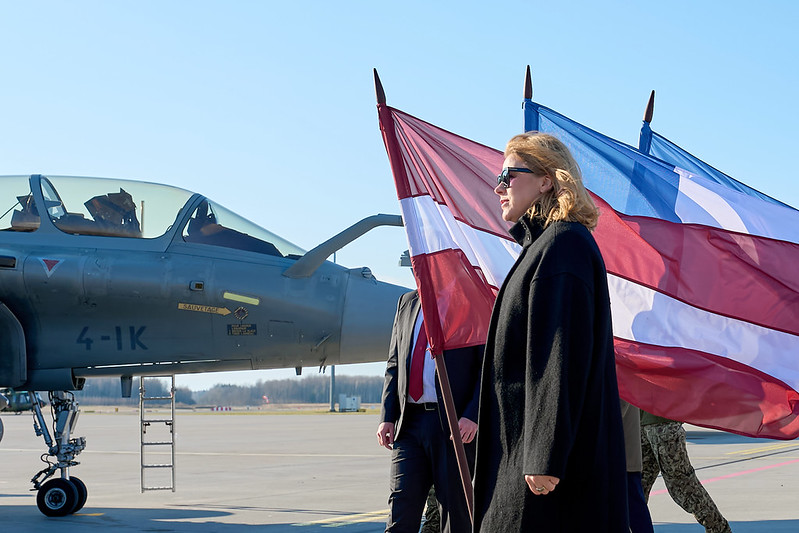
Two French Rafale fighter jets in Latvia arrived at the Lielvārde military base on Tuesday, April 14, 2026, as part of a strategic effort to demonstrate NATO’s continued presence and commitment to security in the region. The arrival was marked by a high-level welcoming ceremony attended by Prime Minister Evika Siliņa and senior military leadership, signaling the importance of the alliance’s rotational air defense capabilities in the Baltic states.
These aircraft, which had previously been stationed at the Šiauliai air base in Lithuania, have now transitioned to Lielvārde to maintain the vigilance of the NATO Baltic Air Policing mission. The deployment serves as a visible deterrent and a reinforcement of the collective defense mechanisms that have protected the airspace of Latvia, Lithuania, and Estonia for over two decades.
The event brought together a significant diplomatic and military contingent. Joining Prime Minister Siliņa were Major General Kaspars Pudāns, the Commander of the National Armed Forces, and Manuel Lafons Rapnuijs, the French Ambassador to Latvia. The ceremony too included various NATO ambassadors, defense attachés, and the leadership of the Latvian Air Force according to reports from the Ministry of Defence.
The NATO Baltic Air Policing Rotation
The arrival of the Dassault Rafale jets is part of a broader shift in NATO’s regional posture. On April 1, 2026, France and Romania officially replaced the Spanish Air Force contingent in the primary air policing mission based out of Šiauliai, Lithuania as confirmed by regional news sources. This rotation ensures that the burden of airspace surveillance is shared among alliance members while maintaining a constant state of readiness.
The current rotation involves a diverse array of advanced aircraft. The French contingent is operating with four Dassault Rafale fighter jets, while Romania has deployed six F-16 Fighting Falcon jets to the Šiauliai base. These assets replace the F-18 Hornet aircraft previously utilized by Spain during their tenure in the mission.
Support Operations at Ämari Base
While the primary patrolling is centered in Lithuania and now supplemented in Latvia, the support mission remains critical. At the Ämari air base in Estonia, the Portuguese contingent has taken over support duties from Italian forces as reported by LETA. Portugal is providing this support using F-16 aircraft for a duration of four months.
Historical Context of Baltic Airspace Security
The system of rotational air policing in the Baltic region is a long-standing commitment that began in March 2004, coinciding with the admission of Latvia, Lithuania, and Estonia into NATO. Because the Baltic states lacked their own fighter jet capabilities at the time of accession, the alliance established a rotational system to ensure their skies remained protected.
For the majority of this period, the Šiauliai air base in Lithuania has served as the primary hub for these operations. To enhance the flexibility and resilience of the mission, NATO expanded its footprint in 2014 by establishing a secondary support mission operating out of the Ämari base in Estonia per official records.
The recent deployment of French assets to Lielvārde further decentralizes these operations, demonstrating that NATO can project power and maintain surveillance from multiple strategic points within the Baltic region, thereby increasing the complexity and effectiveness of the defensive shield.
Summary of Current NATO Air Assets (April 2026)
| Country | Aircraft Type | Quantity | Primary Location |
|---|---|---|---|
| France | Dassault Rafale | 4 | Šiauliai / Lielvārde |
| Romania | F-16 Fighting Falcon | 6 | Šiauliai |
| Portugal | F-16 | Not Specified | Ämari (Support) |
The continued presence of these high-performance aircraft underscores the alliance’s strategy of integrated air and missile defense. By rotating different national air forces, NATO not only maintains operational readiness but also fosters interoperability between different nations’ military protocols and hardware.

The mission continues to operate on a rotational basis, with the Portuguese support mission at Ämari scheduled to last for the next four months. Further updates on the rotation schedule and the deployment of additional assets will be provided as they are officially announced by NATO and the respective ministries of defence.
World Today Journal encourages readers to share this report and exit comments regarding the impact of NATO rotations on European regional security.
- Since the provided input is only an image link and contains no text or context about the article’s content, it is impossible to create a specific SEO title. However, based on the source (Times of India), if this is a general news piece, a high-performing SEO template would be: [Main Subject/Keyword]: Latest Updates, News, and Key Highlights
- Armed Clashes Erupt in the Libyan City of Zawiya
- UFC Fighter Allan Nascimento Dies at 34 After Apparent Heart Attack (archyworldys.com)