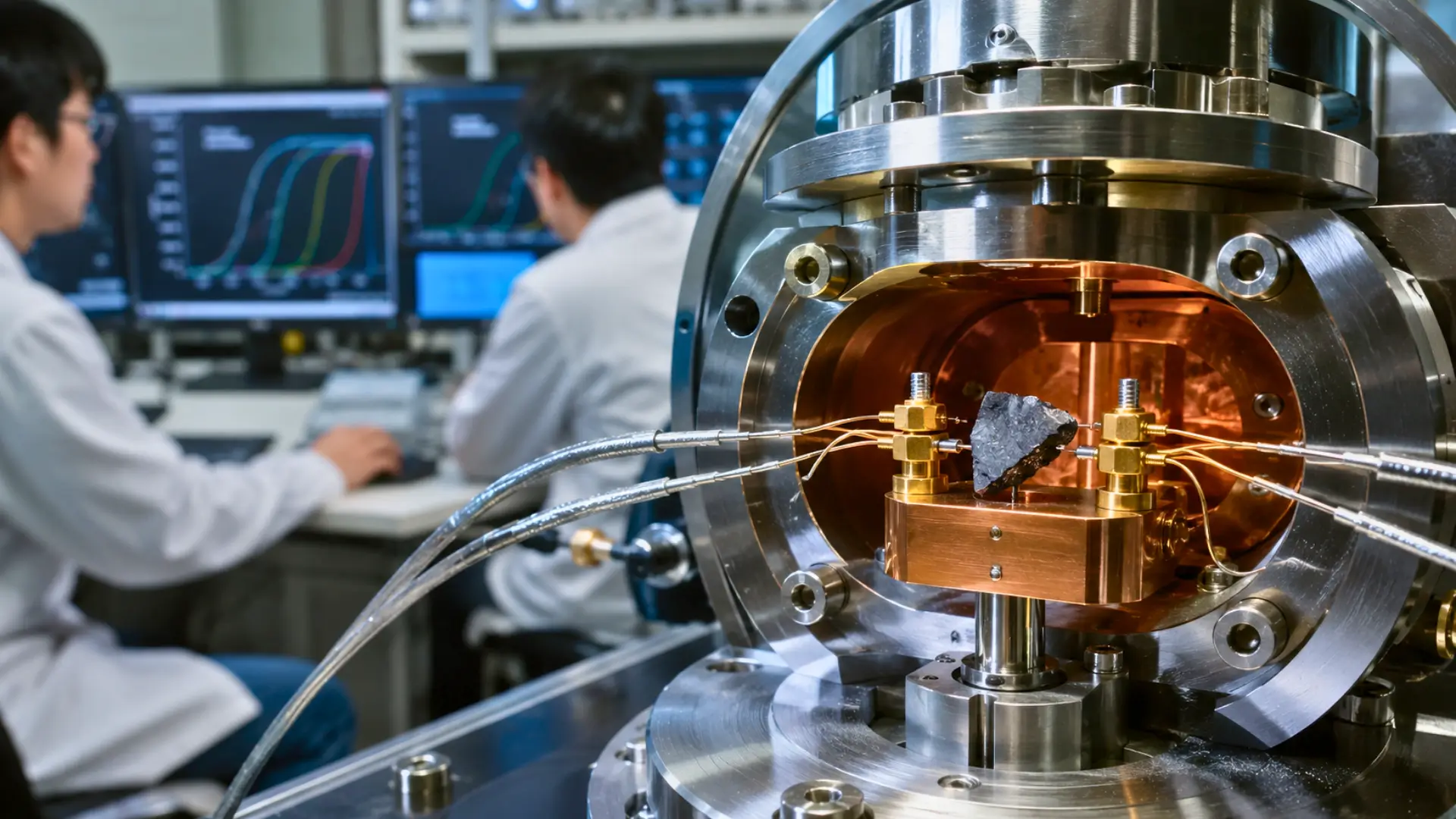
Researchers have identified four distinct forms of superconductivity within a single structure of rhombohedral pentalayer graphene, a material derived from the same carbon source found in common pencils. This discovery, detailed in recent experimental physics reports, demonstrates how stacking atomic-thin layers of carbon can be manipulated to achieve complex quantum states, offering a new pathway for developing high-efficiency electronic devices.
Superconductivity—the ability of a material to conduct electricity with zero resistance—is typically achieved under extreme conditions. By utilizing rhombohedral pentalayer graphene, scientists have observed these four superconducting phases appearing as they adjust the material’s electrical environment. This research, published in the journal Nature, highlights the unique electronic properties that emerge when graphene layers are precisely aligned in a specific rhombohedral, or “ABC,” stacking sequence, according to the study conducted by researchers at MIT and Harvard University.
Understanding Rhombohedral Pentalayer Graphene
Graphene is a single layer of carbon atoms arranged in a hexagonal lattice. When these layers are stacked, their interaction changes significantly depending on the orientation. In this specific experiment, the team focused on “pentalayer” graphene, consisting of five layers of atoms stacked in an ABC configuration. Unlike the more common Bernal (ABA) stacking, the rhombohedral (ABC) arrangement creates a flat electronic band structure, which is critical for allowing electrons to interact strongly enough to form Cooper pairs—the mechanism necessary for superconductivity.

The researchers found that by applying an external electric field, they could “tune” the density of electrons within the material. As the electron density shifted, the material transitioned through four different superconducting states. This tunability is a significant departure from traditional superconductors, such as lead or niobium, which generally possess a fixed set of properties. By using an external gate voltage to control the electronic behavior, the pentalayer graphene acts as a highly flexible platform for quantum research, as noted in the official project summary from the Massachusetts Institute of Technology.
Why Multiphase Superconductivity Matters
The existence of four distinct superconducting phases within one material structure is rare. Typically, researchers must synthesize entirely different materials to observe different types of superconductivity. Having multiple phases in a single, controllable system allows physicists to study how these states compete or coexist at the atomic level. This insight is essential for understanding the fundamental physics of “unconventional” superconductivity, where the standard theories of electron pairing are often challenged.
The ability to switch between these states using a simple electrical gate suggests potential applications in “superconducting electronics.” While current superconductors require cryogenic cooling, the discovery of new ways to manipulate these states in carbon-based materials provides a blueprint for future devices that could eventually operate at higher temperatures or with greater energy efficiency. The research team emphasizes that this discovery is a fundamental step in characterizing the “phase diagram” of graphene, providing a map that other researchers can use to explore further in the field of condensed matter physics.
Experimental Challenges and Future Directions
Maintaining the specific ABC stacking in five layers of graphene requires extreme precision. Any misalignment during the fabrication process can disrupt the flat band structure and prevent the emergence of the superconducting phases. To achieve these results, the researchers used specialized mechanical exfoliation and dry-transfer techniques to ensure the layers were aligned with sub-degree accuracy. The study confirmed that the superconducting transitions are sensitive to both the electric field and the displacement field, which effectively pushes the electrons to different layers within the five-layer stack.

The next phase of investigation, as outlined by the research group, involves testing the limits of these superconducting states under varying magnetic fields and at different temperatures. By mapping out how these phases respond to external pressure and magnetic interference, scientists hope to determine if these states can be stabilized for practical applications. As of the latest updates from the laboratory, the team is continuing to refine the fabrication process to create larger samples of pentalayer graphene, which will allow for more detailed spectroscopic measurements.
Researchers interested in the technical specifications of the gate-tunable phase diagram or the specific parameters of the pentalayer stacking can find the full dataset and methodology in the original peer-reviewed publication in Nature. Future updates regarding the scalability of these carbon-based structures are expected as the team continues their experimental cycle. If you found this breakdown of quantum materials interesting, feel free to share your thoughts or questions in the comments section below.
Worth a look