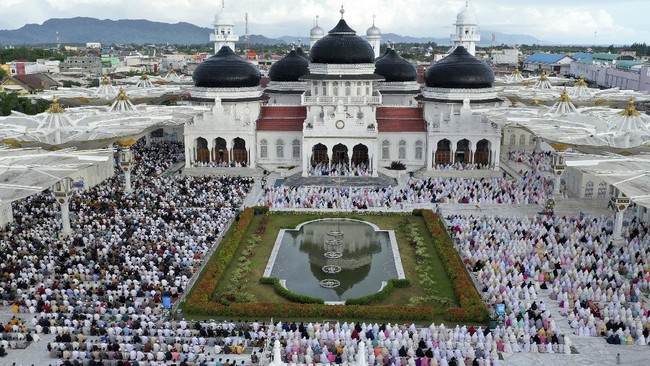
Berlin, Germany – As millions across Indonesia prepare for the festivities of Eid al-Fitr, a unique astronomical event is poised to coincide with the holiday: the spring equinox. So that during prayers and celebrations, the sun will be positioned almost directly overhead for many, marking a moment of equal daylight and darkness across the globe.
The equinox, derived from the Latin words meaning “equal night,” occurs when the Earth’s axis is neither tilted toward nor away from the sun. This results in roughly 12 hours of daylight and 12 hours of darkness for all locations on Earth. The phenomenon happens twice annually, in March and September. The March equinox is known as the vernal equinox in the Northern Hemisphere and the autumnal equinox in the Southern Hemisphere. According to Time and Date, the March 2026 equinox will occur on March 20th.
Eid al-Fitr is predicted to fall on March 21st, 2026, the day following the equinox. The Indonesian Agency for Meteorology, Climatology, and Geophysics (BMKG) has provided data on sunset times, noting the earliest sunset will occur at 17:48:13 WIT in Waris, Papua, and the latest at 18:49:39 WIB in Banda Aceh, Aceh. This timing is significant as it relates to the sighting of the new moon, a traditional method for determining the start of the Islamic month of Shawwal and, Eid al-Fitr.
Determining the exact date of Eid al-Fitr often involves differing interpretations and methodologies. The BMKG data indicates that on March 19, 2026, the crescent moon’s altitude and elongation did not meet the criteria established by the MABIMS (Ministerial Conference of Islamic Affairs of Brunei, Indonesia, Malaysia, and Singapore) organization. MABIMS requires a crescent moon altitude of at least 3 degrees with an elongation of 6.4 degrees for a valid sighting. But, the BMKG data shows that across Indonesia, the crescent moon’s altitude ranged from 0.91 degrees in Merauke, Papua, to 3.31 degrees in Sabang, Aceh, while the geocentric elongation varied from 4.54 degrees in Waris, Papua, to 6.1 degrees in Banda Aceh, Aceh.
Based on this data, We see projected that Ramadan will complete its 30 days, and Eid al-Fitr will likely fall on Saturday, March 21, 2026. However, the Muhammadiyah organization, a prominent Islamic organization in Indonesia, has already announced that Eid al-Fitr will be observed on Friday, March 20, 2026. This difference highlights the varying approaches to lunar calendar calculations and the determination of religious holidays.
The Equinox and Solar Radiation
When the equinox occurs, the Earth-sun distance is relatively close, resulting in maximum solar radiation for regions around the equator. This means that countries located in the tropics will experience intense sunlight during this period. However, the BMKG emphasizes that the equinox does not necessarily cause a drastic or extreme increase in air temperature. The average maximum temperature in Indonesia typically ranges from 32 to 36 degrees Celsius (89.6 to 96.8 degrees Fahrenheit).
The equinox is a natural astronomical phenomenon, and the BMKG clarifies that it is not comparable to heat waves, which can cause significant and prolonged increases in air temperature. The public is advised not to be alarmed by the equinox, as it does not pose a health or environmental risk. Concerns about a drastic temperature increase are unfounded, as the equinox is a predictable event that does not inherently lead to dangerous conditions.
Understanding the Significance of the Equinox
The equinox is a pivotal moment in the Earth’s annual cycle, marking the transition between winter and spring in the Northern Hemisphere and autumn and summer in the Southern Hemisphere. It’s a time of balance, where day and night are of equal length, symbolizing renewal and change. The equinox has been recognized and celebrated by cultures around the world for millennia, often associated with agricultural cycles and religious observances.
In Indonesia, the timing of the equinox coinciding with Eid al-Fitr adds a unique dimension to the holiday celebrations. While the astronomical event itself doesn’t directly impact the religious significance of Eid, it serves as a reminder of the natural rhythms of the universe and the interconnectedness of all things. The increased sunlight during this period may similarly contribute to a more vibrant and festive atmosphere during the holiday.
Preparing for Eid al-Fitr and the Equinox
As the date of Eid al-Fitr approaches, preparations are underway across Indonesia. Families are busy cleaning their homes, purchasing new clothes, and preparing traditional foods. The spirit of generosity and togetherness is palpable as people prepare to celebrate with loved ones. The coinciding equinox serves as a backdrop to these preparations, reminding everyone of the beauty and wonder of the natural world.
While the equinox itself doesn’t require any specific preparations, it’s a good time to be mindful of sun safety. With increased solar radiation, it’s important to protect skin from harmful UV rays by wearing sunscreen, hats, and sunglasses, especially during outdoor activities. Staying hydrated is also crucial, particularly in the tropical climate of Indonesia.
Differing Opinions on Eid al-Fitr Date
The differing announcements regarding the date of Eid al-Fitr from the BMKG-aligned calculations and the Muhammadiyah organization underscore the complexities of determining the start of Islamic months based on lunar sightings and calculations. Muhammadiyah utilizes a different method, relying on hisab (astronomical calculations) rather than rukyatul hilal (the sighting of the new crescent moon). This difference in methodology has led to variations in the dates of Islamic holidays for many years. The Indonesian Ministry of Religious Affairs typically follows the results of rukyatul hilal, conducted by teams dispatched to various locations across the archipelago.
Looking Ahead
As Indonesia prepares to celebrate Eid al-Fitr under the influence of the equinox, it’s a time for reflection, gratitude, and renewal. The combination of these two significant events creates a unique and memorable occasion for communities across the nation. The BMKG will continue to monitor atmospheric conditions and provide updates as needed, ensuring the public remains informed about any potential weather-related impacts. Further updates regarding the official date of Eid al-Fitr will be announced by the Indonesian Ministry of Religious Affairs following the rukyatul hilal observation on the evening of March 19, 2026.
The anticipation surrounding Eid al-Fitr and the equinox highlights the importance of both religious and scientific understanding in shaping our lives. By embracing both traditions and knowledge, You can navigate the world with greater awareness and appreciation. We encourage readers to share their thoughts and experiences regarding these events in the comments below.