
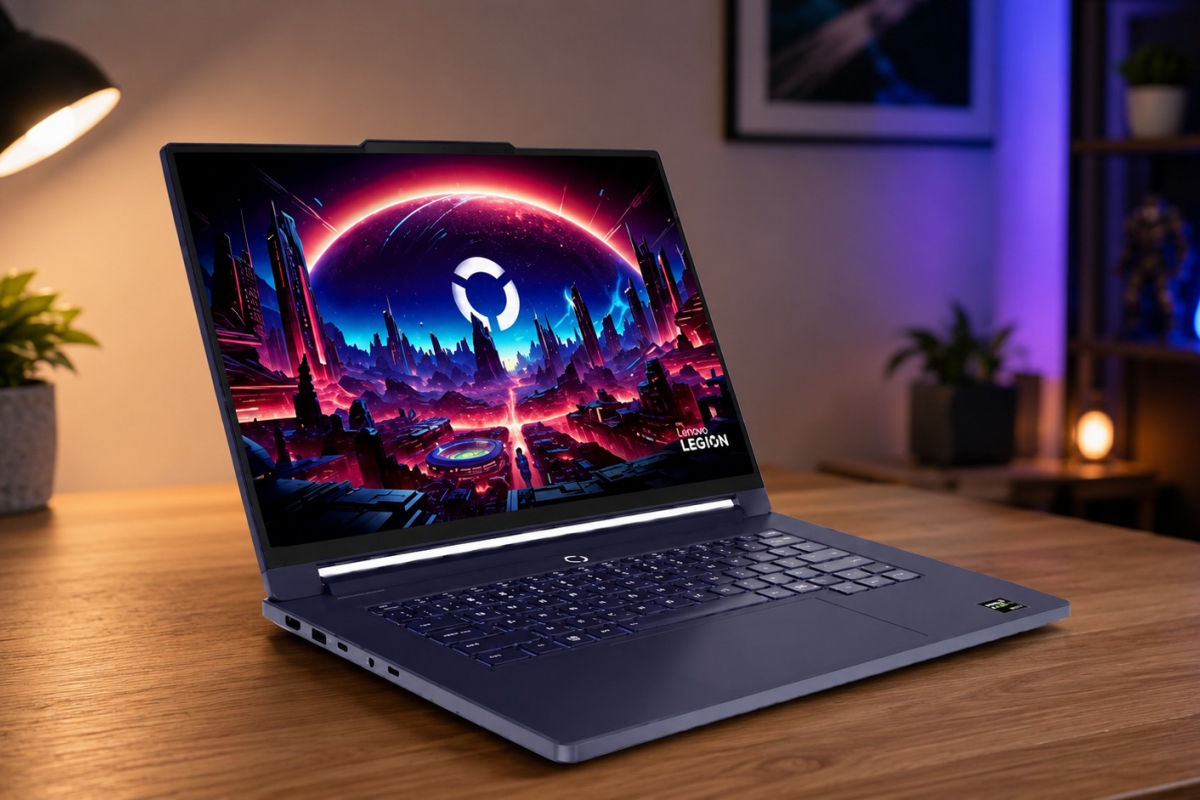
The gaming laptop market has long been defined by a singular, uncompromising requirement: the discrete GPU (dGPU). For years, the presence of a beefy NVIDIA GeForce or AMD Radeon chip—complete with its own dedicated VRAM and massive cooling solution—was the only way to guarantee a “gaming” experience. However, a new shift in hardware philosophy is beginning to emerge, challenging the notion that a dedicated graphics card is mandatory for a high-end gaming machine.
Recent industry chatter and unverified reports have pointed toward a potential strategic pivot from Lenovo, suggesting the possibility of a “Legion 7a” model that eschews the discrete GPU entirely. While Lenovo has not officially announced a model by this specific name or confirmed the existence of a “Radeon 8060S” integrated chip, the conversation itself highlights a critical trend in the industry: the rise of high-performance integrated graphics (iGPUs) that are finally capable of handling modern titles.
As a software engineer turned journalist, I have watched the gap between integrated and discrete graphics narrow over the last three years. With the advent of chiplet designs and advanced fabrication processes, the “integrated” label no longer means “basic.” If Lenovo is indeed experimenting with a GPU-less Legion, it would signal a bold bet on the efficiency of the next generation of AMD silicon, moving the Legion brand away from raw power and toward a more versatile, “thin-and-light” gaming hybrid.
The Evolution of Integrated Graphics: Beyond Basic Display
To understand why a dGPU-less gaming laptop is even a possibility, we have to look at the current state of AMD’s integrated graphics. For a long time, iGPUs were designed merely to output a signal to a monitor or handle light productivity. That changed with the introduction of RDNA architecture into the Ryzen processor lineup. The AMD Radeon graphics found in recent Ryzen 7 and 9 processors, such as the Radeon 780M, have already demonstrated the ability to run AAA games at 1080p with modest settings.
The rumor of a “Radeon 8060S” likely stems from anticipation surrounding AMD’s next-generation “Strix Point” architecture. While the specific “8060S” nomenclature is not currently in AMD’s official public roadmap, the new Ryzen AI 300 series is introducing the Radeon 800M series of integrated graphics. These chips are designed to leverage shared system memory (LPDDR5x) more efficiently, significantly reducing the bottleneck that previously made iGPUs unviable for serious gaming.
By removing the discrete GPU, a laptop manufacturer can fundamentally redesign the chassis. A dGPU requires its own power delivery system and a substantial heat sink, often occupying 30% to 50% of the internal volume of a gaming laptop. Without it, Lenovo could produce a Legion that is significantly thinner, lighter and quieter, while potentially offering battery life that rivals premium ultrabooks—a feat nearly impossible for traditional gaming rigs.
The Trade-Off: Performance vs. Portability
The primary question for any gamer is whether an integrated solution can truly replace a dedicated card. The answer depends entirely on the user’s definition of “gaming.” For those chasing 4K resolution and ray-tracing at 144fps, a dGPU-less machine is a non-starter. However, for a growing segment of the market, the trade-off is attractive.
Current high-end iGPUs are beginning to rival entry-level discrete GPUs from a few generations ago. When paired with technologies like AMD FSR (FidelityFX Super Resolution) and the upcoming iterations of AI-driven upscaling, these integrated chips can “cheat” their way to higher frame rates by rendering at a lower resolution and using AI to upscale the image. This makes 1080p gaming entirely viable for titles like Baldur’s Gate 3, Cyberpunk 2077 (on low/medium), and a vast library of eSports titles like Valorant or League of Legends.
the reliance on shared memory means that the speed of the system RAM becomes the primary performance driver. If a rumored “Legion 7a” were to ship with ultra-fast LPDDR5x memory, the iGPU would have the bandwidth necessary to handle more complex textures and shaders, further blurring the line between “integrated” and “discrete.”
Who Benefits from a GPU-less Legion?
If Lenovo moves forward with a gaming-branded laptop that relies solely on an iGPU, they aren’t targeting the hardcore enthusiast; they are targeting the “hybrid user.” Here’s a demographic that needs a professional-looking machine for university or the office but wants to play a few hours of gaming in the evening without carrying a five-pound brick and a massive power adapter.

The stakeholders in this shift include:
- Students: Who need a single device for coding, coursework, and gaming.
- Digital Nomads: Who prioritize battery life and portability over maximum graphical fidelity.
- Casual Gamers: Who primarily play indie titles or optimized multiplayer games.
- Enterprise Users: Who want the thermal efficiency of an ultrabook but the build quality and cooling of a gaming chassis.
From a market perspective, this allows Lenovo to expand the Legion ecosystem. Instead of the Legion being a niche product for gamers, it becomes a high-performance computing brand that offers a spectrum of power—from the ultra-portable iGPU models to the powerhouse Legion 9 series.
Technical Hurdles and the “VRAM” Problem
Despite the promise, there are significant technical hurdles. The biggest is the lack of dedicated VRAM. A discrete GPU has its own high-speed memory (GDDR6), which is significantly faster than the system RAM used by an iGPU. When an integrated GPU “borrows” memory from the system, it reduces the amount of RAM available for the CPU and the operating system.
For a GPU-less Legion to be successful, it would likely need to ship with at least 32GB of high-speed RAM to ensure that neither the processor nor the graphics engine is starved for resources. This would increase the base price of the machine, potentially offsetting some of the cost savings gained by removing the dGPU.
thermal management remains a concern. While a single chip produces less heat than two separate processors, the heat is concentrated in one area. Lenovo would need to utilize its advanced Coldfront cooling technology to ensure that the Ryzen chip doesn’t throttle under sustained gaming loads, which would lead to erratic frame rates and a poor user experience.
Conclusion: A New Category of Laptop?
While we wait for official confirmation from Lenovo regarding the “Legion 7a” and the specific hardware it might employ, the industry is at a crossroads. The distinction between a “productivity laptop” and a “gaming laptop” is evaporating. We are entering the era of the “Performance Hybrid”—a machine that doesn’t compromise on build quality or thermal headroom but recognizes that for many, a dedicated GPU is an unnecessary power drain.
If the rumors hold a grain of truth, we may be seeing the birth of a new sub-category: the “Light Gaming” powerhouse. This wouldn’t be a budget laptop, but rather a premium, engineered machine designed for efficiency and agility.
What to watch next: Keep an eye on Lenovo’s official press room and upcoming hardware showcases for any mention of “Legion Slim” updates or new Ryzen AI-powered configurations. We expect more clarity on the 2025 product roadmap in the coming months as AMD finalizes the rollout of its next-gen mobile processors.
Do you think a gaming laptop without a dedicated GPU is a viable move, or is the dGPU still essential for a true gaming experience? Share your thoughts in the comments below.