
For decades, the narrative of New Orleans has been one of resilience and engineering triumph. Following the devastation of Hurricane Katrina in 2005, the city became a global symbol of flood defense, underpinned by billions of dollars in investments into a sophisticated network of levees, floodgates, and pumping stations. However, a sobering new assessment suggests that these physical barriers may only be delaying an inevitable conclusion.
A stark study published in the journal Nature Sustainability concludes that New Orleans has reached a “point of no return.” The research warns that the combination of accelerating sea-level rise and the rapid erosion of southern Louisiana’s coastal wetlands will likely leave the city surrounded by the Gulf of Mexico within decades, rather than centuries. For policymakers and residents, the conclusion is clear: the belief that levees can no longer save New Orleans in the long term is becoming a scientific consensus.
The crisis is not the result of a single failure but a convergence of global and local pressures. While global heating drives rising oceans and more intense hurricanes, the local coastline is physically sinking—a process known as subsidence. This decline is compounded by decades of industrial activity, specifically the carving of the coastline by the oil and gas industry. According to the researchers, the region is now the most physically vulnerable coastal zone in the world, necessitating an immediate and coordinated plan to transition the population to safer ground.
Residents move a boat through a flooded neighborhood after Hurricane Ida in August 2021 in Barataria, Louisiana, near New Orleans. | Brandon Bell/Getty Images
The Geography of a ‘Timebomb’
New Orleans is uniquely precarious, situated in a bowl-shaped basin where much of the land sits below sea level. This geographic reality means that the city does not just face the threat of storm surges, but the gradual encroachment of the ocean from all sides. A separate study released in April highlighted that 99 percent of the city’s population is at major risk of severe flooding, the highest exposure of any city in the United States.

The Nature Sustainability perspectives paper provides a harrowing projection of the future. By comparing current temperature trends with a period of similar heat from 125,000 years ago, researchers estimate that southern Louisiana could face between 3 and 7 meters of sea-level rise. Such an increase, paired with the loss of three-quarters of the remaining coastal wetlands, could cause the shoreline to migrate as much as 100 kilometers (62 miles) inland, effectively stranding both New Orleans and Baton Rouge in a landscape dominated by open water.
Wanyun Shao, a geographer at the University of Alabama and co-author of the April study, describes the situation as a “timebomb.” Shao notes that while there is no specific day the clock runs out, the rate of sea-level rise in the region is among the highest globally, questioning how long human engineering can possibly fight against such a tide.
The Accelerating Loss of Land
The threat is not merely the rising water, but the vanishing land that acts as the city’s first line of defense. Since the 1930s, Louisiana has lost 2,000 square miles of land to coastal erosion—an area roughly the size of Delaware. Projections suggest another 3,000 square miles will vanish over the next 50 years according to state coastal data. The pace of this loss is staggering: a football field-sized area of land is wiped out every 100 minutes.
This erosion strips away the natural buffer that absorbs storm surges before they hit the man-made levee systems. As the wetlands disappear, the levees are forced to withstand the full force of the Gulf of Mexico, increasing the likelihood of catastrophic failure during major weather events.
The Limits of Engineering and the ‘Terminal’ Diagnosis
The post-Katrina era was defined by the belief that enough concrete and steel could secure the city’s future. Billions of dollars were spent on the current levee and pump system, and these structures continue to require expensive upgrades to remain viable. However, the researchers argue that these measures are temporary fixes for a permanent problem.
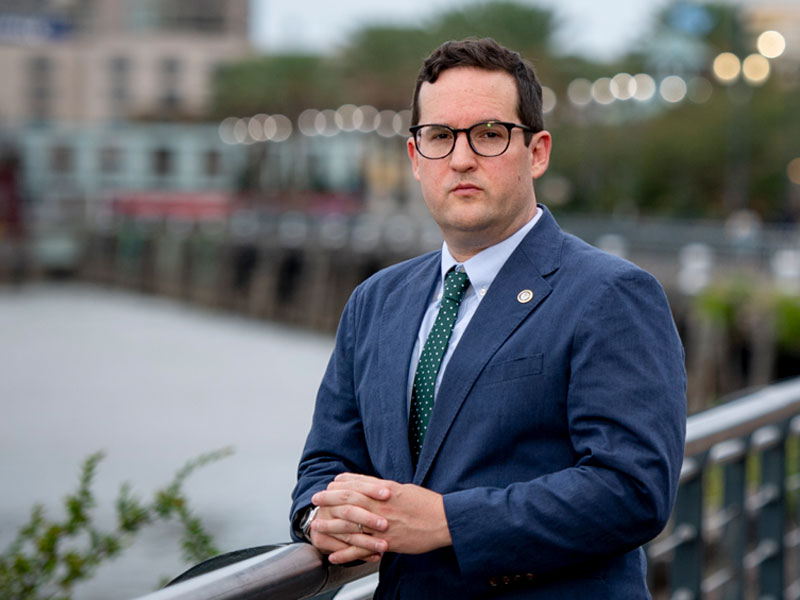
Jesse Keenan, an expert in climate adaptation at Tulane University and a co-author of the Nature Sustainability paper, offers a blunt assessment of the city’s viability. “In paleo-climate terms, New Orleans is gone; the question is how long it has,” Keenan stated. He argues that even if climate change were halted today, the city’s days are numbered because We see impossible to keep an island situated below sea level afloat indefinitely. “There’s no amount of money that can do that.”
Keenan compares the city’s condition to a terminal patient, suggesting that the focus of leadership should shift from “curing” the city to “palliative care”—meaning a managed, dignified transition of the economy and the people. He notes that while politicians may discuss this reality behind closed doors, they are often unwilling to deliver a “terminal diagnosis” to the public for fear of the political fallout.
The Policy Failure: The Mid-Barataria Conflict
For a time, Louisiana attempted to move beyond traditional flood defenses by harnessing the natural power of the Mississippi River. The strategy focused on sediment diversion—allowing the river to overflow its banks in controlled ways to deposit sediment and rebuild the wetlands, mimicking the natural delta-building process.
The centerpiece of this strategy was the Mid-Barataria Sediment Diversion project, which broke ground in 2023. The project aimed to create more than 20 square miles of new land over the next 50 years. It was funded in part by a settlement from BP following the 2010 Deepwater Horizon disaster.

However, this lifeline was recently severed. Louisiana Governor Jeff Landry scrapped the project last year, citing a $3 billion cost that he deemed unsustainable and arguing that the diversion threatened the livelihoods of the state’s fishing industry as reported by the Governor’s office. This decision has been met with fierce criticism from environmental experts and former officials.
Garret Graves, a former US representative and former leader of the state’s coastal restoration agency, described the cancellation as a “boneheaded decision” and one of the largest setbacks for coastal protection in decades. The Nature Sustainability paper suggests that abandoning the sediment diversion plan effectively means giving up on extensive portions of coastal Louisiana, including the New Orleans area, as it removes the only viable method for building new land to counter the rising sea.
Legal Battles and the Cost of Restoration
The financial burden of coastal restoration is immense, and the state has long looked to the fossil fuel industry to pay for the damage caused by dredging canals and drilling wells, which contributed to land subsidence. However, these legal efforts are facing significant hurdles in the judiciary.
In a recent development, the US Supreme Court allowed the fossil fuel industry to federally contest a state jury decision that ordered Chevron to pay $740 million to remedy harm caused to Louisiana’s wetlands via a Supreme Court ruling. This legal uncertainty makes it increasingly difficult for the state to secure the funding necessary for large-scale restoration projects.
According to Jesse Keenan, the combination of the scrapped sediment diversion project and the stalled legal recoveries creates a scenario where the state has essentially stopped trying to build land. This, he warns, accelerates the timeline for levee failure, as floodwaters will eventually have nowhere else to go.
The Case for Managed Retreat
If the city cannot be saved by engineering, the alternative is “managed retreat”—the planned, coordinated relocation of people and infrastructure from high-risk areas to safer ground. While the United States has never moved a major city in its entirety, smaller communities are already relocating due to the climate crisis.
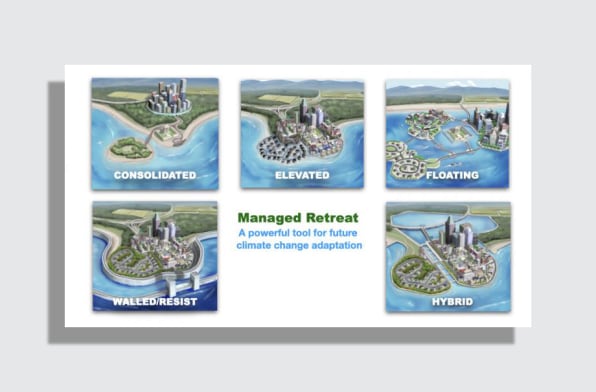
Keenan suggests that the government should begin by supporting the most vulnerable populations, such as those in Plaquemines Parish who live outside the levee system. He proposes a long-term strategy of migrating the population further north, specifically to safer areas on the other side of Lake Pontchartrain, the large estuary north of the city.
The argument for a managed retreat is based on economic and humanitarian stability. Without a plan, Keenan warns that the exodus will happen in a “disordered way.” As insurance companies become unwilling to cover properties in high-risk zones, the market will force people out, leading to a chaotic trickle of migration that leaves the most impoverished residents stranded.
Timothy Dixon, a coastal environment expert at the University of South Florida, agrees that a measured retreat is the only ultimate solution, though he acknowledges the emotional and political difficulty. “Many people don’t want to move. They love where they are born,” Dixon noted, adding that the political system is often ill-equipped to make the unpopular decisions required for such a massive transition.
Key Takeaways for the Region
- Point of No Return: Scientific research suggests New Orleans may be surrounded by the Gulf of Mexico by the end of the century due to sea-level rise and land loss.
- Infrastructure Limits: While levees provide temporary protection, they cannot counter the long-term physical subsidence of the land and the 3–7 meter projected sea-level rise.
- Policy Reversals: The cancellation of the $3 billion Mid-Barataria Sediment Diversion project has removed a primary mechanism for rebuilding protective wetlands.
- Legal Hurdles: Supreme Court decisions have complicated efforts to hold oil and gas companies financially accountable for coastal damage.
- Managed Retreat: Experts advocate for a coordinated relocation of the population to the north of Lake Pontchartrain to avoid a disordered economic and social collapse.
The fate of New Orleans serves as a preview for coastal cities worldwide. It highlights the tension between the desire to maintain cultural and economic hubs and the physical reality of a changing planet. As the land continues to vanish at a rate of one football field every 100 minutes, the window for a coordinated transition is closing.
The next critical checkpoint for the region’s coastal strategy will be the ongoing legal challenges regarding the fossil fuel industry’s liability for wetland restoration, which will determine if the state can secure the funds necessary for any remaining mitigation efforts.
Do you believe managed retreat is a viable solution for historic cities, or should we continue to invest in engineering defenses? Share your thoughts in the comments below.
Worth a look