
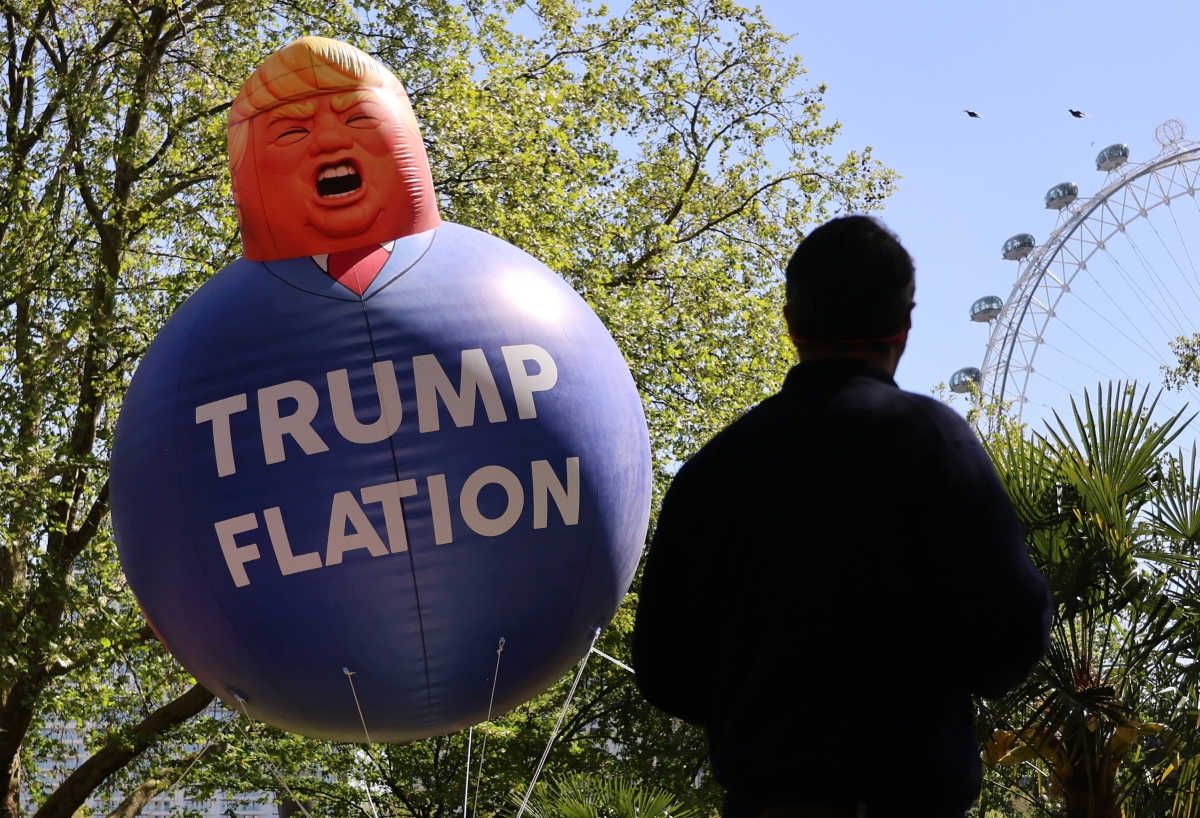
In London on April 22, 2026, a large balloon caricature of former U.S. President Donald Trump appeared near government buildings, bearing the words “트럼프 플레이션” – a Korean-language portmanteau combining “Trump” and “inflation.” The display was part of a political campaign launched by the UK’s Liberal Democrats to criticize what they describe as inflationary pressures linked to U.S. Foreign policy decisions under the Trump administration, particularly regarding Iran.
The term “트럼프 플레이션” (pronounced “teu-remeu peulleishon”) has emerged in political discourse as a critique of economic policies associated with Donald Trump’s presidency, suggesting a causal link between his administration’s actions and rising consumer prices. While the balloon’s appearance in London coincided with heightened tensions between Western nations and Iran over regional security issues, no verified evidence establishes a direct, singular connection between Trump-era policies and current UK inflation rates as of April 2026.
The Liberal Democrats, a centrist political party in the United Kingdom, stated that the balloon was intended to draw public attention to the cost-of-living crisis affecting British households. Party representatives said the visual protest aimed to highlight how international conflicts, including those involving U.S. Strategic interests, can reverberate through global energy markets and supply chains, ultimately impacting domestic prices for fuel, food, and other essentials.
According to verified reports from South Korean news outlet Seoul Shinmun and corroborated by multiple international wire services, the balloon was displayed in central London on the morning of April 22, 2026. Photographs circulated by news agencies showed the inflatable figure positioned near prominent landmarks, with members of the public observed passing by and reacting to the slogan. The display was described as peaceful and non-disruptive, consistent with standard protocols for temporary political expression in public spaces under UK law.
The UK’s approach to regulating such demonstrations falls under the Public Order Act 1986, which requires organizers to notify police in advance for certain types of processions or assemblies but does not prohibit peaceful, static displays like balloons in most public areas. No arrests, fines, or official interventions were reported in connection with the balloon’s presence on April 22, suggesting compliance with existing regulations.
While the Liberal Democrats framed the protest as a commentary on foreign policy consequences, independent economic analysts note that inflation in the United Kingdom during early 2026 stems from a complex mix of domestic and international factors. These include lingering effects of global supply chain disruptions, energy price volatility tied to North Sea production and international crude markets, wage growth in specific sectors, and the monetary policy stance of the Bank of England. Attributing inflation primarily to any single foreign government’s actions oversimplifies a multifaceted economic phenomenon.
The use of Korean-language terminology on a protest balloon in London reflects the increasingly globalized nature of political symbolism and the transnational reach of digital media. The phrase “트럼프 플레이션” originated in online discussions among Korean-speaking users commenting on U.S. Economic policy but has since appeared in various international contexts as a shorthand critique. Its appearance on a physical protest object in the UK illustrates how internet-born political lexicons can migrate into real-world activism across linguistic and cultural boundaries.
Historically, protest balloons featuring political figures have been used in the UK and elsewhere as tools of satirical dissent. Notable precedents include the “Trump Baby” blimp flown during protests against the former U.S. President’s state visit to London in 2019, and similar inflatables depicting other world leaders during international summits or state visits. The “트럼프 플레이션” balloon continues this tradition of using humor and exaggeration to convey political criticism, albeit with a linguistically hybrid message tailored to specific audiences.
As of April 23, 2026, the balloon had been removed from public display, and no further demonstrations using the same slogan have been officially announced by the Liberal Democrats. The party continues to advocate for policies aimed at alleviating household financial strain, including calls for targeted energy subsidies, expanded social welfare provisions, and greater scrutiny of defense spending commitments that may impact national budgets.
For readers seeking to understand the broader economic context, official inflation data for the United Kingdom is published monthly by the Office for National Statistics (ONS). The most recent verified figures, covering March 2026, showed the Consumer Prices Index (CPI) rising at an annual rate of 3.2%, down from a peak of over 11% in 2022 but still above the Bank of England’s 2% target. Detailed reports and methodology are available through the ONS website.
Similarly, information about the UK Liberal Democrats’ current platform, leadership, and policy positions can be accessed via the party’s official website. The party, led by Sir Ed Davey as of April 2026, represents approximately 70 members in the House of Commons and holds seats in devolved legislatures across Scotland and Wales.
While symbolic protests like the London balloon contribute to public discourse, economists emphasize that sustainable solutions to inflation require coordinated action across fiscal, monetary, and international policy domains. No single measure or attribution offers a complete explanation for price stability challenges in interconnected global economies.
As of this writing, no official hearings, legislative votes, or international summits specifically addressing the “트럼프 플레이션” phenomenon are scheduled. The next major economic update from the UK government will be the spring fiscal statement, traditionally delivered by the Chancellor of the Exchequer in late April or early May 2026. Readers interested in ongoing developments are encouraged to consult verified sources such as the Office for National Statistics, the Bank of England’s monetary policy reports, and reputable financial news outlets for authoritative updates.
If you found this explanation helpful, consider sharing it with others seeking clarity on how international politics and economics intersect in everyday life. Thoughtful engagement with complex global issues begins with access to accurate, context-rich information.