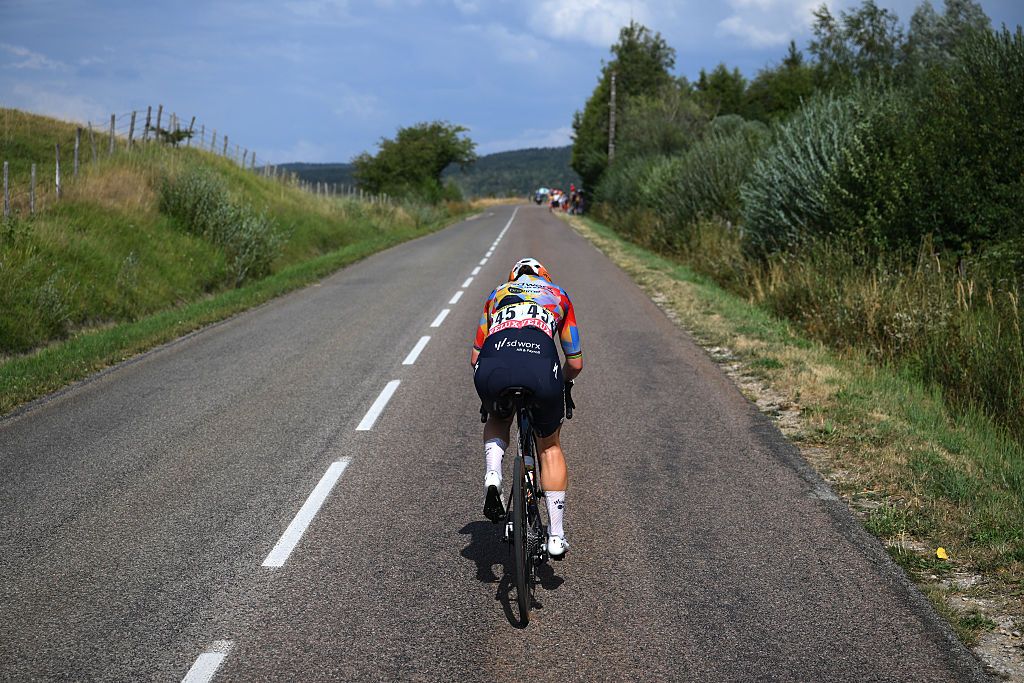
Lotte Kopecky’s fierce solo chase on stage 3 of the Tour de France Femmes evaporated in the grueling Jura heat when severe muscle cramps forced the Belgian star to relent within sight of breakaway leader Sigrid Haugset. Haugset completed a remarkable 85-kilometer breakaway to claim both the stage victory and the yellow jersey, while Kopecky ultimately crossed the finish line in second place, trailing the Uno-X Mobility rider by 1 minute and 24 seconds.
The 156.5-kilometer route across the Jura mountains offered punishing terrain, amplified by a scorching August afternoon where temperatures climbed to 37 degrees Celsius or higher. Operating outside the protective shelter of the peloton, Kopecky launched her pursuit after watching the bunch lose momentum, determined not to hand the Norwegian National Champion a free ride to victory.
“My legs were too good to let that happen so I went on the chase alone,” Kopecky told Eurosport after the stage.
For a stretch of the grueling trek, the SD Worx-Protime rider successfully slashed Haugset’s advantage from over a minute down to just 10 seconds. Yet as the gap closed on the uphill sections where the leader visibly labored, physical exhaustion and intense dehydration caught up with the world-class racer.
The Anatomy of a Failing Chase in the Jura Mountains
Executing a solo pursuit over mountainous terrain in extreme heat demands an extraordinary physiological toll. Without teammates to share the workload or provide tactical shelter, riders caught in long solo efforts face constant exposure to high temperatures without adequate cooling options. Kopecky noted that managing her body temperature became nearly impossible as the miles mounted.
“When you’re alone and riding is such a long effort, you just cannot cool down anymore,” Kopecky explained to Eurosport before heading to the team bus. “I tried to pour as many bottles over me as possible, but in the end, it was too much. She was really strong.”
As the gap hovered around 1 minute and 20 seconds for a significant portion of the race, the pursuit appeared daunting. However, Kopecky sensed an opening as the road tilted upward. Her legs felt strong initially, but the accumulated effort triggered sudden physical limitations just as she caught visual contact with Haugset.
Cramps and the Breaking Point
Hopes of a dramatic catch vanished in the final kilometers when Kopecky’s muscles seized under the relentless strain. Describing the sudden shift from contention to survival, the Belgian rider detailed the precise moment her body pushed back against the effort.
“The thing is I was not empty,” Kopecky said. “My legs were starting to cramp and I couldn’t push anymore. If I pushed harder, my legs went straight. So then I had to let her go. I just couldn’t push any more.”
Following her massive effort, Kopecky spent an extended period slumped against the barriers near the finish line, completely exhausted by what ranked among the longest solo in-race efforts of her professional career. While the tactical gamble ultimately fell short of a stage win, the aggressive riding underscored her competitive tenacity in punishing mid-summer racing conditions.
What Happens Next
The Tour de France Femmes continues with subsequent stages traversing challenging terrain, where general classification contenders must quickly recover from the physical toll inflicted by the Jura mountains. Teams will evaluate rider recovery and hydration strategies ahead of the next day’s neutral start as the peloton presses onward toward the final destination. Cycling fans and analysts can follow official race updates, stage classifications, and team statements through major sports news networks and official race timing portals.
Worth a look