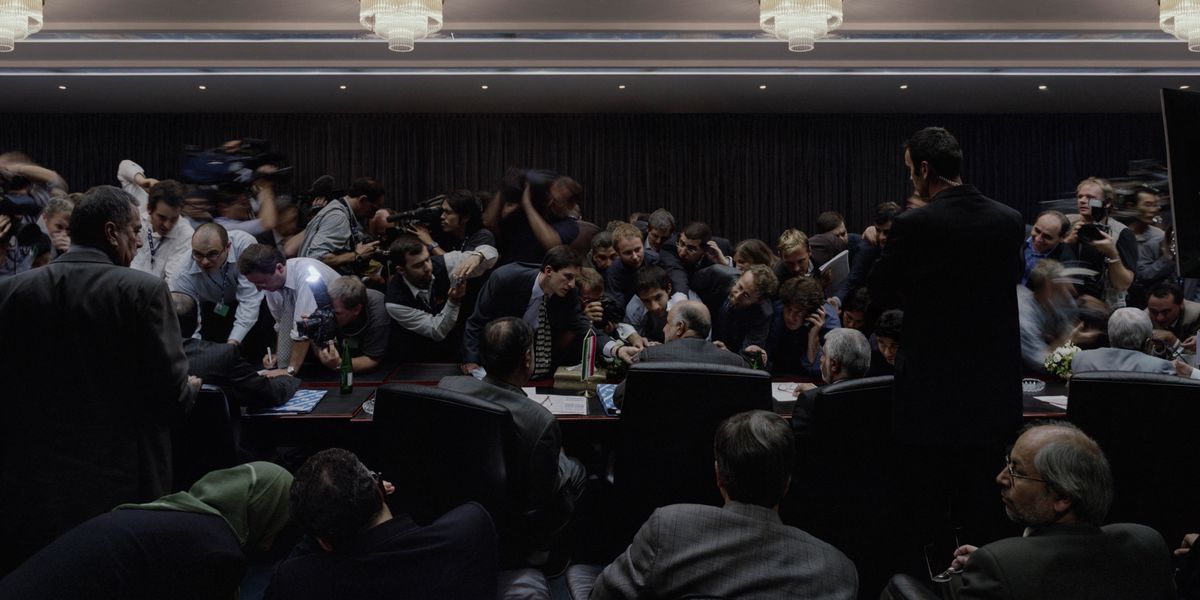
In the heart of Lausanne, Switzerland, a profound visual dialogue is currently unfolding that challenges how we perceive the modern era. The exhibition “Deux regards sur le monde” (Two Gazes on the World), hosted at the prestigious Photo Elysee, brings together two masters of the lens—Luc Delahaye and Salvatore Vitale—to create a stark, meditative contrast between the roar of global conflict and the silence of the natural horizon.
For the visitor, the experience is less of a traditional gallery walk and more of a psychological journey. By pairing Delahaye’s sweeping, often harrowing depictions of war and political turmoil with Vitale’s contemplative, minimalist landscapes, the exhibition forces a confrontation between the chaos of human ambition and the enduring stillness of the earth. It is a curation that does not seek to harmonize these two perspectives, but rather to let them clash, creating a tension that mirrors the volatility of the 21st century.
The Luc Delahaye and Salvatore Vitale exhibition serves as a critical examination of the “documentary gaze.” While one artist captures the evidence of history in the making, the other captures the timelessness of space. Together, they provide a comprehensive map of the human condition: our capacity for systemic destruction and our innate need for quietude and reflection.
As an editor who spends most of my time analyzing the high-stakes drama of international sports, I find a familiar rhythm in this exhibition. Much like a championship match, where the intensity of the action is balanced by the strategic pauses and the silence of the crowd, this exhibition balances the visceral energy of Delahaye’s work with the rhythmic breathing of Vitale’s. It is a masterclass in pacing and perspective.
The Echo of the World: Luc Delahaye’s Unflinching Gaze
Luc Delahaye does not merely take photographs; he constructs visual testimonies. Having spent decades in war zones and international forums, Delahaye has transitioned from the role of a traditional photojournalist to that of an artist who uses the documentary approach to explore the “turmoil of the contemporary world.” His work is characterized by a demanding relationship with reality, where formal rigor meets the raw, often brutal truth of the image.
The monographic portion of the exhibition, titled “The Echo of the World,” spans 25 years of his creative output. Delahaye is renowned for his use of large-format photography, which transforms a snapshot of a conflict zone into a “tableau.” This scale is intentional; it removes the image from the ephemeral nature of a news cycle and places it into the realm of history and art. By doing so, he forces the viewer to linger on details that would be overlooked in a smaller print—the expression of a soldier, the debris of a fallen city, or the oppressive weight of a political gathering.

Delahaye’s approach redefines the relationship between art and documentation. He avoids the sentimentalism often found in war photography, opting instead for a detached, almost clinical precision. This distance does not diminish the emotional impact; rather, it amplifies it by allowing the facts of the image to speak for themselves. His work asks a fundamental question: can a photograph truly capture the scale of human suffering, or is it merely an echo of a larger, incomprehensible tragedy?
The precision of his compositions reflects a deep commitment to formal rigor. Even in the midst of chaos, Delahaye finds a geometric order, suggesting that there is a systemic logic—however cruel—to the conflicts he documents. This intersection of art and evidence makes his work essential for anyone seeking to understand the visual language of modern conflict.
The Quiet Observation: Salvatore Vitale’s Perspective
Standing in direct opposition to the intensity of Delahaye is the work of Salvatore Vitale. If Delahaye is the sound of the explosion, Vitale is the silence that follows. The Italian photographer brings a gaze that is inward-looking, focusing on the subtle interplay of light, shadow, and space. His work does not seek to document an event but to evoke a state of being.
Vitale’s landscapes are exercises in subtraction. He strips away the noise of the world, leaving behind compositions that feel both expansive and intimate. His gaze is one of patience, waiting for the exact moment when the light transforms a mundane horizon into something transcendent. This approach provides the necessary counterbalance to the exhibition, offering the viewer a space to breathe and process the weight of Delahaye’s imagery.

While Delahaye focuses on the “where” and “how” of human history, Vitale focuses on the “is.” His work explores the concept of the void and the beauty of the periphery. In the context of “Deux regards sur le monde,” Vitale’s photographs act as a sanctuary. They remind us that despite the political and social upheavals that dominate our headlines, there remains a world of enduring, quiet beauty that exists independently of human conflict.
The dialogue between the two artists is most potent in the transition zones of the gallery. Moving from a large-scale image of a war-torn landscape to a minimalist Vitale horizon creates a cognitive shift. It forces the viewer to acknowledge the duality of existence: the reality of our capacity for violence and the reality of our need for peace.
A Dialogue of Opposites at Photo Elysee
The choice of Photo Elysee as the venue for this exhibition is significant. As a center for photographic research and exhibition in Lausanne, the institution is uniquely equipped to handle the conceptual weight of such a pairing. The gallery’s architecture—clean, open, and light-filled—complements the monographic nature of the displays, allowing each artist’s voice to resonate without interference.
The curation achieves a rare balance. Rather than attempting to blend the two styles, the exhibition maintains a clear boundary between the “two gazes.” This separation is crucial because it prevents the work from becoming a mere comparison. Instead, it becomes a conversation. The “documentary approach” is interrogated from two different angles: one that looks outward at the world’s fractures and one that looks inward at the world’s essence.
For the Lausanne art scene and international visitors, this exhibition represents a high point in contemporary photographic discourse. It moves beyond the simple act of “showing pictures” and instead creates an immersive environment where the viewer must actively synthesize two opposing truths. The result is a profound reflection on how we consume images of the world—whether we look for the shock of the event or the solace of the landscape.
The exhibition also highlights the evolution of the medium. By showcasing 25 years of Delahaye’s work alongside Vitale’s timeless approach, Photo Elysee demonstrates that photography remains the most potent tool for navigating the complexities of the modern world. Whether through the lens of a war correspondent or the eye of a landscape poet, the camera remains our primary instrument for witnessing the truth.
Understanding the Documentary Transition in Modern Art
To fully appreciate the Luc Delahaye and Salvatore Vitale exhibition, one must understand the “documentary transition” occurring in contemporary art. For decades, there was a strict divide between “photojournalism” (which aimed for objective truth) and “fine art photography” (which aimed for subjective expression). Artists like Delahaye have effectively demolished this wall.
By applying the formal standards of art—scale, composition, and curation—to the subject matter of journalism, Delahaye elevates the documentary image. He suggests that a photograph of a war zone can be as aesthetically significant as a classical painting, without losing its political or historical urgency. This transition allows the viewer to engage with tragedy not just as a consumer of news, but as a witness to history.

Salvatore Vitale contributes to this transition by redefining what “documenting the world” means. Documentation is not always about the event; it can also be about the atmosphere. By documenting the stillness of a landscape, Vitale captures a different kind of truth—the truth of presence and persistence. This expanded definition of the documentary gaze is what makes the exhibition so intellectually stimulating.
This shift in perspective is vital in an era of digital saturation. We are bombarded by thousands of images daily, most of which are fleeting and superficial. The work at Photo Elysee demands a slower pace. It asks us to move from “scrolling” to “seeing,” reminding us that the act of looking is, in itself, a moral and intellectual choice.
Visitor Guide and Practical Information
For those planning to visit “Deux regards sur le monde,” the exhibition is currently open at Photo Elysee in Lausanne. Given the scale of the works, particularly Delahaye’s large-format pieces, it is recommended to allocate at least two to three hours to fully experience the dialogue between the two artists.
- Location: Photo Elysee, Place du Tunnel, Lausanne, Switzerland.
- Exhibition Dates: The exhibition is running through May 31, 2026.
- Recommended Approach: Begin with the monographic works of Luc Delahaye to establish the “echo” of the world, then transition into Salvatore Vitale’s sections to find the necessary balance and reflection.
The exhibition is part of a broader effort by Photo Elysee to bring world-class monographic exhibitions to the region, ensuring that Lausanne remains a pivotal node in the global photography network. Visitors are encouraged to check the official museum schedule for any guided tours or curator talks that may provide deeper insight into the selection process for these specific works.
The juxtaposition of these two artists serves as a reminder that the world is never just one thing. It is simultaneously a place of devastating conflict and breathtaking peace. To look at the world through only one of these gazes is to see only half the truth. By presenting both, Photo Elysee offers a more honest, albeit more challenging, reflection of our shared reality.
The next confirmed checkpoint for the exhibition is its closing date on May 31, 2026, after which the works will be decommissioned from the gallery. We encourage readers to share their thoughts on the intersection of art and documentation in the comments below.