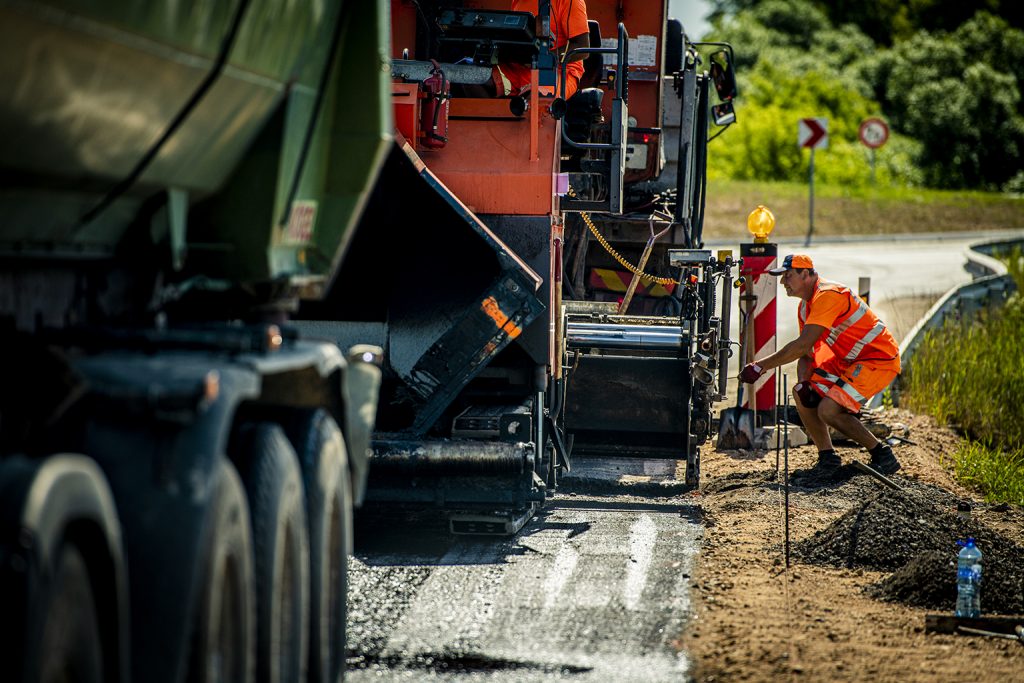
Latvia’s state road agency has confirmed it will need to cancel several planned infrastructure projects this year due to rising material costs, particularly for bitumen, a key component in road construction and maintenance.
The announcement came during the annual Latvian Roads Conference on Thursday, April 23, 2026, where Verners Akimovs, a board member of the Latvian State Roads (LVC), outlined the financial pressures facing the agency. According to Akimovs, the surge in prices extends beyond bitumen to include sand, gravel, crushed stone, and other construction materials, with some costs increasing by as much as 25% over the past year.
LVC, established in late 2004 and fully owned by the Latvian state, manages over 20,000 kilometers of national roads, overseeing their maintenance, administration of funding, and procurement for state needs. The agency said it may be forced to scale back or delay both major road reconstruction projects and regional road upgrades, substituting full reconstructions with simpler surface renovations where feasible.
Some postponed projects could be rescheduled for next year, Akimovs suggested, while others may be cancelled outright if funding does not improve. He specifically mentioned that projects such as the reconstruction of the Viļāni–Preiļi–Spoģi highway are under review for potential cancellation or delay.
The core issue, Akimovs emphasized, is a significant gap between allocated and required funding. For capital investments this year, the state has allocated 153 million euros, but LVC estimates that 407 million euros are necessary to meet infrastructure needs. Similarly, while 57 million euros have been set aside for routine road maintenance, the agency states that 173 million euros are actually required to properly uphold the national road network.
Akimovs pointed out that many regional roads already have developed construction plans, but lack the financial backing to move forward. He argued that relying solely on the state budget is insufficient for sustainable road development and called for additional external financing, particularly through upcoming European Union structural funding periods.
“the development of state roads cannot be achieved with state budget funds alone,” Akimovs said. “Other, external funding is necessary, so road reconstruction must be planned with resources from the next European Union Structural Funds planning period.”
The situation reflects broader challenges across European infrastructure sectors, where inflation in construction materials has strained public works budgets. LVC oversees one of the most extensive road networks in the Baltics, and any reduction in maintenance or expansion could affect regional connectivity, freight transport, and road safety.
As of the conference date, no official list of cancelled or delayed projects had been published by LVC. The agency indicated that further details would be shared as project reviews continue through the remainder of 2026.
For updates on Latvia’s national road projects and funding allocations, the public can refer to the official website of Latvijas valsts ceļi (LVC) at lvc.lv, where procurement notices, project plans, and financial reports are regularly posted.
World Today Journal will continue to monitor developments in Latvian infrastructure policy and report on any official decisions regarding project timelines or funding adjustments.
Have insights or observations about road infrastructure in Latvia or the Baltics? Share your thoughts in the comments below, and help spread awareness by sharing this article with others interested in public works and regional development.