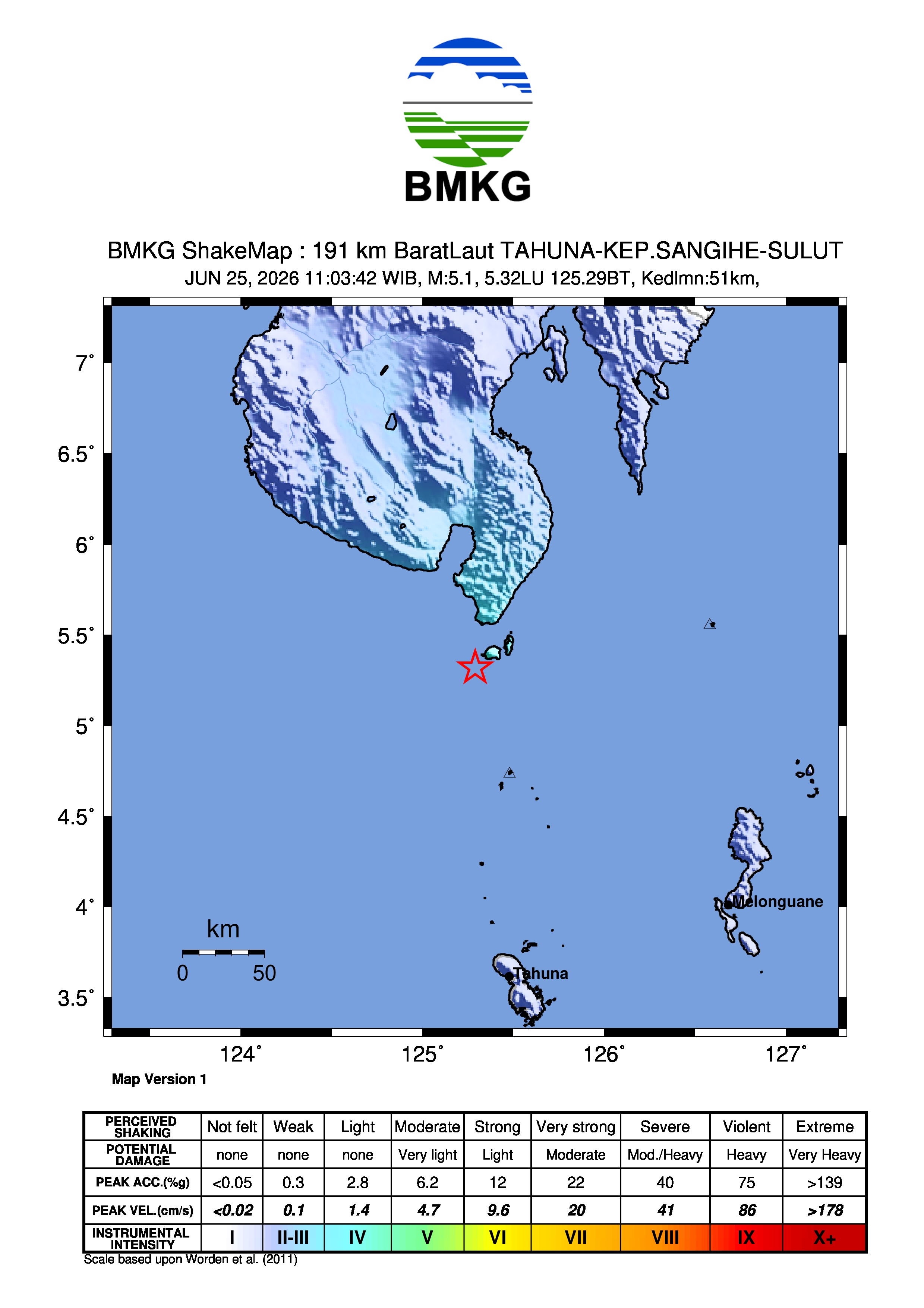
An earthquake with a magnitude of 5.3 struck a region approximately 213 kilometers northwest of the Sangihe Islands in North Sulawesi, Indonesia, according to monitoring data from the Badan Meteorologi, Klimatologi, dan Geofisika (BMKG). The seismic event, which occurred in the waters of the Sulawesi Sea, did not trigger a tsunami warning, as authorities confirmed the tremor did not pose a threat to coastal communities.
The earthquake, recorded by the Indonesian Agency for Meteorology, Climatology, and Geophysics (BMKG), serves as a reminder of the region’s high seismic activity. Located along the Pacific Ring of Fire, the Indonesian archipelago experiences frequent tectonic shifts due to the complex interaction between the Eurasian, Pacific, and Indo-Australian plates. While residents in the Sangihe Islands and nearby Tahuna often report feeling ground motion from offshore events, this specific 5.3-magnitude quake was centered at a significant distance from populated landmasses, minimizing the potential for structural damage.
Seismic Activity in the Sulawesi Region
The North Sulawesi region, particularly the areas surrounding the Sangihe Islands and Melonguane, is subject to constant monitoring by the BMKG. Seismic events in this area are common, though they vary significantly in intensity. For example, while a 5.3-magnitude event is classified as moderate, lower-magnitude tremors, such as the 3.7-magnitude earthquake reported near Melonguane, occur with greater frequency. These smaller events are often barely perceptible to the public but are vital indicators for geologists tracking crustal stress.
The BMKG maintains a network of seismograph stations across the archipelago to provide real-time data to the public. According to their official portal for earthquake information, the agency prioritizes the rapid dissemination of data to prevent misinformation during seismic activity. By providing the exact coordinates, depth, and magnitude of each event, the agency allows local disaster management authorities to assess whether an evacuation or alert is necessary.
Understanding Tsunami Risks and Safety Protocols
A primary concern for coastal residents following any offshore earthquake is the potential for a tsunami. In this instance, the BMKG explicitly stated that the 5.3-magnitude earthquake did not possess the characteristics required to displace the volume of water necessary to generate a tsunami. Tsunami generation typically requires a high-magnitude event occurring at a shallow depth, often with a vertical seafloor displacement.
For residents in high-risk zones, local authorities and the National Agency for Disaster Countermeasure (BNPB) recommend maintaining awareness of emergency procedures. The standard advice for those who feel a strong earthquake includes:
- Drop, cover, and hold on if indoors.
- Move to higher ground if near the coast and the shaking is strong enough to make standing difficult.
- Avoid using elevators in multi-story buildings.
- Monitor official channels, such as the BMKG mobile application or website, rather than relying on unverified social media reports.
Regional Geography and Tectonic Context
The Sangihe Islands, which lie between the northern tip of Sulawesi and the southern Philippines, are situated in a geologically volatile zone. The interaction between the Sangihe microplate and the surrounding larger plates creates a complex environment where earthquakes are frequent. Data from the United States Geological Survey (USGS) often corroborates the findings of the BMKG, highlighting the consistent tectonic pressure exerted on this specific corridor of the Sulawesi Sea.

While the 5.3-magnitude event caused no reported casualties or significant damage, it underscores the necessity for building codes that emphasize seismic resilience in North Sulawesi. As urban development continues in towns like Tahuna, the integration of earthquake-resistant design remains a critical component of regional government policy. Authorities continue to urge the public to remain vigilant, as seismic activity in the region remains unpredictable by nature.
The BMKG continues to monitor the region for any potential aftershocks. Residents are encouraged to check the official BMKG website for the latest updates regarding any further seismic activity in the North Sulawesi area. For those interested in regional developments, please share your thoughts or local observations in the comments section below.
- MP Adib Abdel Masih Meets Syrian Chargé d’Affaires to Strengthen Lebanon-Syria Relations
- Illinois and States Sue Trump Administration Over Commercial Driver Data Access
- Prabowo Highlights Indonesia’s AAA-Rated Panda Bond Issuance (time.news)
- Indonesia Proposes Limited Dual Citizenship to Attract Global Talent (news-usa.today)