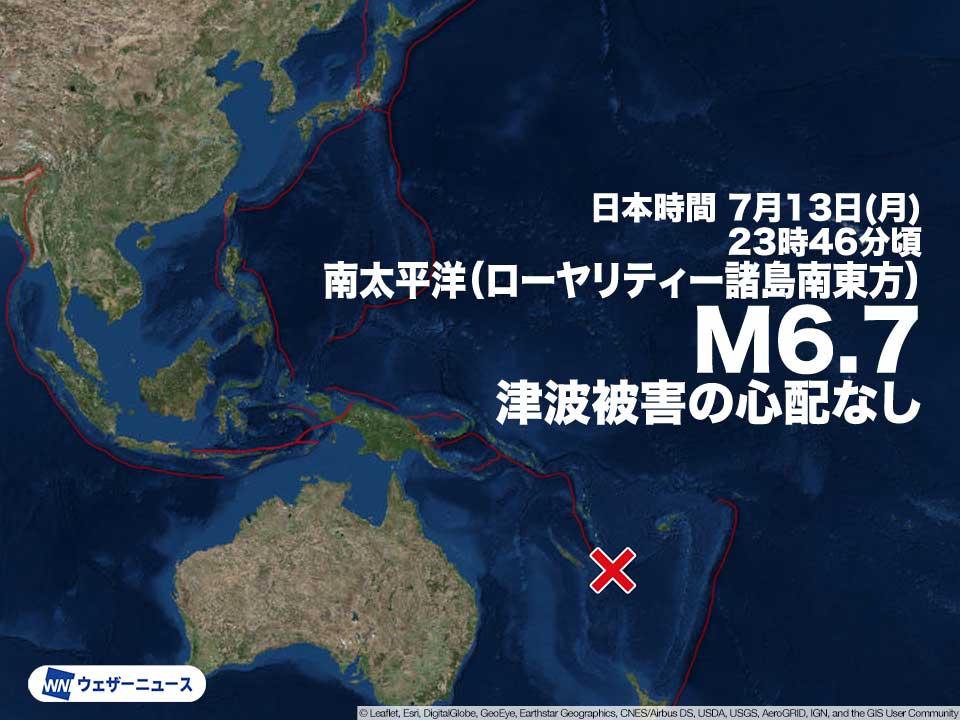
A magnitude 6.7 earthquake struck a remote region of the South Pacific on Wednesday, prompting international monitoring agencies to quickly assess the risk to coastal communities. Following the tremor, official bulletins confirmed that there is no threat of a tsunami, as the location and depth of the seismic event did not meet the criteria for generating significant displacement of seawater.
The earthquake was detected in a sparsely populated area of the South Pacific, a region known for its high level of tectonic activity along the Pacific Ring of Fire. According to data provided by the United States Geological Survey (USGS), which monitors global seismic activity in real-time, the quake occurred at a depth that significantly mitigated its impact on the surface. Because of this depth and the distance from major landmasses, the event did not trigger emergency evacuation protocols or tsunami warnings for surrounding island nations.
Seismic Activity and Tsunami Risk Assessment
When a large earthquake occurs in an oceanic environment, the primary concern for regional authorities is the potential for a tsunami. A tsunami is typically generated by shallow, high-magnitude undersea earthquakes that cause massive vertical displacement of the seafloor. In this instance, international geological centers, including the Pacific Tsunami Warning Center, analyzed the hypocenter of the magnitude 6.7 quake and determined that the energy release was insufficient to displace the water column in a way that would create a hazardous wave.

Regional seismological networks continuously track these events to provide accurate, timely information to the public. For residents in the broader South Pacific, this incident serves as a reminder of the importance of maintaining awareness of local geological hazards. Official agencies advise that in the event of any future seismic activity, individuals should rely exclusively on updates from national meteorological services or the Intergovernmental Oceanographic Commission (IOC) of UNESCO, which coordinates tsunami warning systems globally.
Understanding the Pacific Ring of Fire
The South Pacific remains one of the most geologically dynamic regions on Earth. The majority of the world’s earthquakes and volcanic eruptions occur along the “Ring of Fire,” a 40,000-kilometer horseshoe-shaped belt where several tectonic plates meet. These plates—including the Pacific, Australian, and Philippine Sea plates—are in constant, slow-motion interaction, leading to frequent seismic events.
While a magnitude 6.7 earthquake is considered a significant seismic event, the actual impact on the ground depends on a variety of factors, including the proximity of the epicenter to human settlements and the structural integrity of local infrastructure. In this specific case, the lack of reported damage or casualties reflects the isolated nature of the epicenter. The European-Mediterranean Seismological Centre (EMSC) often provides supplementary data for such events, allowing researchers to refine their understanding of tectonic shifts in the Southern Hemisphere.
How to Access Official Seismic Updates
For those living in or traveling to the South Pacific, staying informed through verified channels is essential. Relying on social media or unverified reports during a seismic event can lead to unnecessary panic or the dissemination of misinformation. Official updates regarding earthquake magnitude, depth, and potential tsunami threats are published immediately by national geological agencies.

Readers are encouraged to monitor the USGS Earthquake Hazards Program for the most accurate, peer-reviewed data on seismic events worldwide. By following these official sources, the public can ensure they receive reliable information regarding safety advisories and the status of local environments. We will continue to monitor regional seismic reports and provide updates should any further significant activity occur. Please share this information with others to ensure accurate reporting reaches those in the affected regions.