The Controversy Surrounding IQ, Race, and Societal Morality: Examining Andrew Branca’s Claims
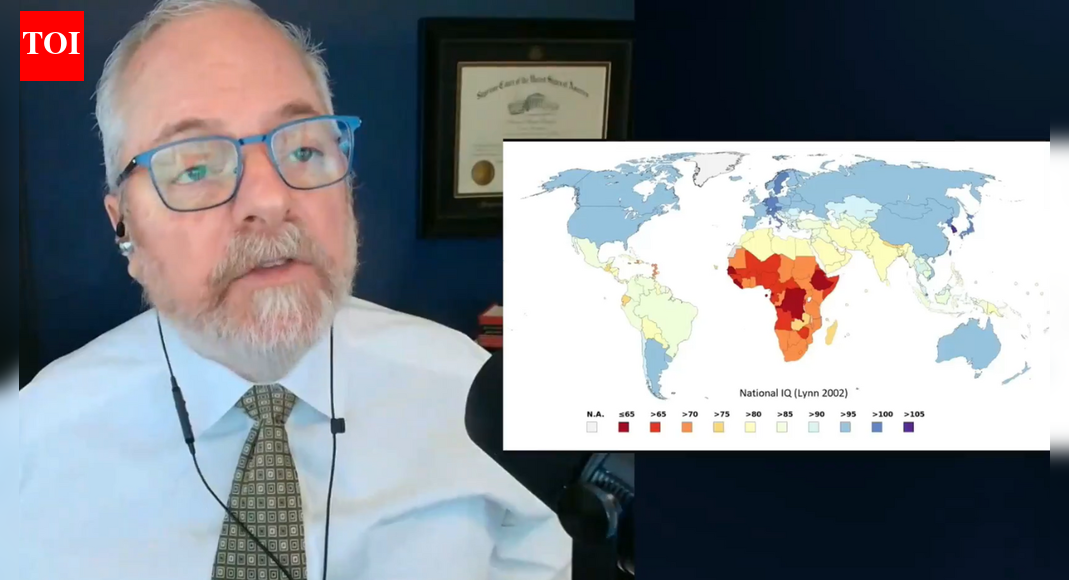
The intersection of intelligence, race, and societal advancement is a deeply sensitive and often contentious topic. Recently, MAGA influencer Andrew Branca ignited a firestorm of debate after sharing a demographic map and accompanying commentary on X (formerly Twitter) linking national IQ scores with racial demographics and perceived moral standards. This article delves into the core of branca’s claims,the controversial research he cites,the criticisms leveled against it,and the broader implications of such arguments. We’ll unpack the complexities, separating scientific inquiry from perhaps harmful generalizations.
Branca’s Core Argument: A Summary
Branca’s posts centered around the assertion that nations with higher average IQ scores – which he explicitly linked to predominantly white populations – tend to produce morally ”good” and prosperous societies. Conversely, he argued that nations with lower average IQs – characterized as “almost invariably non-white” – correlate with societies exhibiting weaker moral standards.
He specifically pointed to “first-world” countries like the United States, Europe, and Australia as examples of high-IQ, high-trust societies, while criticizing nations in Sub-Saharan Africa, India, and Central America. Branca further claimed that the introduction of populations from “third-world” countries into “first-world” nations leads to a decline in societal standards, citing cities like Minneapolis and Dearborn as examples.
The Source of the Controversy: IQ and the Wealth of Nations
Branca’s argument heavily relies on the 2002 book IQ and the Wealth of Nations by richard Lynn and Tatu Vanhanen. This work attempts to establish a correlation between national average IQ scores and per capita Gross Domestic Product (GDP). The authors argue that higher national IQs are associated with greater economic prosperity.
However, the book has been met with significant and sustained criticism from the scientific community. These criticisms are crucial to understanding the context of Branca’s claims.
Why IQ and the Wealth of Nations is Highly Contested
The criticisms of Lynn and Vanhanen’s work are multifaceted and serious:
* Methodological Flaws: Researchers have pointed to inconsistencies in the data collection methods used to determine national IQ scores. Many scores were based on limited data, extrapolated from small sample sizes, or relied on outdated testing methods. (Source: The Guardian -[https://wwwtheguardiancom/science/2002/oct/19/geneticsenvironment[https://wwwtheguardiancom/science/2002/oct/19/geneticsenvironment[https://wwwtheguardiancom/science/2002/oct/19/geneticsenvironment[https://wwwtheguardiancom/science/2002/oct/19/geneticsenvironment)
* Racial Bias: Critics argue the book exhibits inherent racial bias, selectively interpreting data to support pre-existing notions of racial superiority. The very premise of ranking nations based on IQ, and then linking those rankings to racial demographics, is seen as problematic.
* Correlation vs. Causation: Even if a correlation between IQ and GDP exists, it doesn’t prove causation.Numerous other factors – including political stability, access to education, healthcare, natural resources, and ancient context - considerably influence a nation’s economic development. Attributing wealth solely to IQ is a gross oversimplification. (Source: Scientific American -[https://wwwscientificamericancom/article/why-iq-tests-are-not-a-measure-of-racial-superiority/[https://wwwscientificamericancom/article/why-iq-tests-are-not-a-measure-of-racial-superiority/[https://wwwscientificamericancom/article/why-iq-tests-are-not-a-measure-of-racial-superiority/[https://wwwscientificamericancom/article/why-iq-tests-are-not-a-measure-of-racial-superiority/)
* Ignoring Environmental Factors: The book downplays the impact of environmental factors – such as nutrition, education, and socioeconomic conditions – on cognitive development.These factors can significantly influence IQ scores within and between populations.
* Ethical Concerns: The book’s conclusions have been used to justify racist and discriminatory ideologies, raising serious ethical concerns.
The Dangers of Linking IQ, Race, and Morality
Branca’s interpretation of Lynn and Vanhanen’s work takes the controversy a step further by explicitly linking IQ to morality. This is a particularly dangerous assertion.
* Moral Superiority is Not genetically Determined: Moral values are shaped by culture, upbringing, and individual choices, not by inherent intelligence. To suggest that one race is inherently more moral than another is a form of racism with a long and harmful history.
* reinforcing Prejudice: Claims like Branca’s reinforce existing prejudices and stereotypes, contributing
Keep reading