
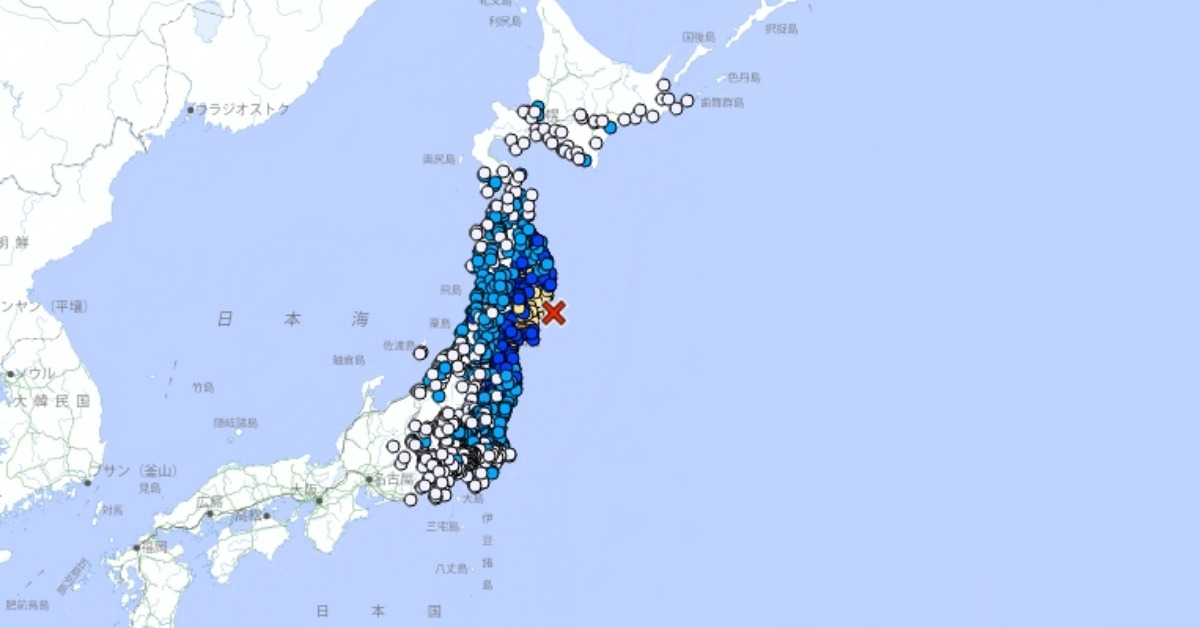
A powerful magnitude 6.3 earthquake struck the waters off the coast of Miyagi Prefecture in northeastern Japan on Friday evening, sending jolts through the region and prompting immediate safety alerts. The seismic event, which occurred at 8:22 p.m. Local time on May 15, 2026, was felt strongly across the Tohoku region, though authorities have confirmed that no tsunami warning was issued following the tremor.
The quake originated at a depth of approximately 50 kilometers, with the epicenter located at coordinates North 38.9 and East 142.1, off the coast of Miyagi. According to preliminary data from the Japan Meteorological Agency (JMA), the tremor reached a maximum seismic intensity of 5-lower on the Shindo scale in parts of Miyagi Prefecture, a level capable of causing significant shaking that makes it tough for people to remain standing.
Emergency services and local officials in northeastern Japan have begun assessing the region for potential infrastructure damage. While the magnitude 6.3 earthquake in northeastern Japan was significant enough to cause widespread alarm, the depth of the quake and its offshore epicenter contributed to the absence of a tsunami threat, providing a critical reprieve for coastal communities that remain vigilant following the region’s history of devastating seismic activity.
Seismic Analysis and the Shindo Scale
To understand the impact of this event, This proves essential to distinguish between magnitude and intensity. While the magnitude of 6.3 measures the total energy released at the source, the JMA uses the “Shindo” scale to measure the actual shaking felt on the ground at specific locations. A “5-lower” intensity is a substantial level of shaking; typically, at this level, unsecured furniture may move or fall over, and many people will find it difficult to walk.


The depth of 50 kilometers is considered shallow to intermediate. In seismic terms, shallower earthquakes often result in more intense surface shaking compared to deeper events of the same magnitude. Because this quake occurred offshore, the energy was dissipated across the ocean floor before reaching the coastline, which likely mitigated the potential for catastrophic structural failure in inland cities.
Geologically, this region of Japan sits atop one of the most volatile tectonic junctions in the world. The interaction between the Pacific Plate and the Okhotsk Plate creates immense pressure that is periodically released through these tremors. This constant activity makes the Tohoku region a focal point for global seismological study and necessitates some of the strictest building codes on earth.
Tsunami Risk and Coastal Safety
One of the primary concerns during any significant offshore quake in Japan is the displacement of water that leads to a tsunami. In this instance, the Mainichi Shimbun reported that no tsunami warnings were issued. This determination is based on the earthquake’s magnitude, the specific movement of the fault line, and the depth of the epicenter.
For residents of Miyagi and neighboring prefectures, the absence of a warning does not mean a total lack of caution. Local disaster management protocols advise residents in low-lying coastal areas to remain aware of official updates, as aftershocks can occasionally trigger localized sea-level changes or landslides in unstable terrain.
The Japanese government’s rapid-response system, which integrates seismic sensors with nationwide cellular alerts, ensured that the majority of the population received warnings seconds before the strongest waves of the quake arrived. This “Early Warning System” is a cornerstone of Japan’s disaster mitigation strategy, designed to allow people to seek cover and trains to automatically slow down.
Regional Impact and Infrastructure Readiness
As of Friday night, there have been no immediate reports of widespread casualties or major structural collapses. However, the “5-lower” shaking in Miyagi Prefecture typically triggers automatic safety shutdowns for high-speed rail lines and industrial plants. Shinkansen (bullet train) operators typically implement precautionary speed restrictions or temporary halts following a magnitude 6.0+ event to ensure track integrity.
The Tohoku region has spent over a decade reinforcing its infrastructure following the Great East Japan Earthquake of 2011. This includes the construction of higher sea walls and the implementation of advanced seismic dampers in public buildings. The resilience of the current infrastructure is being put to the test by this latest event, which serves as a reminder of the region’s inherent vulnerability.
Local authorities are currently monitoring power grids and water lines for leaks or outages. In the immediate aftermath of such quakes, the primary risk often shifts to secondary hazards, such as fires caused by ruptured gas lines or landslides in the mountainous interior of the Tohoku region.
Key Takeaways for Residents and Travelers
- Event: Magnitude 6.3 earthquake.
- Location: Off the coast of Miyagi Prefecture, Japan.
- Time: May 15, 2026, at 8:22 p.m. Local time.
- Tsunami Status: No tsunami warning has been issued.
- Max Intensity: Shindo 5-lower (Miyagi Prefecture).
- Epicenter Depth: 50 kilometers.
What Happens Next
Seismologists are now monitoring the region for aftershocks, which are common following a magnitude 6.3 event. While aftershocks are generally smaller than the main shock, they can pose a risk to buildings already weakened by the initial tremor.

The Japan Meteorological Agency will continue to provide updated seismic data and intensity maps. Residents are encouraged to check official government channels and avoid relying on unverified social media reports during the initial assessment phase.
The next official update regarding infrastructure damage and potential casualty counts is expected from Miyagi prefectural officials early Saturday morning.
World Today Journal encourages readers to share this update to keep friends and family in the region informed. Please leave your comments below if you are in the affected area and can provide first-hand accounts of the situation.