
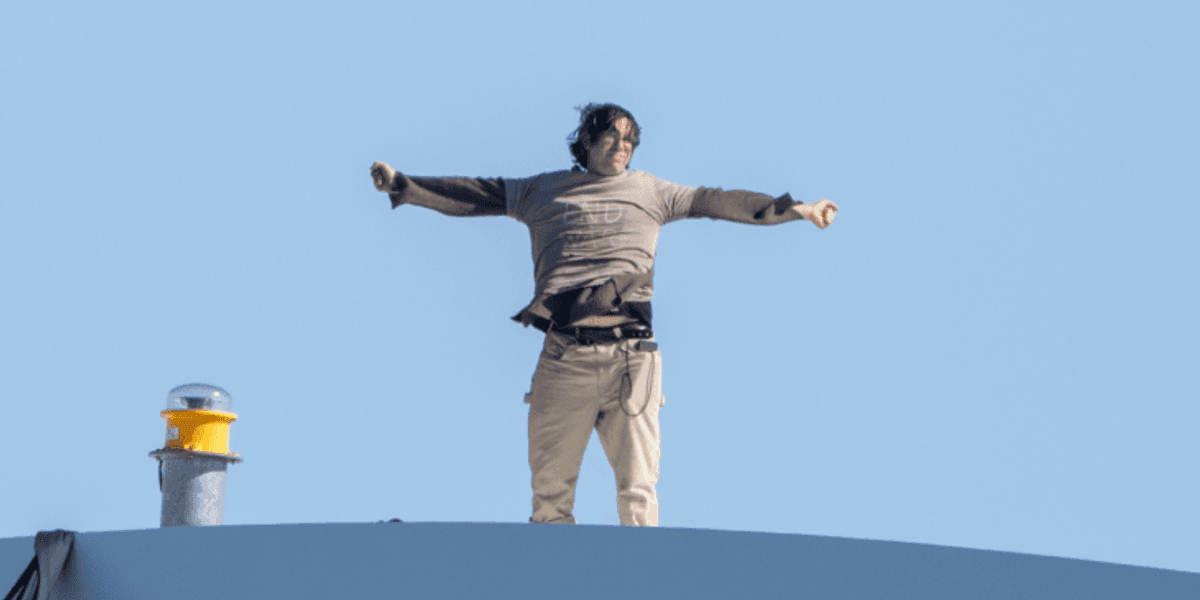
A high-stakes standoff unfolded in the heart of the U.S. Capital as a man scaled the Frederick Douglass Memorial Bridge, sparking a massive police response and paralyzing regional traffic. The individual, whose identity was not immediately released by authorities, climbed to the top of the bridge’s structure to protest U.S. Foreign policy, specifically demanding an end to conflict involving Iran.
The incident, which began on a day of significant traffic congestion, saw the protester ascend a height reported as 168 feet. From this vantage point, he issued a series of demands and declarations, stating I refuse to be complicit
in what he described as the ongoing war effort. The act forced the closure of multiple lanes and the eventual shutdown of South Capitol Street as emergency crews and negotiators converged on the scene.
Metropolitan Police Department (MPD) officers and crisis negotiators spent hours attempting to persuade the man to descend safely. The situation created a barricade situation
, according to reports from WTOP, as police cordoned off the surrounding areas to ensure public safety and prevent any further disruptions to the bridge’s structural integrity or the flow of traffic below.
The Frederick Douglass Memorial Bridge is a critical artery for commuters in Washington, D.C., and the disruption caused by the protest sent ripples through the city’s transportation network. While the bridge eventually reopened to traffic, the event highlighted the growing trend of high-visibility, disruptive protests aimed at influencing federal foreign policy decisions.
The Ascent and the Message
The protester’s decision to scale the bridge was not merely a bid for attention but a calculated act of civil disobedience. Witnesses and media outlets on the scene, including NewsNation, reported that the man spoke live from atop the structure, articulating his grievances regarding the geopolitical tension between the United States, and Iran. He argued that the U.S. Government’s actions in the region were immoral and that citizens had a duty to physically manifest their dissent.
The height of the bridge—approximately 168 feet—presented a significant challenge for law enforcement. Standard rescue operations were complicated by the bridge’s architecture, requiring the deployment of specialized equipment and personnel. Throughout the ordeal, the man remained steadfast in his position, refusing to come down until his message regarding the Iran War
was acknowledged.
This form of protest, known as “vertical protest,” is designed to create an unavoidable visual disruption. By occupying a space that is physically above the reach of standard police intervention and visible to thousands of commuters and government officials, the protester ensured that his demands could not be easily ignored by the public or the press.
Impact on Washington D.C. Infrastructure
The immediate fallout of the protest was felt most acutely by the thousands of motorists utilizing the Frederick Douglass Memorial Bridge. As the situation escalated, the Metropolitan Police Department took the decisive step of closing lanes and eventually shutting down South Capitol Street. This action was necessary to provide a safe perimeter for the crisis negotiators and to prevent any potential accidents should the protester fall or should police be forced to use tactical intervention.
According to reports from FOX 5 DC and NBC4 Washington, the closure led to significant delays across the Southeast quadrant of the city. Commuters were diverted to alternative routes, which in turn caused congestion on nearby corridors. The bridge, which serves as a vital link between the city and the Maryland suburbs, became a focal point of both a security operation and a public spectacle.
The “barricade situation” mentioned by WTOP indicated that police were not only managing the person on the bridge but also controlling the perimeter to keep onlookers and other potential protesters from interfering with the operation. The coordination between the MPD and the District Department of Transportation (DDOT) was critical in managing the flow of traffic once the scene was deemed secure and the bridge was reopened.
The Geopolitical Context of the Protest
The protester’s focus on the “Iran War” refers to a complex web of diplomatic failures, economic sanctions, and proxy conflicts that have characterized U.S.-Iran relations for decades. While the U.S. And Iran are not engaged in a conventional, declared war, the “shadow war” involves cyberattacks, maritime skirmishes in the Persian Gulf, and tensions surrounding Iran’s nuclear program.
For activists like the man on the bridge, the term “war” encompasses the systemic pressure placed on the Iranian population through sanctions and the military presence of the U.S. In the Middle East. The phrase I refuse to be complicit
suggests a belief that the average citizen is indirectly supporting these policies through taxes and silence, and that only extreme, disruptive action can break that complicity.
This incident is part of a broader pattern of protests in Washington, D.C., where activists target landmarks and infrastructure to bring attention to international human rights issues or foreign policy disputes. From the scaling of monuments to the blocking of highways, the strategy is to transform a functional piece of the city into a political stage.
Key Takeaways from the Incident
- The Action: A man scaled the 168-foot Frederick Douglass Memorial Bridge in Washington, D.C.
- The Motive: The individual demanded an end to U.S. Involvement in conflicts with Iran, stating he refused to be complicit.
- The Disruption: The protest led to the closure of multiple lanes and the total shutdown of South Capitol Street.
- The Resolution: After hours of negotiations, the situation was resolved, and the bridge was reopened to the public.
- The Method: The use of “vertical protest” was employed to ensure maximum visibility and disruption.
Legal and Safety Implications of Bridge Protests
Scaling critical infrastructure such as the Frederick Douglass Memorial Bridge carries severe legal consequences. Depending on the specific charges filed by the U.S. Attorney’s Office or local prosecutors, the individual could face charges ranging from disorderly conduct and trespassing to more serious counts of reckless endangerment or interfering with a police officer.

From a safety perspective, such actions place an immense burden on city resources. The deployment of crisis negotiators, specialized rescue teams, and traffic control officers requires a diversion of manpower from other emergency services. The risk of a fatal fall is high, which would transform a political protest into a tragedy and a potential liability for the city.
The Metropolitan Police Department generally treats these incidents as “person-in-crisis” calls until the motives are clarified. Once it is established that the act is a political protest, the approach shifts toward a combination of negotiation and containment. The goal is always to resolve the situation without injury to the protester, the officers, or the general public.
As the city of Washington continues to be a hub for global political expression, the tension between the right to protest and the need for public safety and infrastructure stability remains a point of contention. The Frederick Douglass Memorial Bridge incident serves as a stark reminder of the lengths to which some individuals are willing to go to signal their dissent in an era of deep political polarization.
There are currently no further scheduled demonstrations of this nature on the Frederick Douglass Memorial Bridge, though local authorities remain vigilant regarding similar tactics at other city landmarks. Official updates on any subsequent charges or legal proceedings against the individual are expected to be released through the Metropolitan Police Department’s public information office.
We invite our readers to share their thoughts on the balance between disruptive protest and public safety in the comments below. Please share this report to keep the global community informed.