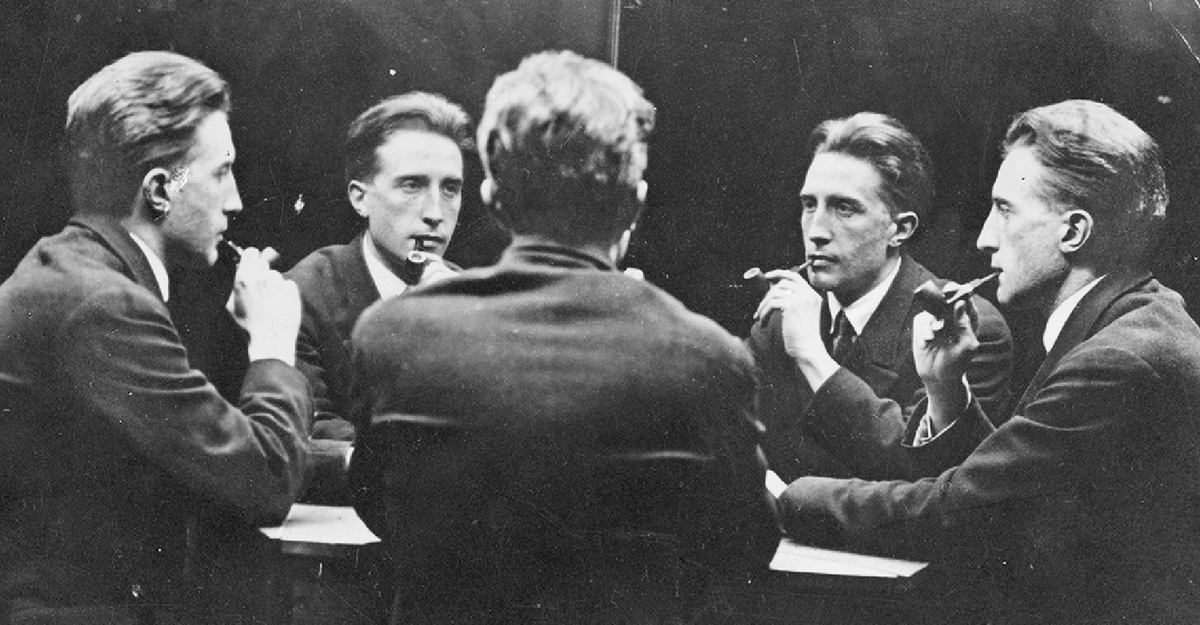
Marcel Duchamp, the French avant-garde provocateur who declared “painting is finished” in 1912, didn’t just challenge art—he dismantled its very foundations. By elevating everyday objects like urinals and bicycle wheels to the status of art through his “readymades,” and creating works that blurred the line between life and art, Duchamp became the architect of conceptual art. His legacy remains one of the most polarizing in modern art history, with critics either hailing him as a revolutionary or condemning him as a destroyer of artistic tradition.
Born in 1887 in Blainville-Crevon, Normandy, Duchamp grew up in a family steeped in artistic tradition. His grandfather was a successful painter, and three of his brothers became professional artists. Yet Duchamp rejected conventional artistic training, famously declaring at age 25 that “painting is finished” after witnessing a propeller at an air show in Paris. This statement marked the beginning of his radical departure from traditional art forms.
Duchamp’s first “readymade,” Bicycle Wheel (1913), consisted of a bicycle wheel mounted on a stool—a simple yet provocative statement about the potential of ordinary objects to become art. His most infamous work, Fountain (1917), a porcelain urinal signed “R. Mutt,” was initially rejected by the Society of Independent Artists in New York but later became one of the most discussed artworks of the 20th century. According to the Museum of Modern Art, Fountain challenged the very definition of art by questioning whether an artist’s hand was necessary for creation.
Why Duchamp’s Readymades Still Matter Today
Duchamp’s readymades were not just artistic statements—they were philosophical provocations. By selecting mass-produced objects and presenting them as art, he questioned the role of the artist, the nature of creativity, and the boundaries of aesthetic value. His approach paved the way for later movements like Pop Art, Minimalism, and even contemporary conceptual art.

Art historian Hal Foster notes that Duchamp’s work “shifted the focus from the object itself to the idea behind it.” This shift allowed artists to explore new mediums, from performance art to digital installations, without being constrained by traditional techniques.
One of Duchamp’s most enduring legacies is his influence on the art market. By introducing the concept of the readymade, he demonstrated that an object’s value could be derived from its context rather than its material or craftsmanship. This idea has been embraced by contemporary artists like Maurizio Cattelan, whose 2021 banana duct-taped to a wall sold for $120,000, proving that Duchamp’s philosophy remains relevant in today’s art world.
Duchamp’s Secret Life: Eroticism, Chess, and Unrequited Love
Beyond his artistic innovations, Duchamp’s personal life was equally enigmatic. His work was deeply intertwined with his fascination with eroticism, chess, and unfulfilled romantic love. In 1920, he created a female alter ego named Rrose Sélavy, a play on words that sounds like “Eros, c’est la vie” (Eros, that’s life). This persona allowed him to explore themes of gender and identity in his art.
Duchamp’s most controversial work, Étant donnés (1969), was only revealed after his death. The piece consists of a wooden door with peepholes leading to a disturbing scene of a naked woman’s torso lying on a bed of branches. According to the Philadelphia Museum of Art, the work was assembled using casts of his second wife, Teeny Duchamp, and two of his lovers. The piece remains one of the most unsettling and debated works in modern art.
Duchamp’s obsession with chess was equally significant. He played competitively for over three decades, representing France in four Chess Olympiads. His dual passions for art and chess reflected his belief in the interplay between logic and creativity. As he once wrote, “Chess is a game of logic, but it also requires intuition and creativity.”
The Large Glass: Duchamp’s Unfinished Masterpiece

One of Duchamp’s most ambitious works, The Bride Stripped Bare by Her Bachelors, Even (1915–1923), commonly known as The Large Glass, is a complex assembly of glass, metal, and dust. The piece depicts a bride and nine bachelors in a mechanical, almost industrial setting. Duchamp intended it to be accompanied by a detailed explanation,
Related reading