Ancient Life on Mars? New Research Points to Icy Preservation
The search for life beyond Earth may need to focus on a new target: ice. A groundbreaking study from NASA and Penn State University suggests that ancient microbial life, or at least its molecular remnants, could survive for tens of millions of years trapped within Martian ice. This finding dramatically shifts our understanding of where to glance for evidence of past life on the Red Planet, suggesting that pristine ice deposits offer a far more promising environment for preservation than the rocky terrain previously prioritized by many missions. The research, published in the journal Astrobiology, highlights the remarkable resilience of organic molecules and offers a compelling roadmap for future exploration.
For decades, scientists have theorized about the possibility of past life on Mars, a planet that once possessed a warmer, wetter climate. However, the harsh radiation environment on the Martian surface poses a significant challenge to the survival of organic compounds. This new research demonstrates that pure water ice provides a surprisingly effective shield against this radiation, potentially preserving biosignatures for timescales previously thought impossible. The implications extend beyond Mars, offering insights into the potential habitability of icy moons like Europa and Enceladus, which harbor subsurface oceans.
The study focused on amino acids, the building blocks of proteins, extracted from E. Coli bacteria. Researchers subjected these amino acids to conditions mimicking the Martian environment, including extreme cold and prolonged exposure to cosmic radiation. The results were striking: in pure water ice, over 10% of the amino acids remained intact after a simulated 50 million years of radiation exposure. This contrasts sharply with samples mixed with Martian sediment, which degraded much more rapidly. This discovery underscores the importance of targeting pure ice or ice-rich permafrost in future missions, rather than solely focusing on rocks and soil.
Simulating the Martian Environment in the Lab
The research team, led by Alexander Pavlov, a space scientist at NASA Goddard Space Flight Center, meticulously recreated Martian conditions in a laboratory setting. Pavlov, who earned his doctorate in geosciences from Penn State in 2001, explained the methodology. “We sealed E. Coli bacteria inside test tubes filled with pure water ice,” he said. “Other samples were combined with water and materials commonly found in Martian sediment, including silicate-based rocks and clay.” ScienceDaily details the process.
The frozen samples were then subjected to intense gamma radiation at Penn State’s Radiation Science and Engineering Center. The chamber was cooled to -60 degrees Fahrenheit (-51 degrees Celsius), mirroring the temperatures found in icy regions of Mars. The bacteria were exposed to radiation equivalent to 20 million years of cosmic ray bombardment on the Martian surface, with an additional 30 million years modeled to reach the 50-million-year mark. After radiation exposure, the samples were carefully transported back to NASA Goddard under cold conditions for amino acid analysis. This rigorous process allowed researchers to assess the long-term stability of organic molecules under simulated Martian conditions.
The Protective Power of Pure Ice
The results revealed a significant difference in the preservation of amino acids depending on the surrounding environment. In pure water ice, a substantial 10% of the amino acids survived the full 50-million-year simulation. However, samples mixed with Martian sediment experienced a tenfold decrease in survival rate and ultimately degraded completely. This finding suggests that the presence of minerals in the sediment accelerates the breakdown of organic molecules.
Researchers believe this accelerated degradation occurs due to a thin film that forms where ice interacts with minerals. This film may facilitate the movement of radiation, increasing its damaging effect on amino acids. As Pavlov explained, “Whereas in solid ice, harmful particles created by radiation get frozen in place and may not be able to reach organic compounds.” Penn State News further elaborates on this mechanism.
Interestingly, a 2022 study by the same team had already indicated that amino acids preserved in a mixture of 10% water ice and 90% Martian soil degraded faster than samples containing only sediment. This earlier research laid the groundwork for the current study, which revealed the surprising resilience of organic molecules in pure ice. “Based on the 2022 study findings, it was thought that organic material in ice or water alone would be destroyed even more rapidly than the 10% water mixture,” Pavlov noted. “So, it was surprising to find that the organic materials placed in water ice alone are destroyed at a much slower rate than the samples containing water and soil.”
Implications for Exploration Beyond Mars
The findings aren’t limited to the search for life on Mars. The research also has implications for the exploration of other icy worlds in our solar system, particularly Europa, an icy moon of Jupiter, and Enceladus, an icy moon of Saturn. Both moons are believed to harbor subsurface oceans, making them potential habitats for life. The team extended their experiments to simulate the even colder temperatures found on these moons, discovering that deterioration slowed down further at lower temperatures.
These results are particularly encouraging for NASA’s Europa Clipper mission, which launched in 2024 and is scheduled to arrive at Jupiter in 2030. The spacecraft will conduct 49 close flybys of Europa to investigate its ice shell and subsurface ocean, assessing its potential for habitability. The Clipper mission will be equipped with instruments designed to search for biosignatures, and the new research suggests that focusing on ice deposits could significantly increase the chances of success.
Accessing Martian Ice: A Technological Challenge
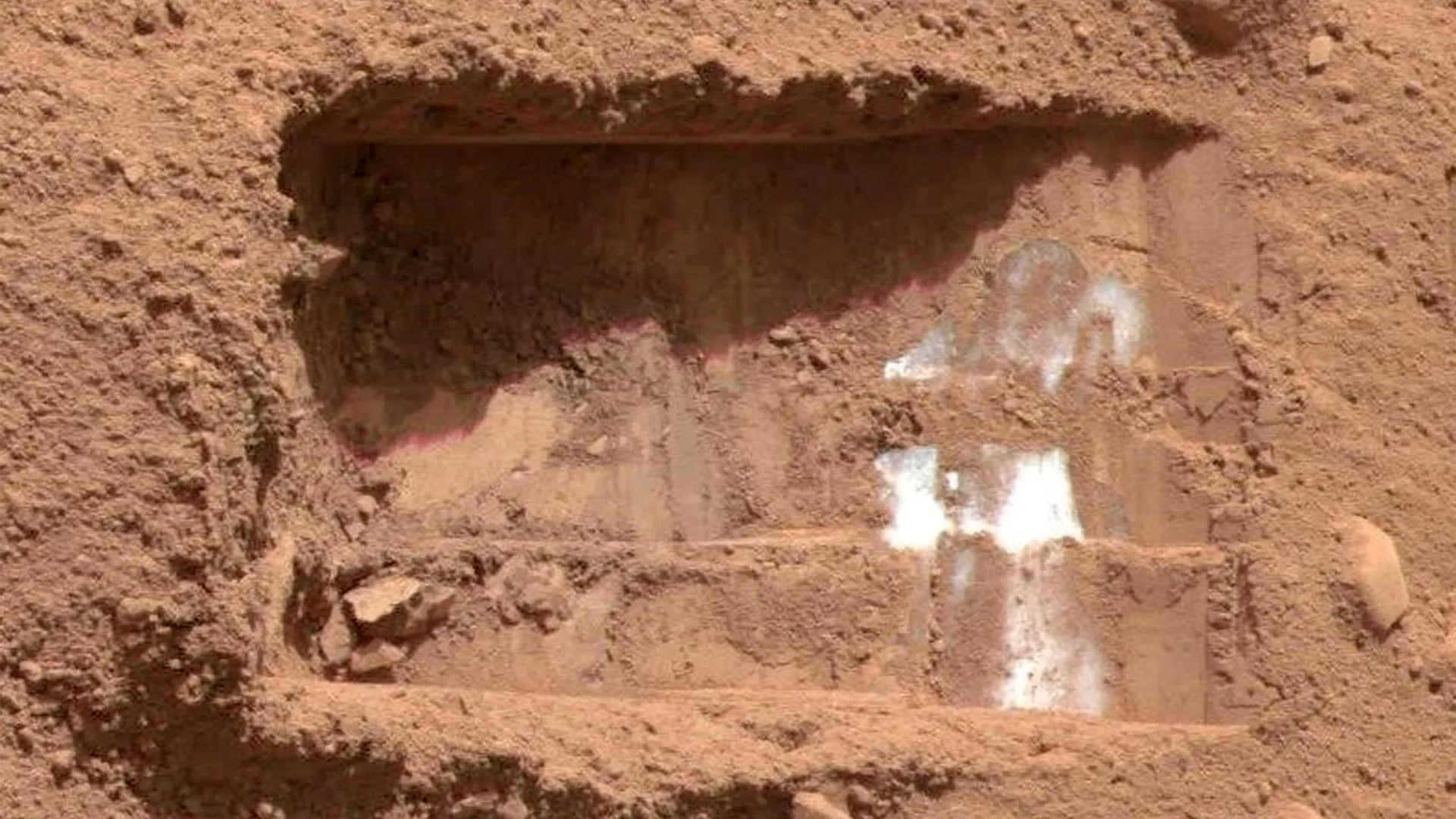
While the research highlights the importance of Martian ice, accessing these deposits presents a significant technological challenge. Future missions will require specialized tools capable of drilling or scooping through the Martian surface to reach the buried ice. The 2008 NASA Mars Phoenix mission was the first to successfully excavate and photograph ice in the Martian Arctic, demonstrating the feasibility of such endeavors.
Christopher House, a co-author of the study and professor of geosciences at Penn State, emphasized the need for advanced drilling capabilities. “There is a lot of ice on Mars, but most of This proves just below the surface,” he said. “Future missions need a large enough drill or a powerful scoop to access it, similar to the design and capabilities of Phoenix.” Developing these tools will be crucial for unlocking the secrets hidden within Martian ice and potentially discovering evidence of past life.
Key Takeaways
- Ice as a Preservative: Pure water ice can protect organic molecules, like amino acids, from radiation damage for tens of millions of years.
- Shift in Search Strategy: Future Mars missions should prioritize exploring pure ice deposits over rocks and soil.
- Implications for Icy Moons: The findings extend to the search for life on Europa and Enceladus, icy moons with subsurface oceans.
- Technological Hurdles: Accessing buried ice requires advanced drilling and excavation technologies.
The research team included Zhidan Zhang, a retired lab technologist at Penn State, along with Hannah McLain, Kendra Farnsworth, Daniel Glavin, Jamie Elsila, and Jason Dworkin of NASA Goddard. The function was funded by NASA’s Planetary Science Division Internal Scientist Funding Program.
The next major step in the search for life on Mars will be the continued analysis of samples collected by the Perseverance rover, which landed in Jezero Crater in February 2021. NASA announced in September 2025 that Perseverance had discovered a potential biosignature in a rock sample, further fueling the excitement surrounding the possibility of past life on the Red Planet. The findings from this new study on ice preservation will undoubtedly inform the strategies used to analyze these samples and guide future missions in the ongoing quest to answer one of humanity’s most profound questions: are we alone?
What are your thoughts on the implications of this research? Share your comments below, and don’t forget to share this article with your network!
Related reading