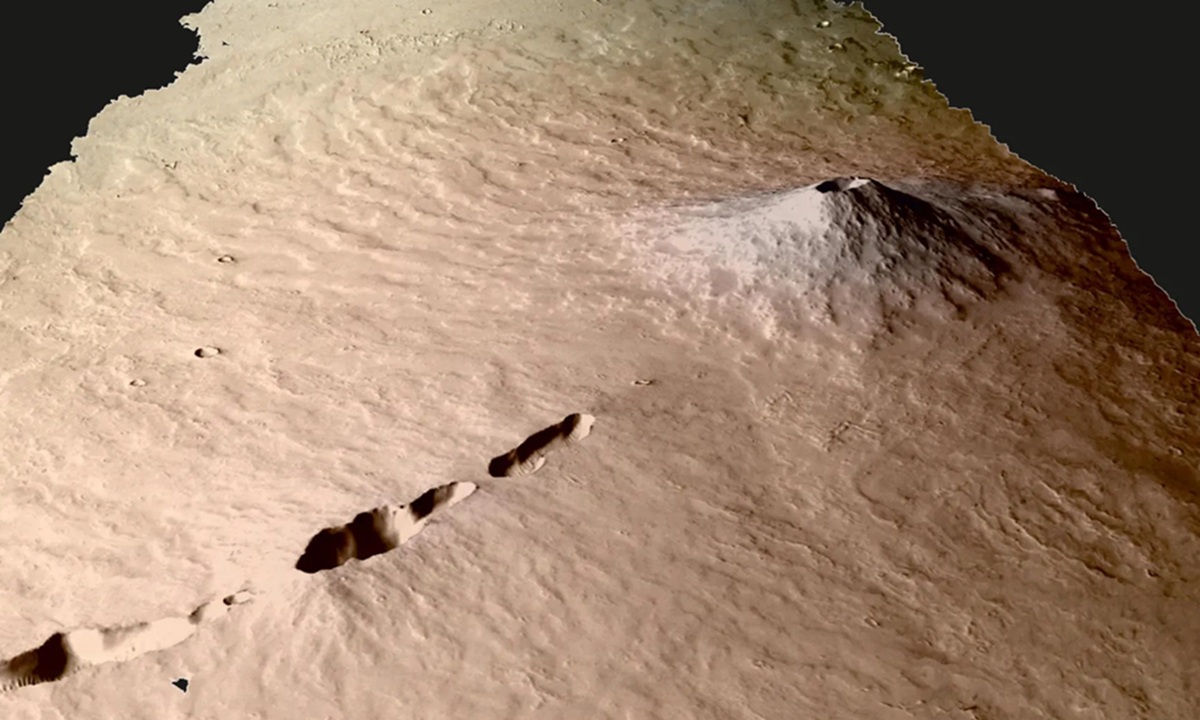
The red planet Mars, long a source of fascination for scientists and space enthusiasts alike, is revealing new secrets about its geological past. Recent research challenges long-held assumptions about Martian volcanoes, suggesting they weren’t simply the result of singular, explosive events. Instead, evidence indicates a far more complex history, driven by evolving magma systems operating beneath the surface for extended periods. This discovery, published in the journal Geology, offers a new perspective on the interior dynamics of Mars and how rocky planets form and change over time.
For years, the prevailing theory posited that Martian volcanoes formed through relatively short-lived eruptions. However, detailed analysis of orbital imagery and mineral data is now painting a different picture. Scientists are finding that even during Mars’ most recent volcanic period, magma systems remained active and complex, shifting and changing chemically over time. This suggests that the planet’s interior was far more dynamic than previously believed, and that volcanic activity on Mars may have been sustained for much longer than initially thought. Understanding these processes is crucial not only for unraveling the history of Mars, but also for gaining insights into the evolution of other rocky planets, including our own Earth.
The research specifically focuses on a volcanic system located south of Pavonis Mons, one of the largest volcanoes on Mars. This region has been the subject of intense scrutiny due to its relatively young age and well-preserved volcanic features. By combining high-resolution surface mapping with orbital mineral data, an international team of researchers, led by Bartosz Pieterek of Adam Mickiewicz University in Poland, has reconstructed the volcanic and magmatic evolution of this area in unprecedented detail. The team included researchers from the University of Iowa and the Lancaster Environment Centre, demonstrating a collaborative effort to unlock the secrets of the Martian landscape.
Unveiling a Complex Magmatic History
The study reveals that the volcanic system near Pavonis Mons didn’t erupt just once, but rather evolved over time as conditions changed in the subsurface. Initially, activity involved lava flows spreading from fissures in the ground. Later eruptions originated from more centralized vents, forming cone-shaped features. These distinct phases of eruption are not isolated events, but rather interconnected stages in a long-lived process driven by a persistent magma system. “Our results show that even during Mars’ most recent volcanic period, magma systems beneath the surface remained active and complex,” Pieterek explained, as reported by ScienceDaily. “The volcano did not erupt just once — it evolved over time as conditions in the subsurface changed.”
Crucially, each eruptive phase left behind a unique “fingerprint” in the form of different mineral compositions. By analyzing these mineral signatures, researchers were able to track how the magma changed over time, revealing insights into its depth of origin and how long it was stored beneath the surface before erupting. These mineralogical variations provide a window into the dynamic processes occurring within the Martian mantle. The changing mineral composition suggests that the magma itself was evolving, a key indicator of a complex and long-lasting system.
Implications for Understanding Mars’ Interior
This research has significant implications for our understanding of Mars’ interior. The discovery of active and evolving magma systems challenges the notion that the planet is geologically “dead.” While Mars doesn’t have plate tectonics like Earth, the presence of ongoing volcanic activity suggests that its interior remains dynamic and capable of generating heat and driving geological processes. This finding supports the idea that Mars may have retained more internal heat than previously thought, potentially extending the period during which liquid water could have existed on its surface – a critical factor in the search for past life.
The study also highlights the importance of orbital data in planetary science. Given that scientists haven’t yet been able to collect rock samples directly from Martian volcanoes, studies based on remote sensing observations are invaluable. The data collected by orbiting spacecraft, such as ESA’s Mars Express, provide a wealth of information about the planet’s surface and subsurface, allowing researchers to reconstruct its geological history without physically visiting the site. Sci.News reports that the detailed surface mapping combined with orbital mineral data was key to reconstructing the volcanic evolution.
The Role of Pavonis Mons
Pavonis Mons, the volcano near which this research was focused, is a particularly intriguing location. As one of the largest volcanoes on Mars, it provides a unique opportunity to study the planet’s volcanic processes. Its relatively young age suggests that volcanic activity on Mars may have persisted for a longer period than previously believed. The complex history of the volcanic system south of Pavonis Mons serves as a model for understanding the evolution of other volcanic regions on the planet. Further research in these areas could reveal even more about the hidden dynamics of Mars’ interior.
The findings also have broader implications for our understanding of planetary volcanism in general. The processes observed on Mars – magma shifting position, changing chemically, and remaining active for extended periods – are likely to occur on other rocky planets and moons throughout the solar system. By studying these processes on Mars, scientists can gain insights into the evolution of volcanic landscapes on other worlds, including potentially habitable environments.
Future Research and the Search for Life
While this study provides valuable new insights into the volcanic history of Mars, many questions remain unanswered. Future research will focus on refining our understanding of the magma system beneath Pavonis Mons, as well as exploring other volcanic regions on the planet. One key goal is to determine the precise timing and duration of volcanic activity on Mars, which could help to constrain the planet’s thermal evolution and assess its potential for past habitability. The European Space Agency’s (ESA) ExoMars Rosalind Franklin rover, scheduled to land on Mars in the coming years, will play a crucial role in this effort. The rover is equipped with instruments capable of analyzing the chemical composition of Martian rocks and soils, providing valuable data that could help to confirm the findings of this study and shed light on the planet’s geological history.
The ongoing exploration of Mars is not only expanding our knowledge of the planet itself, but also informing our understanding of planetary processes throughout the solar system. The discovery of complex magma systems beneath Martian volcanoes is a testament to the power of scientific inquiry and the importance of continued investment in space exploration. As we continue to unravel the mysteries of the red planet, we may also gain valuable insights into the origins and evolution of our own Earth.
The next major step in understanding Martian volcanism will likely come from further analysis of data collected by orbiting spacecraft and, eventually, from the samples returned to Earth by future missions. NASA and ESA are currently collaborating on the Mars Sample Return campaign, which aims to bring Martian rocks and soils back to Earth for detailed analysis in state-of-the-art laboratories. This will provide an unprecedented opportunity to study the planet’s geology and search for evidence of past life.
As Dr. Pieterek and his team continue their research, the scientific community eagerly awaits further discoveries that will undoubtedly reshape our understanding of the red planet. The evolving story of Mars is a reminder that even after decades of exploration, there are still countless secrets waiting to be uncovered.
Stay tuned to World Today Journal for further updates on this developing story and the ongoing exploration of Mars. We encourage you to share your thoughts and questions in the comments below.
Worth a look