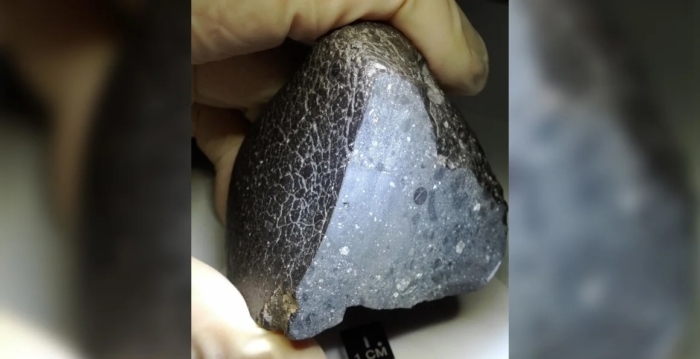
Martian meteorite “Black Beauty” Reveals More Water Than Previously Thought, Boosting Hopes for Past Life
February 8, 2026 – A recent scan of the Martian meteorite “Black Beauty” (NWA 7034) has revealed a substantially higher water content than previously estimated, offering crucial evidence of a wetter past for the Red Planet and bolstering the hypothesis that Mars may once have harbored life.
The meteorite,weighing approximately 11 ounces (320 grams),earned its nickname due to its dark,lustrous appearance. Discovered in the Sahara Desert in 2011, “Black Beauty” is the oldest known Martian meteorite, dating back 4.44 billion years.
Researchers believe the meteorite originated from the Karratha crater in the southern Martian highlands and was ejected into space by an impact event roughly 5 to 10 million years ago, eventually landing on Earth.
While scientists knew “Black Beauty” contained water, accurately measuring its quantity posed a challenge. Conventional analysis required destructive sampling – chipping away at the incredibly valuable meteorite.
However, a new study, submitted in January, utilized an advanced CT scanning technique. Rather of X-rays, researchers employed a neutron beam to penetrate the meteorite. Neutrons excel at identifying hydrogen atoms within dense materials, allowing for a comprehensive analysis of the meteorite’s water content without causing damage.
The scans revealed that water accounts for approximately 0.6% of “Black Beauty’s” total mass. Though seemingly small – equivalent to the amount of water in a fingernail – this is considerably higher than previous estimates.
The water is largely contained within tiny fragments of hydrogen-rich hydroxyl iron oxide (FeHO), a substance similar to the main component of rust, formed when iron reacts with water under high-pressure conditions like those created by meteorite impacts.
Growing evidence suggests that Mars once possessed vast oceans, similar to Earth’s, around 3 billion years ago. While much of this water has since disappeared, it likely remains in the form of subsurface ice or deep reservoirs.
With NASA recently pausing its Mars Sample Return mission, access to new Martian samples is limited. Meteorites like ”Black Beauty,” rich in details about ancient Martian water, are now invaluable resources for understanding the planet’s liquid water history and its potential for past life.
Based on reporting from Live Science, Space.com, and Today’s Universe.
Related reading