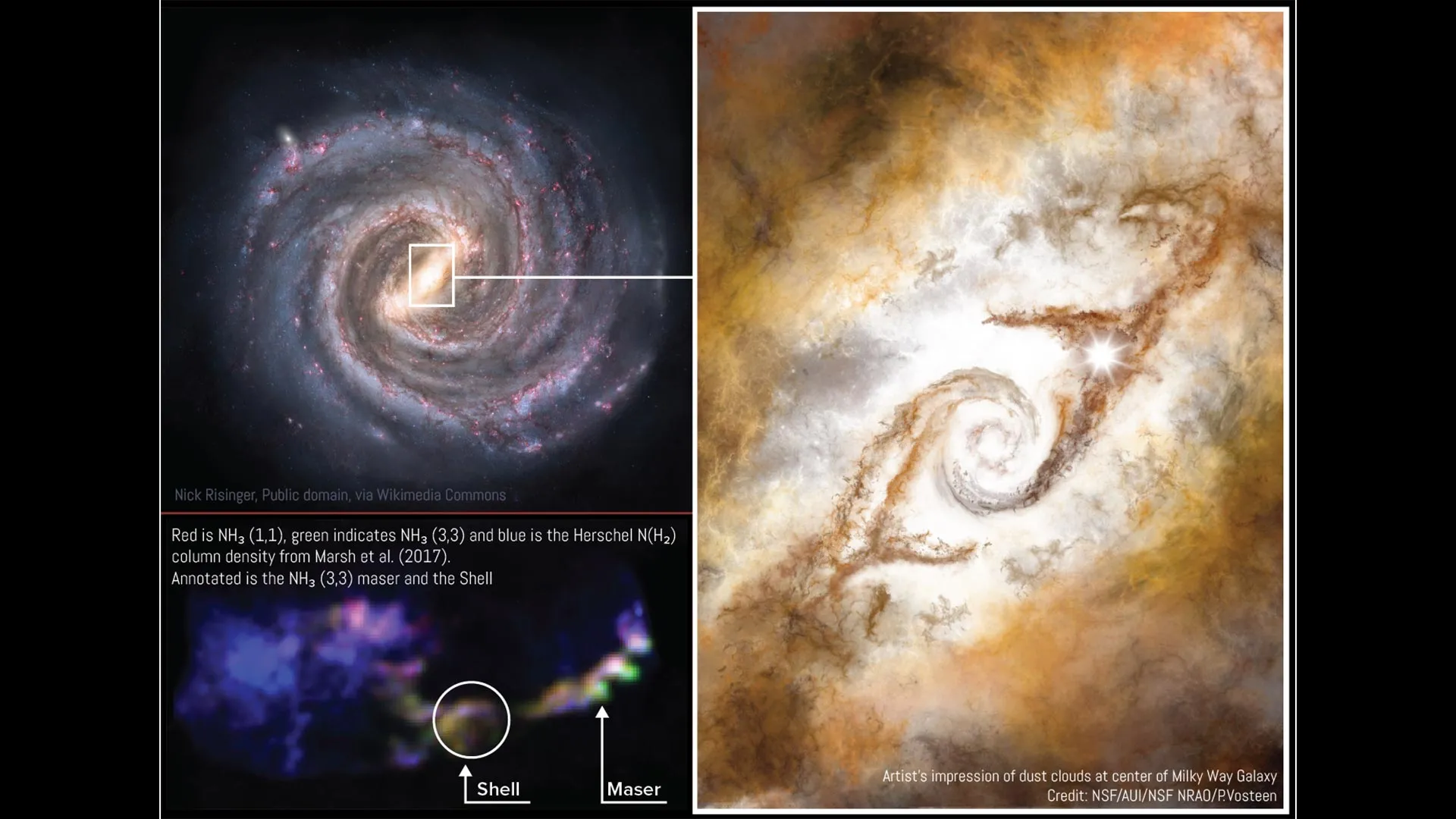
unveiling the Midpoint Cloud: A Stellar Nursery Discovered in the Milky Way’s Dusty Heart
For decades, astronomers have meticulously mapped our galaxy, the Milky Way, yet hidden regions continue to yield astonishing discoveries. Recently, an international team has revealed a previously unknown giant molecular cloud (GMC) – dubbed the Midpoint cloud – nestled within a little-explored area of our galactic neighborhood. This discovery, detailed in The Astrophysical Journal, isn’t just about finding a new cloud of gas and dust; its about unlocking crucial insights into star formation, galactic dynamics, and the very evolution of our galaxy.
A Hidden Giant Revealed
Located approximately 200 light-years (60 parsecs) in length, the Midpoint cloud resides within the Milky Way’s inward-bound dust lane, a region where material spirals towards the galactic center.Using the powerful U.S. National Science Foundation Green Bank Telescope (NSF GBT), researchers peered through the obscuring dust and gas, revealing a dynamic and surprisingly active surroundings.
“One of the moast significant aspects of this research was the identification of the GMC itself,” explains Natalie Butterfield, a scientist at the NSF National Radio Astronomy Observatory (NSF NRAO) and lead author of the study. “Prior to our observations, no one suspected the existence of such a dense gas concentration in this location. Confirming its status as a giant molecular cloud through measurements of its size, mass, and density was a pivotal moment.”
This isn’t merely a passive accumulation of interstellar matter. The Midpoint cloud acts as a critical transition zone,a cosmic crossroads where material from the galactic disk is funneled into the more extreme conditions near the galactic center. This makes it an invaluable laboratory for studying the initial conditions of gas before it’s drawn into the galactic core, offering a unique window into the processes that fuel galactic evolution.
Decoding the Cloud’s secrets: Signs of Stellar Birth and Death
The NSF GBT observations focused on specific molecules – ammonia (NH3) and cyanobutadiyne (HC5N) – which serve as tracers of dense gas, allowing astronomers to map the cloud’s structure and composition. The data revealed a wealth of information,pointing to a complex interplay of star formation and galactic forces. Key findings include:
A Newly Discovered Maser: The team identified a previously unknown maser, a natural source of intense microwave radiation, linked to ammonia gas. Masers are frequently associated with regions of active star formation, suggesting the Midpoint cloud is a fertile ground for new stars.
Potential Star Birth Sites: Within the cloud, researchers detected compact clumps of gas and dust poised to collapse and ignite nuclear fusion, birthing new stars. One notably intriguing clump, designated Knot E, might potentially be a frEGG – a free-floating evaporating gas globule – a small, dense cloud being eroded by the radiation emitted from nearby stars. These frEGGs offer a glimpse into the early stages of stellar progress.
Evidence of Stellar Feedback: The observations revealed a shell-like structure within the cloud, likely sculpted by the powerful energy released from dying stars. This ”stellar feedback” - the impact of stars on their surrounding environment - plays a crucial role in regulating star formation,both triggering and suppressing it. Turbulent Gas Dynamics: The gas within the Midpoint cloud exhibits a high degree of turbulence, mirroring conditions observed in the galaxy’s central regions. This turbulence is likely driven by the inflow of material along the dust lanes and collisions with other interstellar clouds, creating a chaotic yet productive environment.
Galactic Bars and the Puzzle of Star Formation
The location of the Midpoint cloud within the Milky Way’s galactic bar - a central, elongated structure - adds another layer of complexity to the discovery. star formation within galactic bars is frequently enough suppressed by the strong gravitational forces at play. However, the leading edges of these bars, like the location of the Midpoint cloud, can accumulate dense gas, possibly triggering new star formation.”Star formation in galactic bars is a bit of a puzzle,” notes Larry Morgan, a scientist with the NSF Green Bank Observatory (NSF GBO). “The strong forces in these regions can actually suppress star formation. However, the leading edges of these bars, such as where the Midpoint is located, can accumulate dense gas and trigger new star formation.”
The Midpoint cloud,thus,represents a crucial link in understanding how galaxies build their central structures and sustain star formation in extreme environments.
Evergreen Section: The Ongoing Story of Galactic Evolution
The discovery of the Midpoint cloud underscores a fundamental truth about astronomy: our understanding of the universe is constantly evolving. For years, the galactic center was considered a
Worth a look