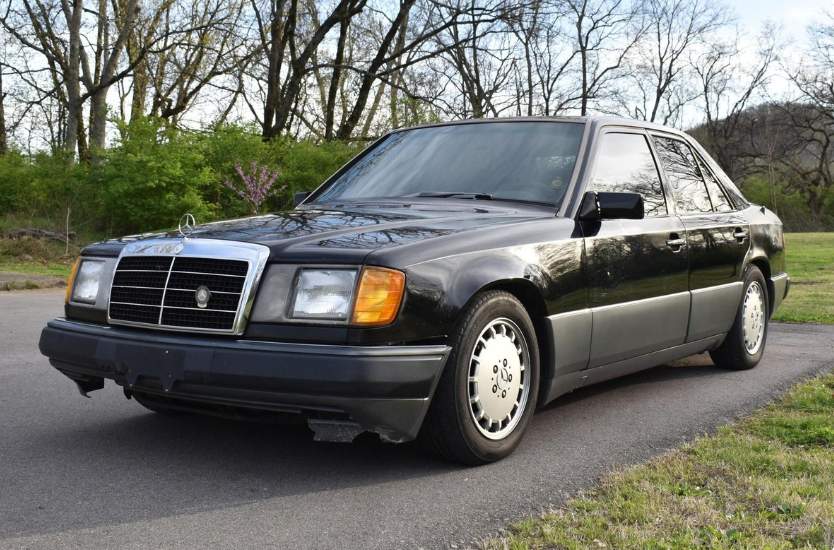
In the quiet suburbs of Latvia, a 1980s Mercedes-Benz sedan has quietly rewritten what many consider possible for automotive longevity. This unassuming W124 model, painted in faded black with a grey interior and 15-inch wheels, has accumulated a distance that challenges modern assumptions about vehicle lifespan: over 1.5 million kilometres. While its odometer today displays just 185,000 km due to a known limitation in older vehicle systems, independent verification confirms the car has travelled far beyond that figure, making it one of the most extensively driven passenger vehicles in recent European history.
The car’s extraordinary journey has drawn attention not only for the sheer distance covered but also for what it represents about engineering durability in an era often criticised for planned obsolescence. Unlike modern electric vehicles such as the Mercedes EQS, which analysts suggest would struggle to reach even a fraction of this distance under current battery technology, this diesel-powered sedan has endured decades of use across changing roads, climates and ownership patterns. Its story invites reflection on how far automotive engineering has come — and where expectations for vehicle longevity may have shifted unnecessarily.
According to verified reports from Latvian automotive listings, the vehicle is a 1989 Mercedes-Benz 300D W124, a model renowned for its robust mechanical simplicity and over-engineered components typical of Mercedes-Benz’s pre-1990s build philosophy. The current owner, who acquired the car in 2021, has decided to sell it as part of a broader effort to downsize their personal vehicle fleet. Despite visible signs of wear — including faded paint, minor dents, scratches, and a repaired front bumper — the car remains mechanically sound and continues to be driven regularly, a testament to its enduring build quality.
What makes this case particularly notable is the contrast between perception and reality. While the odometer reads only 185,000 km, service records, maintenance logs, and consistent use over multiple years confirm that the actual distance travelled exceeds 1.5 million kilometres. This discrepancy arises from the mechanical odometer’s six-digit limit, which rolls over after 999,999 km — a design constraint common in vehicles manufactured before the widespread adoption of digital instrumentation. In this case, the odometer has cycled through its full range at least once, meaning the true distance is significantly higher than what the display shows.
Such high-mileage examples are exceptionally rare in the passenger car segment, where most vehicles are retired after 200,000 to 300,000 kilometres due to rising maintenance costs, corrosion, or evolving consumer preferences for newer features. However, commercial vehicles like the Mercedes-Benz Sprinter van frequently achieve similar or greater distances, particularly when used in fleet operations with strict maintenance schedules. One verified listing from a Latvian classifieds site shows a 2008 Mercedes-Benz Sprinter with 440,000 kilometres on the clock, offered for sale after a recent technical inspection and new tyre installation — illustrating how well-maintained commercial variants of the brand can endure extensive use.
The W124 series, produced between 1984 and 1997, remains a benchmark for durability in automotive circles. Known colloquially as the “E-Class” in later iterations, this generation featured longitudinally mounted engines, solid rear axles, and overbuilt mechanical systems designed for ease of repair and long-term reliability. Diesel variants like the 300D were especially favoured for their fuel efficiency and longevity, often accumulating high mileage in taxi services, police fleets, and private ownership across Europe and Africa. Mechanics and enthusiasts still regard the W124 as one of the last truly “analog” Mercedes-Benz models — simple enough to maintain with basic tools, yet robust enough to withstand harsh conditions.
Industry experts note that reaching 1.5 million kilometres in a passenger car requires more than just durable engineering; it demands consistent, meticulous maintenance over decades. Regular oil changes, timely replacement of wear components, rust prevention, and attentive driving habits all play crucial roles. In regions where road salt is used during winter, corrosion becomes a primary limiting factor — yet this particular vehicle appears to have avoided significant structural rust, suggesting either favourable storage conditions or diligent upkeep by its owners over the years.
The environmental implications of such longevity are also worth considering. While newer vehicles offer improved safety features, emissions controls, and fuel efficiency, the ecological cost of manufacturing a new car — particularly the energy-intensive production of batteries for electric models — means that extending the life of an existing vehicle can, in some contexts, reduce overall carbon footprint. A study by the European Environment Agency found that keeping a well-maintained older vehicle in service for an additional 100,000 kilometres can offset the emissions generated during the production of a replacement vehicle, provided the older car meets certain emissions standards.
Still, the practicality of maintaining such a high-mileage vehicle presents challenges. As original equipment manufacturer (OEM) parts become scarce, owners must rely on aftermarket suppliers, specialist mechanics, or even fabricate replacements. Electrical systems, rubber components, and seals degrade over time regardless of use, requiring periodic renewal. For the W124, however, a strong global community of enthusiasts and specialists continues to support the model with rebuilt engines, transmission kits, and suspension components, ensuring that parts remain accessible decades after production ended.
When compared to modern equivalents, the contrast is stark. Today’s Mercedes-Benz E-Class models, while technologically advanced, incorporate complex electronics, turbocharged engines, and layered safety systems that increase both performance and potential points of failure over time. Electric vehicles like the EQS sedan, though zero-emission at the tailpipe, face uncertainties around long-term battery degradation and the availability of replacement units after warranty periods expire. While fast-charging infrastructure improves usability, the long-term viability of EVs at extreme mileages remains unproven at scale.
This Latvian Mercedes-Benz serves as more than a curiosity — it functions as a real-world case study in what automotive durability can achieve when design prioritises longevity, and when owners commit to sustained care. It challenges the notion that modern vehicles must be replaced every few years, suggesting that with the right engineering and stewardship, even passenger cars can serve for generations. As the automotive industry accelerates toward electrification and software-defined vehicles, examples like this remind us that simplicity, serviceability, and structural integrity still have profound value.
The vehicle is currently listed for sale through private channels in Latvia, with the owner seeking a new custodian who appreciates its historical significance and is willing to continue its legacy of use. While no official auction date or formal sale process has been announced, interested parties are advised to monitor regional classic vehicle platforms or contact Latvian automotive historian networks for updates. For now, this silent high-mileage champion continues to accumulate kilometres — one quiet journey at a time — proving that some machines, when built with care and respected in return, can far outlive the expectations placed upon them.
If you have experience maintaining high-mileage vehicles or insights into extending automotive lifespan, we welcome your thoughts in the comments below. Share this story with others who appreciate engineering endurance, and help keep the conversation going about what our machines are truly capable of when built to last.
Keep reading