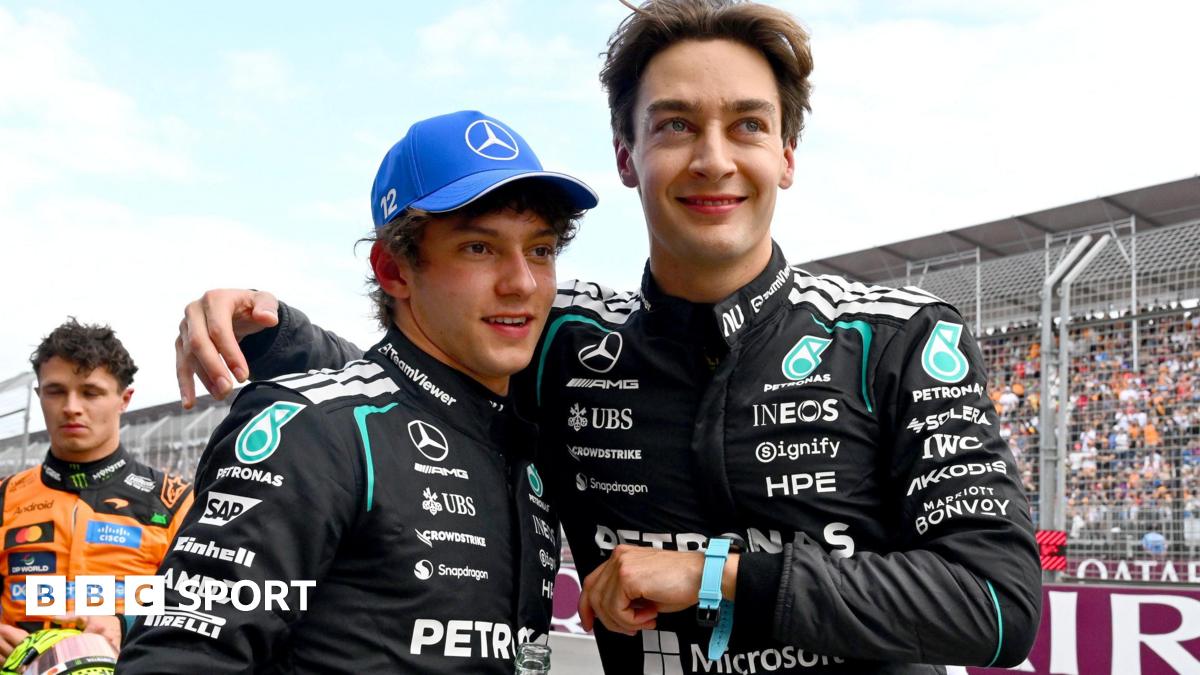
Melbourne, Australia – George Russell delivered a commanding performance at the Australian Grand Prix qualifying session on Saturday, securing pole position for Mercedes with a blistering lap time. The Briton’s achievement was amplified by a challenging day for reigning world champion Max Verstappen, who crashed out early in Q1, and underscored a significant shift in the competitive landscape of Formula 1. Russell’s dominant display, coupled with a strong showing from teammate Kimi Antonelli, signals a potential resurgence for the Silver Arrows in the latest era of regulations.
Russell finished qualifying 0.363 seconds ahead of Antonelli, completing a front-row lockout for Mercedes. Red Bull’s Isack Hadjar secured third place, but trailed Russell by a substantial 0.785 seconds, highlighting the extent of Mercedes’ advantage at Albert Park. The qualifying session was immediately marked by drama as Verstappen lost control of his Red Bull at Turn 1, bringing out the red flags and casting doubt on his ability to participate further in the session. The incident, even as unfortunate for the Dutchman, inadvertently revealed the strength of Mercedes’ package, as Russell continued to push the boundaries of performance.
Mercedes Dominance: A ‘Perfect Storm’ of Factors
Russell attributed his success to a confluence of factors, describing it as a “perfect storm.” “We knew we had a speedy car beneath us. I don’t think we ever anticipated it to be this fast, but Max wasn’t there,” he said, acknowledging the impact of Verstappen’s early exit. According to the BBC, Russell too pointed to Verstappen’s historical pace relative to his teammates, suggesting that even without the crash, the Red Bull driver would have been a strong contender. However, he emphasized that Mercedes capitalized on the opportunity, delivering a flawless performance.
The advantage wasn’t solely down to Verstappen’s misfortune. Mercedes, as the engine manufacturer, possesses a deeper understanding of how to optimize the power unit’s performance, a point highlighted by McLaren team principal Andrea Stella. “Mercedes are quick in the corners, not only in the straights,” Stella explained. Sky Sports reports that this advantage stems from their ability to exploit the power unit’s potential more effectively, particularly in maximizing energy deployment and battery charge. This allows Mercedes to maintain higher speeds through both the straights and the corners of the Albert Park circuit.
The difference in performance was particularly noticeable on the long run between Turns Six and Nine, where Mercedes drivers were able to deploy more energy due to a more highly charged battery upon arrival at Turn Six. Stella further elaborated that the advantage extends beyond power-unit management, noting that Mercedes has also developed a fundamentally strong chassis. “There are a few corners in which You can compete with them, but overall they are faster in the grip-limited sections,” he stated, acknowledging Mercedes’ overall superiority.
Verstappen’s Setback and Red Bull’s Response
Max Verstappen’s crash in Q1 brought an abrupt end to his qualifying session and left his team scrambling to assess the damage. Motorsport.com detailed that the incident occurred when Verstappen spun at high speed while braking for Turn 1, likely due to locked rear wheels. The four-time world champion will start Sunday’s race from 20th position, a significant setback in his championship defense.
Despite Verstappen’s misfortune, Red Bull managed to salvage some points with Isack Hadjar’s third-place qualifying result. However, the gap between Hadjar and the Mercedes drivers underscores the challenge Red Bull faces in matching the Silver Arrows’ pace. The team will need to analyze the data from both cars to understand the performance differences and implement necessary adjustments for the race.
McLaren’s Struggle to Unlock Mercedes Power
While McLaren also utilizes Mercedes engines, their performance in qualifying fell short of expectations. Oscar Piastri, McLaren’s fastest driver, finished in fifth place, more than 0.8 seconds slower than Russell. This discrepancy highlights the complexities of integrating a customer engine into a different chassis and the advantages enjoyed by a works team like Mercedes.
Stella explained that McLaren’s inability to fully exploit the Mercedes power unit stems from a lack of complete understanding of its intricacies. As the engine manufacturer, Mercedes possesses a deeper knowledge of how to optimize its performance, allowing them to extract maximum power and efficiency. “How you exploit these power units to the best of their potential, this moves quite a lot of lap time,” Stella said, emphasizing the importance of fine-tuning the engine’s parameters to match the specific characteristics of the chassis.
Antonelli’s Impressive Debut
Kimi Antonelli, in only his first qualifying session as a Mercedes driver, delivered an impressive performance, securing second place and contributing to the team’s front-row lockout. The young Italian driver demonstrated remarkable composure and speed, quickly adapting to the demands of Formula 1. Antonelli’s strong showing bodes well for his future prospects and reinforces Mercedes’ investment in young talent.
Antonelli’s participation in the session was initially in doubt after a significant crash during final practice. However, the Mercedes team worked tirelessly to repair the car in time for qualifying, showcasing their engineering prowess and dedication. The team was fined €7,500 (£6,500) for releasing Antonelli’s car in an unsafe condition during Q3, as reported by Sky Sports, but the incident did little to dampen the team’s overall success.
Looking Ahead to the Australian Grand Prix
The Australian Grand Prix promises to be a thrilling race, with George Russell starting from pole position and Max Verstappen facing an uphill battle from the back of the grid. Mercedes will be looking to capitalize on their qualifying advantage and secure a dominant victory, while Red Bull will aim to minimize the damage and salvage valuable championship points. The race will also be a crucial test for McLaren, as they strive to unlock the full potential of their Mercedes-powered package.
The performance of Aston Martin also warrants attention. Fernando Alonso qualified in 17th position, highlighting the team’s struggles with power-unit reliability, particularly with their Honda partnership. The team faces a significant challenge in improving their performance and competing with the frontrunners.
The race is scheduled to begin on Sunday at 4:00 AM GMT, with pre-race coverage starting at 2:30 AM GMT on Sky Sports F1 and Main Event. Fans around the world will be eagerly tuning in to witness the unfolding drama and see if Mercedes can maintain their impressive form.
The next key checkpoint will be the race itself on Sunday, where we will see if Mercedes can convert their qualifying dominance into a race victory. Stay tuned to World Today Journal for comprehensive coverage of the Australian Grand Prix and ongoing analysis of the Formula 1 season.
What are your predictions for the Australian Grand Prix? Share your thoughts in the comments below and be sure to share this article with fellow Formula 1 enthusiasts!
Related reading