
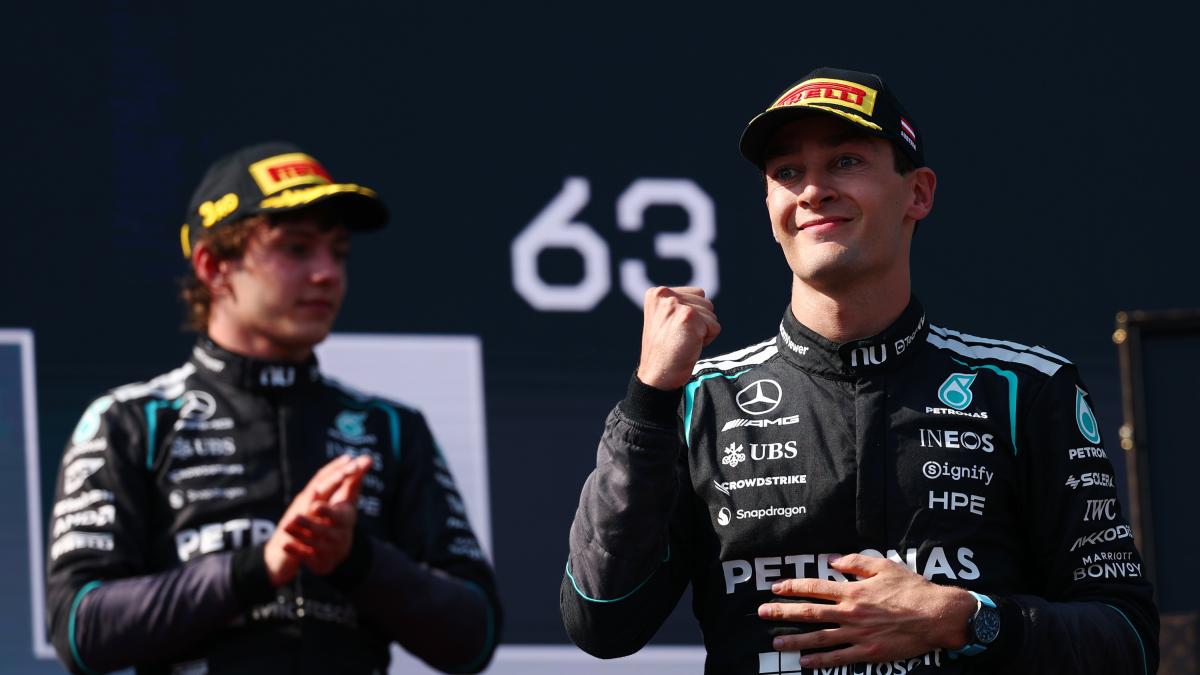
Kimi Antonelli is positioned as the primary candidate to replace Lewis Hamilton at Mercedes for the 2025 Formula 1 season following strong Free Practice 1 performances at the Hungarian and Italian Grands Prix. The 18-year-old Italian driver has used these sessions to demonstrate a pace that rivals established veterans, creating a high-pressure environment for George Russell, who now transitions into the role of the team’s undisputed lead driver.
Mercedes Team Principal Toto Wolff has repeatedly praised Antonelli’s adaptability, noting the teenager’s ability to handle the W15’s complex aerodynamics across diverse circuit profiles. While Russell remains the focal point for the team’s current championship efforts, particularly at high-speed venues like Silverstone, the internal focus has shifted toward how Antonelli’s raw speed at Monza and the Hungaroring translates into a full-time race seat.
The contrast in their current roles is stark. George Russell is fighting for podiums and constructor points, while Antonelli is operating under a rigorous evaluation program designed to determine if he is ready for the leap from Formula 2 to the pinnacle of motorsport. This transition marks the first time since 2013 that Mercedes will integrate a rookie driver into its primary lineup.
How Kimi Antonelli performed at the Hungarian and Italian Grands Prix
Kimi Antonelli’s Free Practice 1 (FP1) outings in Hungary and Italy served as critical litmus tests for his readiness. According to official F1 timing data, Antonelli showed immediate competence in the Mercedes W15, avoiding significant errors while maintaining a competitive gap to the regular race drivers. At the Hungarian Grand Prix, Antonelli focused on tire management and precision in the tight, twisty sectors of the Hungaroring, a track known for punishing inexperienced drivers with its lack of runoff and high physical demand.
The Italian Grand Prix at Monza provided a different challenge, emphasizing high-speed stability and braking efficiency. During the FP1 session at Monza, Antonelli operated under the intense scrutiny of the Tifosi, yet he delivered lap times that suggested a natural affinity for the high-velocity Temple of Speed. His performance there is viewed by analysts as a successful “home” debut, proving he can handle the psychological pressure of a massive crowd alongside the technical demands of a top-tier F1 car.
Toto Wolff told reporters that Antonelli’s progress is “remarkable,” citing the driver’s ability to provide technical feedback that aligns with the team’s telemetry. This feedback loop is essential for Mercedes as they attempt to refine the W15’s balance, which has been inconsistent throughout the 2024 season.
George Russell’s role and the Silverstone benchmark
George Russell entered the British Grand Prix at Silverstone as the face of the Mercedes project in the UK. While Lewis Hamilton secured the victory at the 2024 British Grand Prix, Russell’s performance served as a benchmark for the car’s ceiling in high-speed, high-downforce conditions. According to Formula 1 official race results, Russell finished the race in 6th place, highlighting the ongoing struggle Mercedes faces in maximizing the W15’s potential across a full race distance compared to Red Bull and McLaren.
Silverstone represents the type of circuit where Russell’s precision and familiarity with high-load corners give him an edge. However, the emergence of Antonelli creates a new dynamic. For the first time, Russell is not just competing against the grid, but is the standard against which a potential teammate is being measured in real-time. The “head-to-head” is not yet a direct race, but a comparison of trajectories: Russell is in the refinement phase of his career, while Antonelli is in the explosive growth phase.
The pressure on Russell has increased since Lewis Hamilton announced his move to Ferrari for 2025. Russell is now tasked with leading the technical development of the 2025 car, meaning any gap in performance between him and a rookie like Antonelli would be viewed critically by the Mercedes board.
The 2025 driver seat: Why Antonelli is the frontrunner
The vacancy left by Lewis Hamilton is the most coveted seat in Formula 1. While other drivers have been linked to the position, Mercedes has prioritized their own academy talent. The decision to promote Antonelli rests on three primary factors: raw pace, technical feedback, and the long-term strategic vision of the team.
Antonelli’s trajectory in Formula 2 has been steep. According to FIA Formula 2 standings, his ability to challenge for wins despite limited experience in the category has mirrored the early careers of drivers like Max Verstappen. Mercedes is betting that this “generational talent” profile is the only way to disrupt the current dominance of McLaren and Red Bull.
The risk associated with promoting an 18-year-old is significant. The physical toll of a full F1 season and the mental strain of global media attention can break young drivers. However, Toto Wolff has indicated that the team is prepared to provide a structured support system to mitigate these risks, similar to the approach used during the early years of the hybrid era.
Comparing circuit dynamics: Silverstone vs. Monza and Hungary
The performance differences between Russell and Antonelli are best understood through the lens of the circuits they have prioritized. Silverstone is a “power and aero” track, where George Russell’s experience in managing high-speed stability is paramount. The British circuit requires a driver who can trust the car at 200 mph through Copse and Maggots-Becketts, a skill Russell has mastered over several seasons.

In contrast, the Hungaroring is a “technical and precision” track. Antonelli’s performance there showed he possesses the patience and accuracy required for low-speed corners and heavy braking zones. Monza, the fastest track on the calendar, tests a driver’s bravery and ability to maintain momentum. By excelling at both the slow-speed Hungaroring and the high-speed Monza, Antonelli has demonstrated a versatility that is rare for a driver who has not yet competed in a full Grand Prix weekend.
This versatility is exactly what Mercedes needs to complement Russell. While Russell provides the stability and consistency of a veteran, Antonelli offers the “X-factor”—the ability to find a tenth of a second in qualifying through sheer aggression and instinct.
What happens next for the Mercedes lineup
The final confirmation of the 2025 lineup is expected following the conclusion of the current season’s testing and evaluation phase. While a formal contract announcement may be delayed, the team’s actions—specifically giving Antonelli FP1 sessions at the most prestigious European tracks—signal a clear intent.
For George Russell, the remainder of the 2024 season is about establishing his dominance as the team leader. He must prove that he can lead Mercedes back to the top step of the podium independently. For Kimi Antonelli, the focus remains on his Formula 2 campaign and any further FP1 opportunities Mercedes may grant him in the Americas leg of the tour, including Mexico City, Las Vegas, and Abu Dhabi.
The transition from the Hamilton era to the Russell-Antonelli era represents a fundamental shift in the Mercedes philosophy. They are moving from a model of hiring established superstars to one of cultivating internal talent. The success of this experiment will depend on whether Antonelli can translate his FP1 speed into race-day results under the pressure of a full championship battle.
The next confirmed checkpoint for the team is the upcoming flyaway races, where the technical development of the W15 will be tested in varied climates. Official confirmation of the 2025 driver contracts typically occurs before the winter break, once all contractual obligations and super-license requirements are finalized.
Do you believe Kimi Antonelli is ready for a full-time seat in 2025, or should Mercedes look for a more experienced driver to partner with George Russell? Share your thoughts in the comments below.