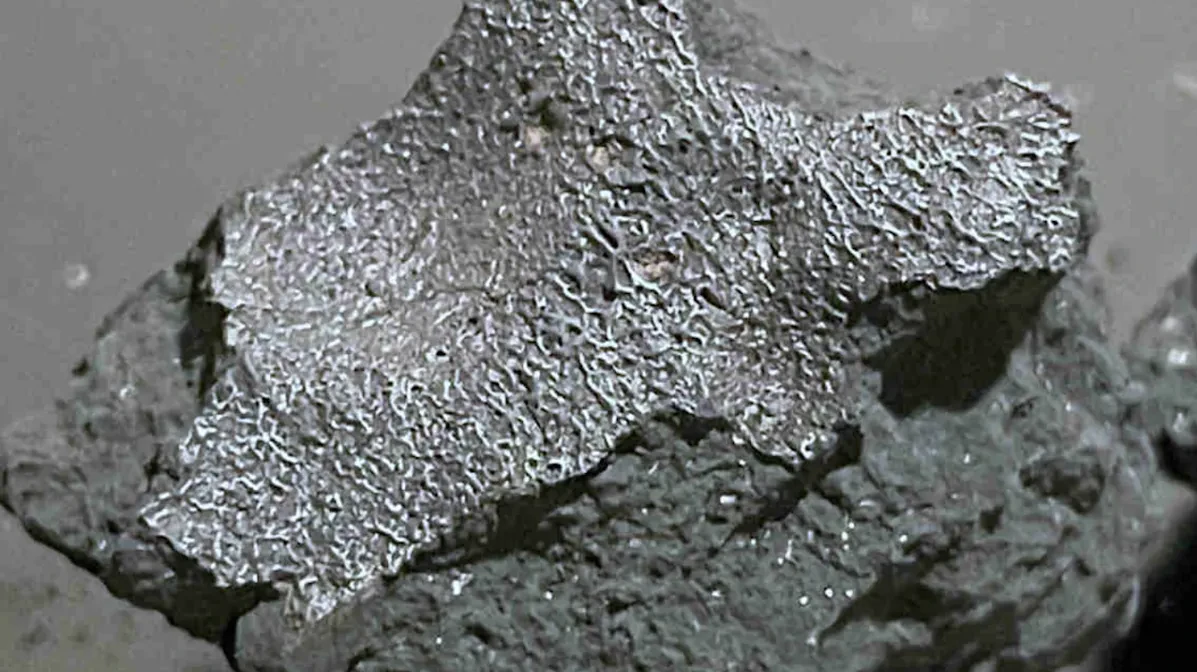
Scientists have confirmed that a meteorite which crashed through the roof of a home in May 2023 contains evidence of extraterrestrial salt-rich water. According to official findings released by the institution, this discovery provides new insights into the chemical history of early solar system materials.
The Discovery of Extraterrestrial Saltwater
The meteorite, which made headlines on May 8, 2023, when it struck a residence. While such impacts are rare, the scientific significance of this specific specimen lies in its composition. Analysis conducted by TCNJ faculty and students revealed the presence of halite—a form of rock salt—which typically requires the presence of liquid water to form. This suggests that the parent asteroid underwent a period of aqueous alteration, a process where water interacts with minerals to create new chemical compounds.

“It’s not just a rock; it’s a time capsule from the early solar system,” said Nathan Magee, in a university statement. The research team utilized scanning electron microscopy and energy-dispersive X-ray spectroscopy to confirm that the salt crystals were trapped inside the meteorite before it reached Earth, ruling out contamination from the environment.
Understanding the Classification
Meteorites are classified based on their mineralogy and physical properties. The specimen is identified as a type of stony meteorite that has undergone significant heat and pressure within its parent body. The “6” indicates the level of thermal metamorphism the rock experienced during its formation roughly 4.5 billion years ago.
While many meteorites show signs of past water, the discovery of salt-rich water in this specific type of chondrite is notable for planetary scientists. Researchers believe this provides evidence that even bodies classified as “dry” or highly metamorphosed may have contained liquid water at some point in their evolution. This challenges previous assumptions about the distribution of water in the early solar system and expands the criteria for identifying potential habitats for prebiotic chemistry.
The Impact Event and Public Interest
The incident occurred in the early morning hours when the meteorite plummeted through the roof of a residence, eventually coming to rest on a bedroom floor. No injuries were reported, though the impact left a hole in the ceiling and damaged the hardwood floor. The family initially discovered the object, which was still warm to the touch, and contacted local authorities before realizing its astronomical origin.
Following the event, the meteorite was handed over to the scientific community for study. The TCNJ research team has since documented the physical and chemical properties of the specimen, providing a rare opportunity for undergraduate students to participate in high-level planetary science. The meteorite remains a subject of ongoing study, with researchers looking to isolate further organic compounds that may have been preserved within the mineral matrix.
Future Research and Scientific Implications
The study of this meteorite is part of a broader effort to understand the role of water and organic molecules in the formation of planets. Scientists are currently comparing the chemical signatures found in the specimen with samples retrieved from space missions, such as NASA’s OSIRIS-REx mission to the asteroid Bennu. By analyzing how water behaves in these environments, researchers hope to better understand how the building blocks of life may have been distributed across the solar system.

As of the most recent updates from the academic team, the specimen continues to undergo non-destructive testing to preserve its integrity for future generations of scientists. The university has indicated that further findings regarding the mineralogical composition will be published in peer-reviewed journals as the analysis concludes.
Have questions about the science behind this event or want to share your thoughts on the discovery? Join the conversation in the comments below.
Related reading