
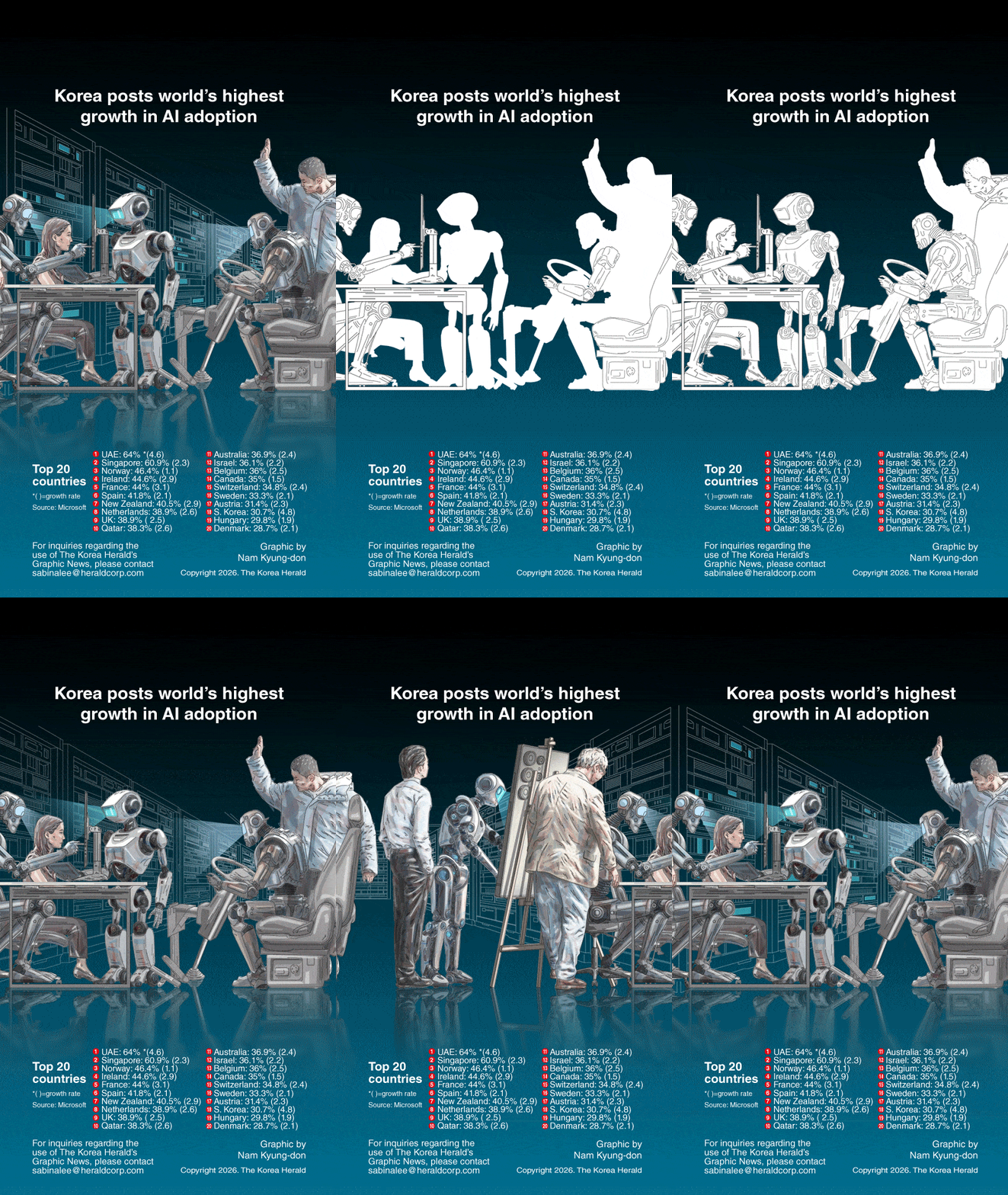
South Korean employees are adopting AI tools at a faster pace than their companies, creating a growing productivity gap that Microsoft Korea says threatens business competitiveness unless addressed immediately. While 68% of Korean workers report using AI tools in their daily tasks—ranging from productivity software to generative AI assistants—only 32% of organizations have integrated AI into core workflows, according to a June 2024 report by the Korea Productivity Center. Microsoft Korea’s local leadership, including CEO Jo Won-woo, has warned that this mismatch risks stalling digital transformation efforts just as global competitors accelerate AI-driven innovation.
The disconnect highlights a broader challenge in Asia’s fourth-largest economy, where AI adoption rates trail regional peers like Singapore (72% organizational integration) and Japan (58%), despite Korea ranking second globally in AI research output. “The problem isn’t a lack of interest—it’s an organizational bottleneck,” said Jo Won-woo during a June 15 press briefing at Microsoft Korea’s Seoul headquarters. “Employees are already using AI to solve problems faster, but companies are treating it as a pilot project rather than a strategic imperative.”
This article examines the root causes of Korea’s AI adoption gap, the specific tools employees are using without company approval, and Microsoft’s proposed solutions—including a new “AI Readiness Index” for Korean businesses launching in Q4 2024.
Why Are Korean Employees Using AI Without Company Approval?
Three quarters of Korean workers (74%) now use AI tools outside sanctioned corporate environments, according to a March 2024 survey by the Korea Information Society Agency. The most popular unauthorized tools include:
- Generative AI assistants (42%) like Microsoft Copilot and Google Gemini for drafting reports and emails
- Automated translation tools (38%) for multilingual teams, despite many companies maintaining legacy translation services
- Code generation platforms (28%) among software developers, who cite faster debugging as the primary benefit
The trend reflects a global pattern, but Korea’s adoption rate is particularly high due to its tech-savvy workforce and the rapid proliferation of consumer AI tools. “Developers here are using GitHub Copilot at three times the rate of their global peers,” noted GitHub’s 2023 Developer Report. “The issue isn’t capability—it’s governance.”
Companies cite three main barriers to AI adoption:
- Data security concerns: 61% of organizations restrict AI tools due to fears of intellectual property leaks, according to a 2024 Korea Intellectual Property Office survey
- Integration challenges: Legacy systems in industries like manufacturing and finance require costly upgrades to support AI APIs
- Skill gaps: Only 18% of Korean companies offer AI training programs, compared to 45% in the U.S., per OECD workforce data
How Microsoft Korea Is Pushing for Change
Microsoft Korea has launched a three-pronged strategy to bridge the gap:

- AI Readiness Index: A benchmarking tool for Korean businesses, set to debut in October 2024, that will evaluate companies on data infrastructure, employee training, and AI policy maturity. The index will be free for SMEs and paid for enterprises.
- Partnerships with local universities: Expanding its “AI for Business” curriculum to 10 Korean universities, including Seoul National and Korea Advanced Institute of Science and Technology (KAIST), with a focus on ethical AI deployment.
- Government lobbying: Microsoft Korea is working with the Ministry of Science and ICT to propose tax incentives for companies that adopt AI tools, similar to Germany’s 2023 “AI Innovation Bonus” program.
Jo Won-woo emphasized that the solution requires both top-down and bottom-up approaches. “We can’t just tell employees to stop using AI—they’re already solving problems faster,” he said. “Instead, we need to create environments where AI is governed, not banned.”
What Happens If Korea Doesn’t Close the AI Gap?
Industry analysts warn that the current trajectory could cost Korea $12 billion in lost productivity by 2026, based on projections from the Korea Trade-Investment Promotion Agency. The risks include:
- Talent drain: Skilled workers, particularly in tech and finance, are increasingly seeking roles at global firms where AI adoption is more advanced
- Competitive disadvantage: Neighboring economies like Vietnam and the Philippines are aggressively recruiting AI talent with lower regulatory hurdles
- Regulatory lag: Korea’s data protection laws, while stringent, lack clear guidelines for AI-generated content, creating legal gray areas
For context, Singapore’s AI adoption rate jumped 40% in 2023 after implementing a “National AI Strategy” in 2021, with government-led incentives playing a key role. Korea’s current approach—relatively light-touch regulation with minimal public-sector investment—risks leaving businesses at a disadvantage.
Key Takeaways for Korean Businesses
- Employees are already using AI: 74% of workers report using unauthorized AI tools, primarily for productivity gains
- Security is the #1 barrier: 61% of companies block AI due to data concerns, despite employees finding workarounds
- Training is critical: Only 18% of Korean companies offer AI upskilling, compared to 45% globally
- Government action is needed: Tax incentives and clearer regulations could accelerate adoption, as seen in Germany and Singapore
- Microsoft’s AI Readiness Index will provide a benchmark for companies to assess their maturity starting October 2024
What’s Next for Korea’s AI Strategy?
The Ministry of Science and ICT is expected to release a revised National AI Master Plan in September 2024, with a focus on bridging the employee-company gap. Key upcoming milestones include:

- September 2024: Draft AI governance framework for businesses, including data-sharing guidelines
- October 2024: Launch of Microsoft Korea’s AI Readiness Index
- Q1 2025: Potential tax incentives for AI-adopting SMEs, subject to government approval
For businesses looking to act now, Microsoft Korea recommends starting with pilot programs in non-sensitive departments (e.g., marketing or HR) to build internal trust before scaling. “The companies that succeed will be those that treat AI as a collaboration tool—not a threat,” Jo Won-woo concluded.
Have insights on Korea’s AI adoption challenges? Share your experiences in the comments or connect with our tech team at [email protected].
Related reading