Unveiling the Hidden Dynamics of Liquids with High-Harmonic Generation: A New Window into Molecular Interactions
For decades,understanding the behavior of electrons within the complex surroundings of liquids has remained a meaningful challenge in physics,chemistry,and biology. Now, a groundbreaking collaboration between researchers at Ohio State University (OSU) and Louisiana State University (LSU) has demonstrated a novel technique – solution-phase high-harmonic generation (HHS) – capable of probing these dynamics with unprecedented sensitivity. This research, funded by the Department of Energy and the National Science Foundation, opens a new avenue for investigating basic processes occurring in liquids, with potential implications ranging from optimizing chemical reactions to understanding radiation damage in biological systems.
The Power of Light to Reveal the Invisible
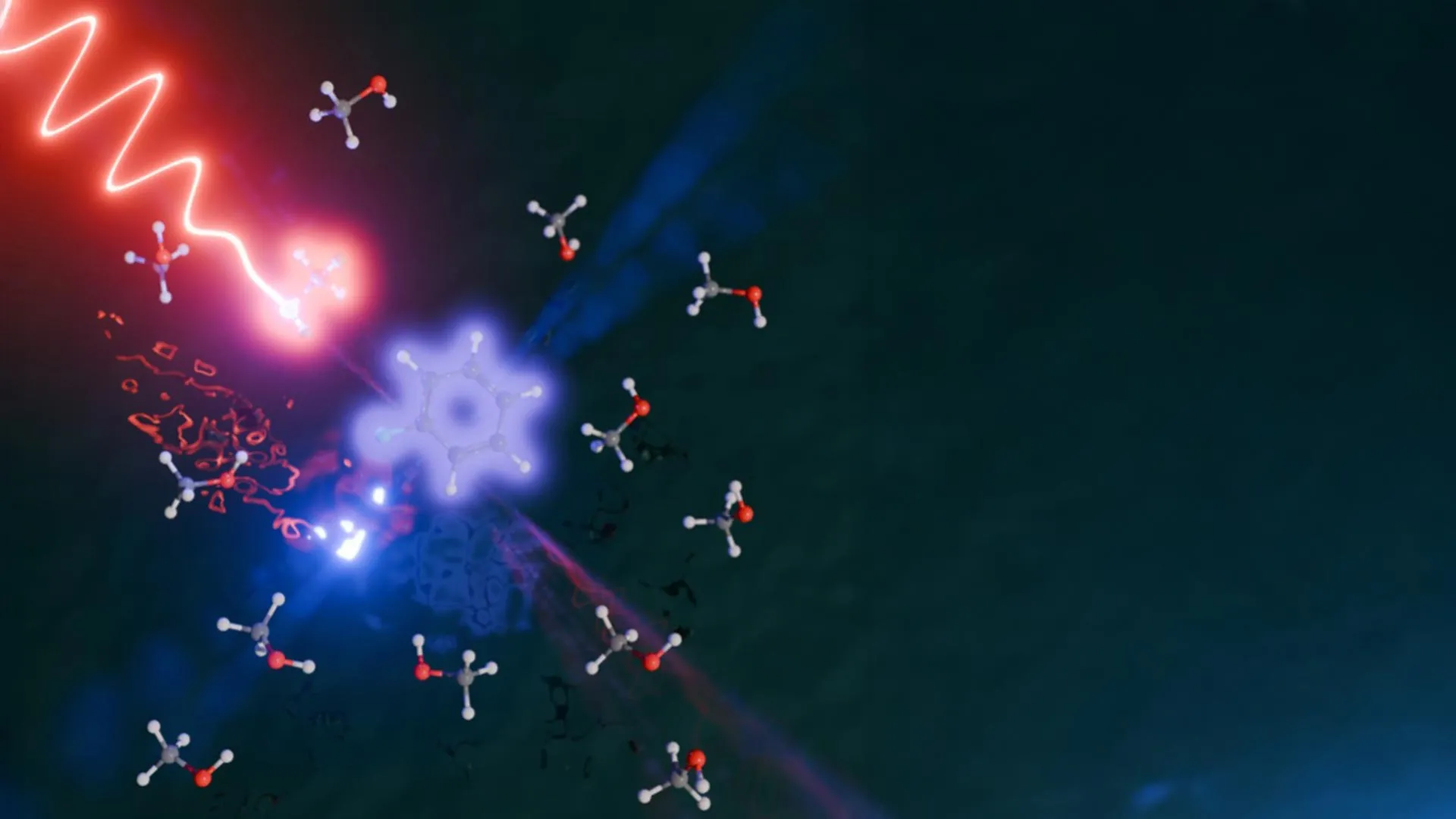
The core of this innovation lies in shining intensely focused mid-infrared laser light through liquid mixtures. High-harmonic generation is a non-linear optical process where the laser light interacts with the material, creating new frequencies of light – harmonics – that reveal information about the electronic structure and dynamics within the sample. Researchers strategically chose methanol as a base solvent, combined with small amounts of halobenzenes (fluorobenzene, chlorobenzene, bromobenzene, and iodobenzene). These halobenzenes, differing only by a single halogen atom, were selected for their strong harmonic signals, providing a clear contrast against the relatively quiet background of methanol. The initial expectation was that the halobenzene signal would consistently dominate, offering a straightforward analysis.
However, the experiment yielded a surprising result. While most halobenzene-methanol mixtures behaved as predicted, fluorobenzene (PhF) exhibited dramatically different behavior. “We were really surprised to see that the PhF-methanol solution gave fully different results from the other solutions,” explains Dr. Lou DiMauro, Edward E.and Sylvia Hagenlocker Professor of Physics at OSU. “Not only was the mixture-yield much lower than for each liquid on its own, we also found that one harmonic was completely suppressed.” This selective suppression – the complete disappearance of a specific frequency of light – is exceptionally rare and signaled a highly specific molecular interaction at play. The observed reduction in light output and harmonic silencing indicated that somthing was actively interfering with the electrons’ motion within the mixture.
A Molecular ‘Handshake’ Revealed Through Simulation
To decipher the underlying mechanism, the OSU team employed large-scale molecular dynamics simulations. Their analysis revealed a key difference in the interaction between PhF and methanol compared to the other halobenzenes. The highly electronegative fluorine atom in phf promotes the formation of a hydrogen bond – a “molecular handshake” – with the oxygen-hydrogen (O-H) bond of methanol. This leads to a more organized and structured arrangement of molecules in the mixture, a phenomenon known as solvation.
This structural insight prompted the LSU team, led by Dr. Mette Gaarde, Boyd Professor of Physics, to investigate whether this arrangement could explain the experimental observations. Using a sophisticated model based on the time-dependent schrödinger equation, they hypothesized that the electron density surrounding the fluorine atoms created a “scattering barrier” for the electrons accelerated by the laser pulse. This barrier disrupted the harmonic generation process, accounting for both the diminished light output and the missing harmonic.
“We also learned that the suppression was very sensitive to the location of the barrier – this means that the detail of the harmonic suppression carries information about the local structure that was formed during the solvation process,” adds Dr. Sucharita Giri, a postdoctoral researcher at LSU. Essentially, the subtle changes in the harmonic signal provide a fingerprint of the molecular arrangement within the liquid.
Implications for Chemistry, Biology, and Materials Science
This research represents a significant leap forward in our ability to probe the intricacies of liquid environments. Many crucial chemical and biological processes occur within liquids, and understanding electron dynamics in these systems is paramount. moreover, the energies of electrons involved in these processes are comparable to those responsible for radiation damage, making this technique possibly valuable for developing strategies to mitigate harmful effects.
“Our results demonstrate that solution-phase high-harmonic generation can be sensitive to the particular solute-solvent interactions and therefore to the local liquid environment,” emphasizes Dr. DiMauro. “We are excited for the future of this field.”
The researchers anticipate that continued advancements in both experimental techniques and computational modeling will further refine this approach, providing increasingly detailed insights into how liquids respond to ultrafast laser pulses.This will ultimately lead to a deeper understanding of the fundamental processes governing the behavior of matter in its most common state – the liquid phase.
Research Team & Funding:
This groundbreaking work was a collaborative effort involving Eric Moore, Andreas Koutsogiannis, Tahereh Alavi, and Greg McCracken from OSU, and Kenneth Lopata from LSU. The study was generously supported by the DOE office of Science,Basic Energy Sciences,and the National Science Foundation.
**Why this article demonstrates E-E-A
Related reading