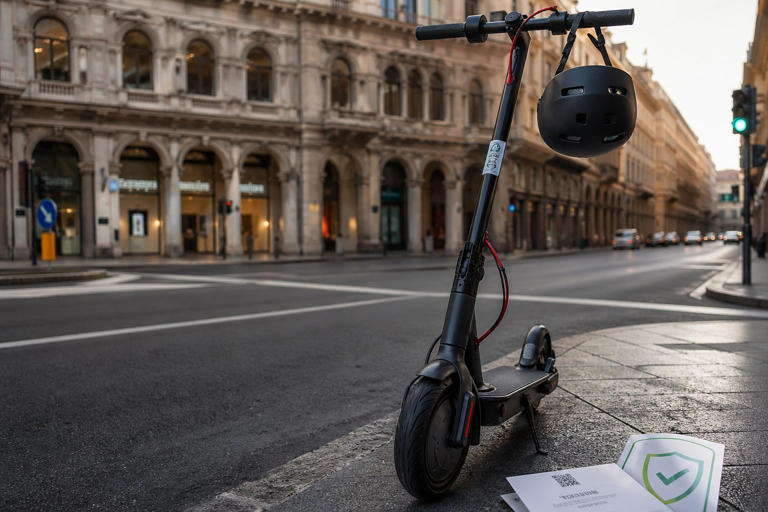
Starting July 16, 2026, owners of electric scooters in Italy will be legally required to hold mandatory third-party liability insurance, known as Responsabilità Civile Auto (RCA). This shift follows the implementation of European Union Directive 2021/2118, which aims to harmonize insurance requirements for motorized vehicles across member states to ensure better protection for accident victims. The new regulation mandates that all electric micro-mobility devices categorized as motor vehicles must be covered by a policy that compensates for damages caused to third parties during circulation.
The transition toward compulsory insurance for electric scooters marks a significant evolution in Italian road safety policy. Previously, coverage was often left to the discretion of the owner or governed by fragmented local rules. Under the updated framework, the definition of a “motor vehicle” now encompasses electric scooters, effectively bringing them under the same legal umbrella as cars and motorcycles regarding liability. According to the European Parliament and Council Directive 2021/2118, this mandate is designed to protect those involved in accidents by ensuring that compensation is always available, even if the vehicle owner lacks personal financial means.
Regulatory Scope and Compliance Requirements
The requirement applies to all electric scooters circulating on public roads. Compliance involves obtaining a policy that specifically covers civil liability for damages to persons or property. As of the latest guidance from the Italian Ministry of Infrastructure and Transport, owners are responsible for ensuring that their insurance remains active throughout the duration of the vehicle’s use. Failure to maintain this coverage will result in administrative penalties, which may include significant fines and the potential impoundment of the vehicle.
The directive emphasizes that the insurance must cover the entirety of the European Economic Area. This means that a policy purchased in Italy will be recognized across borders, providing consistent protection. For owners, the process involves selecting a provider that offers coverage specifically tailored for micro-mobility. While the market for these policies is expected to grow as the 2026 deadline approaches, the industry is currently preparing to standardize terms to match the requirements set forth by national regulators.
Impact on Scooter Owners and Operators
The primary intent behind the regulation is to address the rising number of incidents involving micro-mobility devices in urban centers. By mandating insurance, the government aims to alleviate the burden on the public health system and judicial courts, which often struggle to process claims when uninsured drivers are involved in collisions. Data from the Italian National Institute of Statistics (ISTAT) regarding road accidents highlights an increase in incidents involving electric scooters over the last five years, underscoring the necessity for a structured insurance framework.
For individuals who own their scooters, the next two years serve as a grace period to evaluate insurance products. Insurance companies are expected to roll out specialized policies that factor in the distinct risks associated with lightweight electric vehicles. Financial analysts suggest that premiums will likely vary based on factors such as the owner’s accident history, the specific model of the scooter, and the intended usage frequency. Unlike standard auto insurance, these policies are expected to be more accessible, though costs will depend on the underwriting models adopted by major insurers.
Enforcement and Penalties
Local authorities will be tasked with enforcing the mandate starting in mid-2026. Routine traffic stops, which already include checks for vehicle compliance and safety features like lights and brakes, will be expanded to verify the presence of a valid insurance certificate. In accordance with the Italian Highway Code, non-compliance is likely to carry heavy financial consequences. Owners are advised to keep digital or physical copies of their insurance documentation at all times to avoid delays or administrative sanctions during roadside inspections.
The enforcement strategy will likely mirror the current protocols used for mopeds and small motorcycles. If a driver cannot provide proof of insurance, they may face immediate fines and be required to provide proof of coverage within a set timeframe. If they fail to do so, the vehicle may be subject to seizure. It is recommended that owners monitor updates from the Ministry of Infrastructure and Transport as the implementation date approaches, as specific technical decrees may clarify the exact format of required documentation.
Preparing for the Transition
As the July 2026 deadline draws closer, the focus remains on ensuring that both the insurance industry and the general public are prepared for the change. Consumer advocacy groups have already begun advising owners to review their current homeowner or personal liability insurance policies, as some of these may already offer limited coverage for micro-mobility devices. However, it is critical to verify that any existing policy meets the specific legal criteria stipulated by the new directive to avoid gaps in coverage.
The integration of compulsory insurance into the broader urban mobility ecosystem is expected to provide a more stable environment for both riders and pedestrians. By formalizing the status of electric scooters, the legislation seeks to improve safety standards and provide a clear path for legal recourse in the event of an accident. As the regulatory landscape continues to evolve, keeping track of official announcements from the relevant government bodies remains the most reliable way to stay compliant.
Future updates regarding the technical specifications of these insurance policies are expected to be released through the official government portal. Readers are encouraged to check back for further developments as the July 2026 deadline approaches. We welcome your questions and comments on how this change might affect your daily commute.